
The High-Stakes Reality of Commercial Panel Builds
Commercial control panel electrical wiring is not simply about making connections; it is an exercise in risk mitigation, thermal management, and strict regulatory compliance. Whether you are building a motor control center (MCC) for a municipal water treatment plant or a variable frequency drive (VFD) array for a commercial HVAC system, the margin for error is zero. A poorly executed panel can lead to catastrophic arc flash incidents, premature component failure, or failed municipal inspections, resulting in tens of thousands of dollars in rework and downtime.
This guide dissects the advanced methodologies required for commercial and industrial panel builds today, focusing on UL 508A compliance, precise mechanical execution, and advanced thermal strategies that separate amateur enclosures from professional, field-ready assets.
Navigating the Regulatory Triad: NEC, UL 508A, and NFPA 79
Before stripping a single wire, commercial panel builders must internalize the three governing frameworks that dictate design and execution. Ignoring any one of these will result in a rejected inspection or a dangerous installation.
- NEC Article 409 (Industrial Control Panels): Dictates the minimum requirements for field installation, including disconnect sizing, overcurrent protection, and grounding. It is the baseline legal requirement enforced by local Authorities Having Jurisdiction (AHJ).
- UL 508A (Standard for Industrial Control Panels): The gold standard for panel fabrication. Achieving a UL 508A certification means your shop has proven its ability to calculate Short Circuit Current Ratings (SCCR), manage wire bending space, and select listed components correctly.
- NFPA 79 (Electrical Standard for Industrial Machinery): Crucial if your panel is integrated directly into a machine tool or automated assembly line. It governs specific color-coding, emergency stop (E-stop) circuit architectures, and disconnect interlocks. You can review the scope of the standard via the official NFPA 79 development page.
Expert Insight: Many commercial electricians mistakenly apply residential or general commercial building wiring rules (like standard NM-B or basic THHN routing) to control panels. Control panels are manufactured equipment, not building wiring. You must use machine tool wire (MTW) or thermoset equivalents internally, and adhere to manufacturing clearances, not building clearances.
Component Selection and SCCR Calculations
The Short Circuit Current Rating (SCCR) is arguably the most misunderstood aspect of control panel electrical wiring. The SCCR dictates the maximum fault current the panel can safely withstand without catastrophic failure. Under UL 508A Supplement SB, you cannot simply guess this number; it must be mathematically derived.
SCCR Impact by Component Type
| Component Category | Typical Default SCCR (if untested) | Impact on Branch Circuit | Mitigation Strategy |
|---|---|---|---|
| Manual Motor Starters | 5 kA | Drastically limits entire branch | Use tested combinations or add current-limiting fuses |
| Contactors (IEC Rated) | 5 kA to 10 kA | Limits branch if no upstream SCCD | Pair with specific SCCD (fuses/breakers) per manufacturer tables |
| VFDs (Standard) | 5 kA | Often the weakest link in modern panels | Install line reactors or use high-SCCR rated drives (e.g., 65 kA) |
| Power Supplies (24VDC) | Varies (often unlisted for SCCR) | Must be isolated from power circuits | Use SCCR-rated DIN rail power supplies (e.g., PULS or Phoenix) |
The Supplement SB Calculation Method: To calculate the branch SCCR, you must identify the weakest link. If a branch circuit contains a 65 kA rated breaker, a 65 kA rated contactor, but a 5 kA rated overload relay, the entire branch SCCR drops to 5 kA. To fix this, you must either replace the overload with a higher-rated unit or use a tested combination table provided by the manufacturer (such as the Siemens SIRIUS or Allen-Bradley CENTERLINE tested combinations).
Internal Wiring Best Practices: Beyond the Basics
The physical routing and termination of internal control panel electrical wiring dictate the panel's longevity and serviceability.
Wire Type and Preparation
Never use standard solid-core THHN inside a commercial control panel. The continuous vibration from contactors and the tight bending radii inside wire ducts will cause solid wire to snap or loosen over time.
- Wire Selection: Use stranded MTW (Machine Tool Wire) or XHHW-2. Southwire's 600V MTW in 14 AWG and 12 AWG is the industry workhorse for 120VAC control and 480VAC power circuits, respectively.
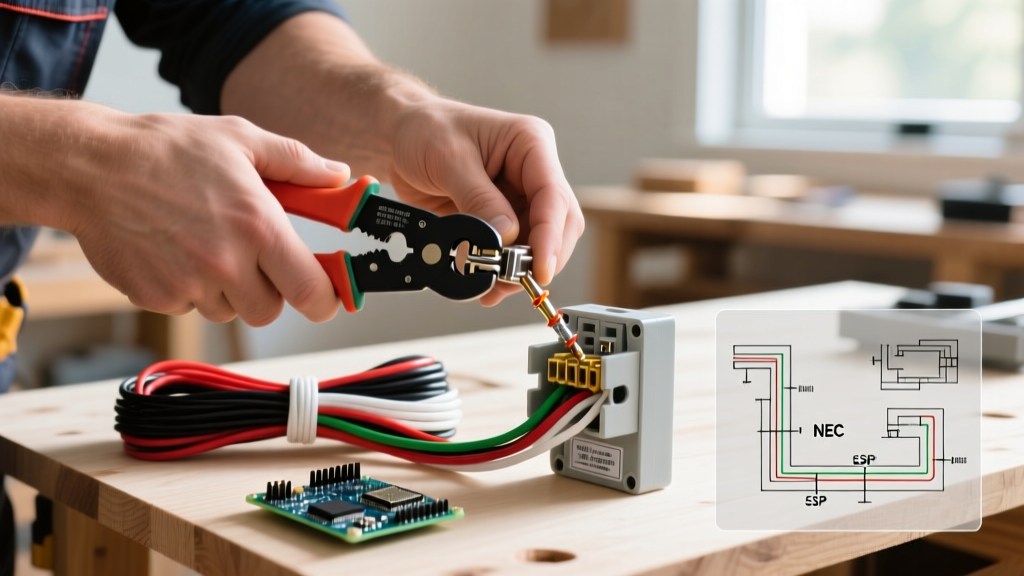
- Ferrule Crimping: Stranded wire must never be inserted directly into a screw-clamp terminal block. The strands will splay, reducing contact area and creating a high-resistance hot spot. Use DIN 46228-compliant ferrules. Invest in a ratcheting crimp tool like the Phoenix Contact CRIMPFOX 6 or Weidmüller PZ 4 to ensure a gas-tight, uniform crimp every time.
Wire Duct Fill and Routing
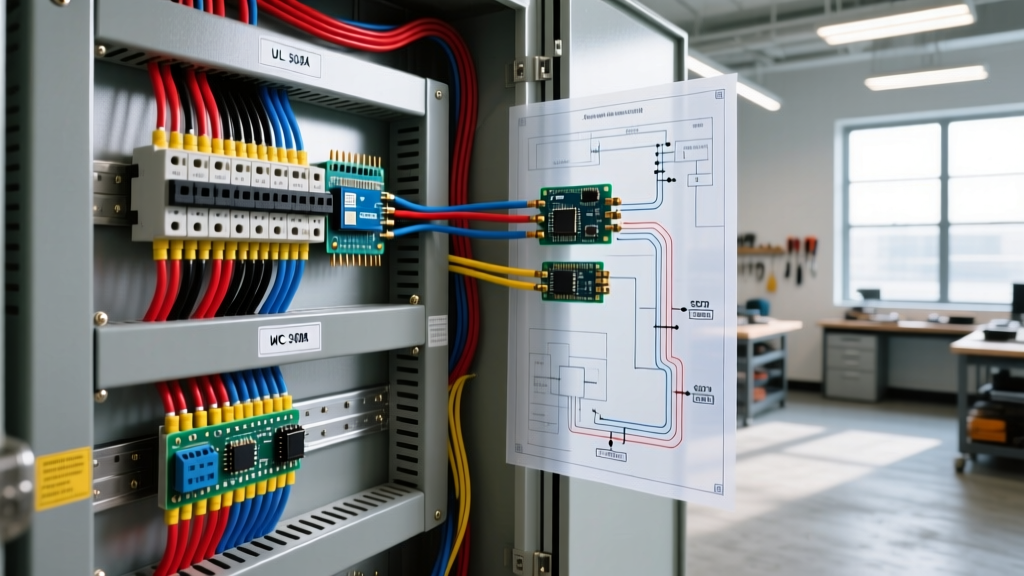
Stuffing a Panduit wiring duct to the brim is a common rookie mistake that leads to overheating and impossible troubleshooting. UL 508A Section 16.2.1 strictly mandates that wiring ducts shall not be filled to more than 20% of the cross-sectional area at any point, or 25% if no future wiring is anticipated.
Pro-Tip for Duct Sizing: When sizing Panduit ducts (e.g., F2X2LG6 for 2x2 inch), calculate the total cross-sectional area of your wires using NEC Chapter 9, Table 5. If your wires take up 0.8 square inches, you need a duct with at least 4.0 square inches of usable internal area. Always upsize to the next standard duct dimension to accommodate wire labels and sweeping bends.
Field Wiring and Terminal Block Architecture
The interface between your meticulously wired panel and the chaotic reality of the commercial job site is the terminal block strip. This is where field wiring lands, and where most post-installation failures occur.
Terminal Block Selection
Move away from cheap, generic barrier strips. Modern commercial panels utilize modular, DIN-rail mounted terminal blocks like the Phoenix Contact CLIPLINE complete or Weidmüller Klippon Connect series. These systems offer:
- Double-Level and Triple-Level Blocks: Saves up to 66% of DIN rail space for high-density I/O wiring.
- Universal Testing Points: Allows technicians to insert standard 2mm test probes without loosening the wire clamp.
- Push-In Technology (PIT): For control wiring (24VDC, 120VAC), push-in ferrule terminals reduce termination time by 50% compared to screw terminals, while maintaining a constant, vibration-proof clamping force.
The Critical Role of Torque Specifications
According to OSHA standard 1910.303 and NEC 110.14(D), electrical connections must be tightened to the manufacturer's specified torque. 'Hand-tight' is not a legal or safe standard.
For a standard 10-32 screw on a heavy-duty power terminal block, the required torque is typically between 12 and 18 inch-pounds. For smaller control terminal blocks (like the Phoenix UTTB 2.5), the spec is often 0.6 to 0.8 Nm (5.3 to 7.1 in-lbs). Use a calibrated, adjustable torque screwdriver (such as those from Wiha or Wera) and mark the screw head with a torque seal pen (e.g., DYKEM Torque Seal) after tightening. This provides visual proof to inspectors and future maintenance crews that the connection was properly secured.
Thermal Management and Enclosure Clearances
Commercial control panels generate significant heat, particularly those housing VFDs, soft starters, and high-amperage power supplies. Failure to manage this heat will degrade the insulation of your control panel electrical wiring and prematurely kill sensitive logic components.
- Component Placement: Heat-generating devices (VFDs, power resistors) must be mounted at the top or extreme bottom of the enclosure to facilitate natural convection. Never mount a VFD directly above a PLC or a thermal-magnetic breaker, as the rising heat will cause nuisance tripping and processor faults.
- Wire Bending Space: NEC Table 430.10(B) dictates minimum wire bending space at terminals. For a 3/0 AWG conductor, you must maintain at least 6.5 inches of unobstructed space between the terminal and the opposite enclosure wall or duct. Ignoring this forces electricians to kink the wire, damaging the internal stranding and altering the wire's impedance.
- Active Cooling: When ambient plant temperatures exceed 95°F (35°C), passive louvers are insufficient. Utilize filtered fan trays (e.g., Rittal TopTherm) or closed-loop air conditioners (e.g., Hammond Manufacturing CLCA series) to maintain an internal panel temperature of 77°F to 95°F (25°C to 35°C).
Troubleshooting Common Panel Build Failures
Even experienced commercial electricians make critical errors when transitioning from building wiring to panel building. Watch out for these specific edge cases:
- Bonding the Neutral in a 480V Panel: Unlike a main service disconnect in building wiring, the neutral bar in a commercial 480V/277V control panel must never be bonded to the ground bus or the enclosure. Doing so creates parallel neutral return paths, leading to circulating currents and severe shock hazards.
- Undersized Equipment Ground Bus: The main ground bus must be sized according to NEC Table 250.122 based on the rating of the main upstream overcurrent protective device (OCPD). If the panel is fed by a 400A breaker, the copper ground bus must be at least 3 AWG. Many builders mistakenly use a small 1/4" x 1" copper bar, which will vaporize during a high-energy fault.
- Mixing AC and DC in the Same Duct: Running 480VAC power wires and 24VDC analog sensor wires in the same Panduit duct without a physical divider will induce electromagnetic interference (EMI), causing erratic PLC readings. Always use separate ducts, or at minimum, a center-divider duct, and cross AC and DC wires at strict 90-degree angles when they must intersect.
Final Thoughts on Execution
Excellence in commercial control panel electrical wiring is defined by what you cannot see: the mathematical rigor of the SCCR calculation, the precise torque applied to a terminal screw, and the strict adherence to duct fill capacities. By treating the panel not just as a box of parts, but as a highly engineered, integrated system, you ensure safety, pass AHJ inspections on the first attempt, and deliver an asset that will operate reliably for decades in demanding commercial environments.