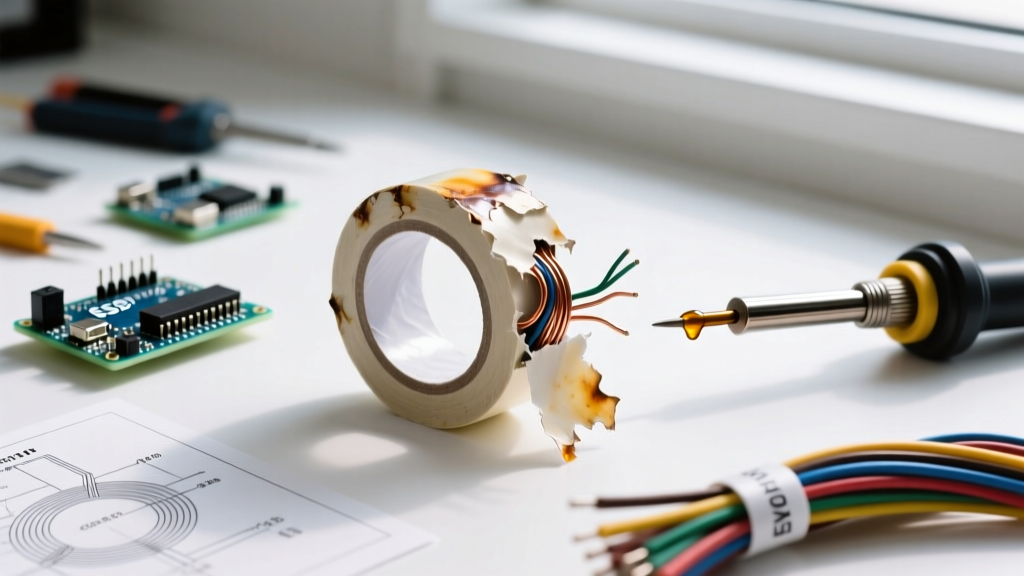

The Hidden Dangers of Failing Electrical Wiring Tape
Electrical wiring tape is often treated as an afterthought in both residential and commercial wiring projects, yet it serves as a critical dielectric barrier and mechanical protector for spliced connections. When applied correctly, high-grade polyvinyl chloride (PVC) tape provides excellent insulation and moisture resistance. However, when electrical wiring tape fails, it rarely does so silently. Peeling, melting, and adhesive degradation are early warning signs of underlying thermal issues, improper application techniques, or the use of counterfeit or substandard materials.
As of 2026, the market is flooded with economy-grade tapes that lack the necessary plasticizers and UV inhibitors required for long-term stability. Troubleshooting these failures requires a systematic approach to identify whether the root cause is environmental, electrical, or mechanical. In this comprehensive guide, we will dissect the most common electrical wiring tape failures, provide a diagnostic matrix, and outline professional remediation protocols that comply with modern safety standards.
Diagnostic Matrix: Identifying Your Tape Failure
Before attempting a repair, you must accurately diagnose the failure mode. Use the following troubleshooting matrix to pinpoint the exact issue affecting your electrical wiring tape.
| Symptom | Probable Cause | Immediate Action | Long-Term Solution |
|---|---|---|---|
| Ends peeling up ('Flagging') | PVC memory; insufficient stretching during wrap | Secure with a secondary wrap or cable tie | Re-wrap using the half-lap stretch technique |
| Tape feels gummy or oozes black residue | Plasticizer migration; thermal overload; age | De-energize circuit and strip tape immediately | Clean with isopropyl alcohol; apply rubber splicing tape |
| Tape is brittle and cracking | UV exposure; extreme cold; cheap economy tape | Wrap with UV-resistant self-fusing silicone tape | Use 3M Super 33+ or move splice to an enclosure |
| Tape is melted or fused to the wire | High-resistance splice causing localized heating | Check wire nut torque and wire gauge compatibility | Re-terminate using Wago lever nuts or crimp connectors |
Failure Mode 1: 'Flagging' and PVC Memory
The most ubiquitous complaint regarding electrical wiring tape is 'flagging'—a phenomenon where the tail end of the tape lifts away from the bundle and unspools over time. This is not necessarily a defect in the adhesive; rather, it is a result of the physical properties of PVC. PVC has a high degree of 'memory,' meaning it naturally wants to return to its original, unstretched flat state after being deformed.
If an electrician simply wraps the tape around a wire nut without stretching it, the PVC will continuously exert a outward mechanical force against the adhesive bond. Over weeks or months, this tension overcomes the pressure-sensitive adhesive, resulting in flagging.
The Half-Lap Wrapping Technique
To defeat PVC memory and ensure a permanent bond, professional linemen and electricians use the half-lap stretching method. Follow these steps to eliminate flagging:
- Anchor the Tape: Start wrapping on the insulation of the wire, at least one inch below the exposed copper or the base of the wire nut.
- Stretch to 75% Width: As you pull the tape, stretch it firmly until it narrows to about three-quarters of its original width. This activates the pressure-sensitive adhesive and breaks the PVC's structural memory.
- Overlap by Half: Each subsequent wrap should overlap the previous layer by exactly 50% (a half-lap). This ensures a uniform dielectric thickness.
- End on the Side, Not the Top: Never cut the tape and let the end rest on the top or the bottom of the splice where it can be easily snagged. Always terminate the wrap on the side of the bundle, and press it down firmly with your thumb for three seconds to generate friction heat, which aids adhesion.
Failure Mode 2: Melting, Oozing, and Thermal Overload
If you unwrap a piece of electrical wiring tape and find a black, tar-like goo coating the wires and your hands, you are witnessing plasticizer migration. PVC tape relies on chemical plasticizers to remain flexible. When subjected to temperatures beyond its rating, or when left in contact with certain types of wire insulation (like older rubber or specific cross-linked polyethylene compounds) for extended periods, these plasticizers break down and leach out.
Furthermore, melting is a severe red flag. Standard economy tapes (often sold in bulk bins for $1.50 to $2.50 a roll) are typically rated for a maximum continuous temperature of 80°C (176°F). Premium tapes, such as the industry-standard 3M Super 33+ (which retails for roughly $4.50 to $6.00 per roll in 2026), are rated for 105°C (221°F). If your tape is melting, it indicates that the splice itself is generating excessive heat due to a high-resistance connection, loose wire nut, or harmonic overloading on the neutral conductor.
Code Compliance Note: According to the NFPA 70 National Electrical Code (NEC), specifically Article 110.14(B), splices must be electrically and mechanically secure before insulation is applied. Tape is considered a secondary insulator and environmental seal, not a primary mechanical splice mechanism. Always ensure your primary connection (wire nut, crimp, or push-in) is fully torqued and secure.
Failure Mode 3: Adhesive Degradation in Cold and UV Environments
Electrical wiring tape is highly susceptible to environmental degradation. In outdoor applications, UV radiation breaks down the molecular chains in the PVC, causing the tape to turn chalky, brittle, and eventually shatter when touched. Similarly, in sub-zero temperatures, the adhesive on standard PVC tape loses its tackiness, refusing to bond to cold wire insulation.
For outdoor or cold-weather troubleshooting, abandon standard PVC tape entirely. Instead, transition to 3M Scotch 2228 Rubber Splicing Tape (priced around $9.00 to $12.00 per roll). This is a self-fusing, ethylene-propylene rubber (EPR) tape that contains no adhesive. Instead, it chemically welds to itself when stretched and wrapped, creating a solid, waterproof, and UV-resistant block of rubber that is impervious to temperature swings.
Step-by-Step Remediation Protocol
When you encounter a failed tape splice during a remodel or maintenance check, do not simply wrap new tape over the old, degraded mess. Follow this strict remediation protocol to restore the integrity of the connection:
- De-energize and Verify: Turn off the breaker and verify zero voltage using a non-contact voltage tester and a digital multimeter.
- Strip the Old Tape: Use a hooked cable stripper or a dull knife to carefully slit the old tape lengthwise. Avoid nicking the primary wire insulation beneath.
- Clean the Adhesive Residue: If the wires are coated in black plasticizer ooze, wipe them down with a lint-free cloth soaked in 90% or higher isopropyl alcohol. Allow to dry completely.
- Inspect the Primary Splice: Check the wire nut or crimp. If the wires pull out with gentle tension, or if the copper shows signs of black oxidation or arcing pitting, cut the splice back to bare, clean copper and re-terminate.
- Apply a Primary Moisture Seal (Optional but Recommended): For damp locations, wrap the bare splice first with a layer of self-fusing rubber splicing tape (like Scotch 2228) to create a waterproof seal.
- Apply the PVC Overwrap: Wrap the connection with 3M Super 33+ using the half-lap stretch technique described above to provide mechanical protection and flame retardancy.
When to Bypass Tape Entirely
While troubleshooting, it is vital to recognize when electrical wiring tape is the wrong tool for the job. Modern electrical practices have introduced alternatives that offer superior safety and longevity in specific scenarios:
- Enclosed Junction Boxes: If the wire nut is fully seated inside a UL-listed junction box, and the wires are not being pulled or subjected to vibration, tape is entirely optional. Many modern electricians skip taping wire nuts in dry, indoor boxes to save time and prevent the messy plasticizer buildup years later.
- Lever-Style Connectors: Push-in lever connectors (such as Wago 221 series) completely enclose the stripped wire end in a polycarbonate housing. Wrapping tape over a Wago connector is redundant, violates the manufacturer's listing, and makes future troubleshooting unnecessarily difficult.
- High-Vibration Environments: In HVAC units, industrial motors, or automotive wiring harnesses, tape will eventually vibrate loose. Use adhesive-lined dual-wall heat shrink tubing instead. The inner hot-melt adhesive creates a permanent, waterproof bond to the wire jacket that tape cannot replicate.
Frequently Asked Questions
Can I use duct tape, masking tape, or Gorilla tape as a temporary fix?
Absolutely not. Non-electrical tapes lack the necessary dielectric strength to contain 120V or 240V alternating current. Furthermore, the adhesives on duct and masking tapes are highly flammable and can actually ignite if the splice generates heat. The OSHA Electrical Safety Standards strictly mandate the use of UL-listed insulating materials for any exposed conductors. Using household tapes is a severe fire hazard and an immediate code violation.
Does the color of the electrical wiring tape affect its insulating properties?
Chemically and electrically, the color dyes used in premium tapes like 3M Super 33+ do not alter the dielectric strength or temperature rating. Black tape is the industry standard because carbon black provides superior UV resistance for outdoor applications. However, colored tapes (red, blue, yellow) are perfectly safe for indoor phase-identification purposes, provided they are rated for the same voltage (typically 600V) and temperature (105°C).
How long does electrical wiring tape actually last?
In a climate-controlled, indoor junction box, high-quality PVC electrical wiring tape can easily last 30 to 50 years without degrading. However, in outdoor environments, under direct UV exposure, or in attics where ambient temperatures regularly exceed 120°F in the summer, standard PVC tape may begin to flag and degrade within 3 to 5 years. For harsh environments, always upgrade to self-fusing silicone or EPR rubber tapes, which boast a functional lifespan exceeding two decades.
For more detailed information on material safety and testing standards, refer to the 3M Electrical Tape Specifications and testing data sheets provided by the manufacturer.