
The Shift in Automotive Compliance: Why Standard Splicing Fails
Modern vehicles are no longer simple mechanical machines; they are rolling data centers. With the proliferation of Advanced Driver Assistance Systems (ADAS), CAN-FD networks, and high-voltage electric vehicle (EV) architectures, car electrical wiring repair has evolved from a basic continuity fix into a highly regulated discipline. A poorly executed splice in a 2026 vehicle doesn't just risk a blown fuse—it can introduce electromagnetic interference (EMI) that blinds radar sensors or causes catastrophic thermal runaway in a lithium-ion battery pack.
For professional technicians and advanced DIYers, adhering to inspection and compliance standards is non-negotiable. This guide breaks down the exact materials, termination methods, and testing protocols required to ensure your automotive wiring repairs meet original equipment manufacturer (OEM) and industry safety standards.
The Regulatory Landscape: SAE and OEM Mandates
Unlike residential wiring governed by the NEC, automotive electrical systems are regulated by the Society of Automotive Engineers (SAE) and individual OEM specifications. According to the SAE International standards database, the baseline for low-voltage automotive wiring is SAE J1128, which dictates insulation thickness, temperature resistance, and voltage drop limits for circuits operating below 60V DC.
When performing a car electrical wiring repair, compliance means rejecting generic hardware store wire. You must use automotive-grade wire that meets specific SAE J1128 sub-classifications, ensuring the insulation can withstand engine bay temperatures, chemical exposure (oil, brake fluid), and mechanical vibration.
Expert Insight: The National Highway Traffic Safety Administration (NHTSA) frequently issues recalls related to wiring harness chafing and improper routing. Reviewing the NHTSA recall database for your specific vehicle make and model before beginning a repair can reveal known OEM routing flaws that you must avoid replicating during your aftermarket fix.
Material Selection: Cross-Linked Polyethylene (XLPE) vs. PVC
The most common compliance failure in amateur car electrical wiring repair is the use of standard PVC-insulated wire. PVC melts at relatively low temperatures and becomes brittle in extreme cold. Industry compliance mandates the use of Cross-Linked Polyethylene (XLPE) insulated wires. The three primary SAE-compliant wire types you must stock are:
| Wire Type | Wall Thickness | Max Temp Rating | Primary Application |
|---|---|---|---|
| TXL | Thin | 125°C | Tight-space cabin routing, sensor pigtails |
| GXL | General | 125°C | General engine bay, chassis, and lighting circuits |
| SXL | Special (Thick) | 150°C | High-heat zones (near exhaust manifolds, turbos) |
Wire Gauge and Current Capacity Compliance
Automotive wire gauge (AWG) differs slightly from standard AWG due to stranding counts designed for vibration resistance. For a compliant repair, a 16 AWG GXL wire (approx. 19 strands) is rated for roughly 10 amps in a single-circuit, enclosed harness environment. If you are repairing a circuit that draws 15 amps, compliance requires stepping up to 14 AWG, regardless of the physical size of the OEM wire you are splicing into, as aftermarket routing may lack the OEM's active cooling airflow.
Connector and Termination Compliance
The Specialty Equipment Market Association (SEMA) and major OEMs strictly advise against "twist-and-solder" splices or the use of vinyl electrical tape for under-hood wiring. Solder creates a rigid joint that fractures under the constant harmonic vibration of a vehicle chassis. Furthermore, vinyl tape adhesive degrades into a sticky residue at 80°C, unraveling and exposing bare copper to short-circuit risks.
Approved Termination Methods
To pass a rigorous electrical inspection, your car electrical wiring repair must utilize one of the following compliant termination methods:
- Open-Barrel Crimps with Sealed Heat Shrink: Using OEM-style TE Connectivity or Deutsch terminals. The crimp must be performed with a calibrated ratcheting tool (e.g., Rennsteig PEW 12) to ensure exact compression ratios. The wire brush (conductor crimp) and insulation brush must be visibly distinct and correctly sized.
- Ultrasonic Welding: Used in modern EV battery pack repairs, this fuses copper strands at a molecular level without adding foreign metals like solder, maintaining high flexibility and low resistance.
- Adhesive-Lined Heat Shrink (Dual Wall): When an inline splice is unavoidable, it must be sealed with 3:1 shrink ratio, dual-wall polyolefin tubing containing an inner layer of thermoplastic adhesive. This creates a waterproof, vibration-proof environmental seal rated to IP67.
High-Voltage (HV) EV Wiring: SAE J2840 Compliance
If your car electrical wiring repair involves a hybrid or fully electric vehicle, you are entering a heavily regulated, high-risk domain. High-voltage circuits (typically 400V to 800V DC in 2026 models) are universally identified by orange sheathing, as mandated by SAE J2840 and ISO 6722.
⚠️ CRITICAL SAFETY WARNING: Never attempt HV wiring repairs without specific OEM high-voltage certification and insulated PPE (Class 0 gloves rated to 1000V). HV cables utilize a High Voltage Interlock Loop (HVIL)—a low-voltage signal wire woven into the connector that detects if the harness is disconnected. Bypassing or improperly repairing an HVIL circuit will cause the vehicle's battery management system (BMS) to permanently lock out the contactors, resulting in a bricked vehicle and severe shock hazards.HV cable repairs require specialized shielded splicing kits. The copper braid shielding must be meticulously reconnected using conductive heat shrink and grounding pigtails to prevent EMI from disrupting the vehicle's low-voltage CAN-bus networks.
Post-Repair Inspection & Testing Protocol
A compliant car electrical wiring repair is only as good as its verification. Inspectors and master technicians rely on a strict four-step testing protocol to validate the repair before reassembling the vehicle.
- Visual and Mechanical Inspection: Verify that all crimp bells are visible (the wire insulation and conductor are correctly positioned in the terminal). Perform a pull-test; a compliant 16 AWG crimp should withstand a minimum pull force of 30 lbs without separating.
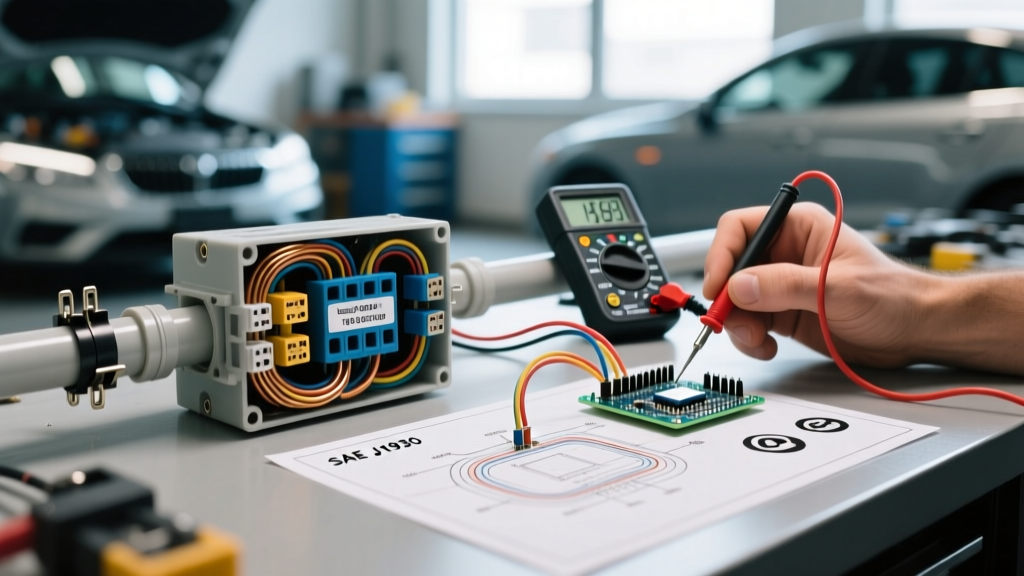
- Continuity and Pin-Out Verification: Use a digital multimeter to confirm end-to-end continuity. For multi-pin connectors, verify that no adjacent pins are shorting due to pushed-back terminals or improper seating.
- Voltage Drop Testing (The Gold Standard): This is where most amateur repairs fail. With the circuit under load, measure the voltage drop across your repaired splice or connector. A compliant repair must show a voltage drop of less than 0.1V (100mV) per connection. If your repair drops 0.3V, the crimp is too loose or the wire is undersized, which will lead to localized heating and eventual failure.
- Insulation Resistance Testing (Megger Test): For critical circuits (ABS, airbags, EV HV systems), use an insulation resistance tester to apply 500V DC between the conductor and the chassis ground. The reading must exceed 10 Megohms. This ensures the wire insulation was not nicked during the routing process.
Frequently Asked Questions (FAQ)
Can I use marine-grade wire for car electrical wiring repair?
While marine-grade wire (UL 1426) features excellent corrosion resistance due to tinned copper strands, its PVC insulation is generally not rated for the high-temperature, high-abrasion environment of an automotive engine bay. Always default to SAE J1128 XLPE automotive wire (GXL/TXL) for under-hood compliance.
How much does a compliant wiring harness repair cost compared to OEM replacement?
Dealerships rarely repair harnesses, opting instead to replace entire assemblies, which can cost between $800 and $2,500 in parts and labor. A professional, compliant aftermarket repair using OEM-spec TE Connectivity connectors, GXL wire, and adhesive heat shrink typically costs between $150 and $400, offering massive savings while maintaining safety standards.
Does twisting and soldering wires pass automotive inspection?
No. In modern automotive compliance, solder is considered a mechanical weak point. Solder wicks up into the wire strands, creating a stiff section right next to a flexible section. Under constant vehicle vibration, this stress concentration point will inevitably fracture, leading to an open circuit or intermittent short.
Conclusion
Executing a proper car electrical wiring repair requires a fundamental shift in mindset. You are not just restoring electrical flow; you are engineering a joint that must survive extreme thermal cycling, chemical exposure, and relentless vibration. By strictly adhering to SAE material standards, utilizing open-barrel crimp terminations, and validating your work with millivolt voltage-drop testing, you ensure the vehicle remains safe, reliable, and fully compliant with modern automotive engineering standards.