
Decoding the Colors: NEC Standards for Red and Black Conductors
When navigating residential and commercial circuits, understanding electrical wiring red and black conductors is non-negotiable for both safety and code compliance. In North American alternating current (AC) systems, black and red wires are universally designated as ungrounded (hot) conductors. According to the National Fire Protection Association (NFPA) and the National Electrical Code (NEC), these colors must never be used as grounded (neutral) or equipment grounding conductors.
While black is the standard primary hot wire for 120V circuits, red serves several critical secondary functions. It acts as the second hot leg in 240V appliances (like electric dryers and ranges), the switched hot in lighting circuits, and the traveler wire in 3-way and 4-way switch configurations. Misidentifying or misusing these colors is a leading cause of arc faults and reversed polarity violations during home inspections.
NEC Article 310.12: Grounded conductors (neutrals) must be white or gray. Ungrounded conductors (hot) can be any color except white, gray, or green. Therefore, red and black are strictly reserved for current-carrying ungrounded lines.
Material Breakdown: NM-B vs. THHN/THWN-2
Choosing the right cable jacket and insulation type for your red and black wires depends entirely on the installation environment. In 2026, the market is dominated by two primary categories for general wiring projects:
| Cable / Wire Type | Configuration | Red/Black Usage Scenario | 2026 Avg. Material Cost |
|---|---|---|---|
| NM-B (Romex SIMpull) | 14/2 (Black, White, Bare) | Standard 15A lighting & receptacles (Black only) | $0.45 - $0.55 / ft |
| NM-B (Romex SIMpull) | 12/3 (Black, Red, White, Bare) | MWBCs, 240V baseboard heaters, 3-way switches | $0.85 - $1.10 / ft |
| THHN/THWN-2 | 12 AWG Individual (Black & Red) | Conduit runs, subpanels, commercial retrofits | $0.35 - $0.45 / ft (per conductor) |
| UF-B (Underground) | 12/3 (Black, Red, White, Bare) | Direct burial for detached garages or outdoor lighting | $1.60 - $1.90 / ft |
For interior dry-wall installations, 12/3 NM-B is the gold standard when you need both red and black conductors in a single sheath. The SIMpull technology introduced by Southwire significantly reduces the friction coefficient, making it easier to pull through bored studs without damaging the PVC jacket.
Multi-Wire Branch Circuits (MWBC): The Red and Black Advantage
One of the most efficient applications of electrical wiring red and black conductors is the Multi-Wire Branch Circuit (MWBC). An MWBC uses a single 12/3 NM-B cable to supply two separate 120V circuits (one on the black wire, one on the red wire) while sharing a single white neutral wire.
Why Use an MWBC?
- Material Savings: Eliminates the need to run a second neutral wire, saving roughly 30% on copper costs.
- Conduit Fill Reduction: Fewer wires mean less heat buildup and easier pulls in EMT conduit.
- Neutral Cancellation: Because the red and black wires are on opposite phases (L1 and L2), the return current on the shared neutral cancels out, preventing neutral overload.
Critical 2026 Code Warning: NEC Article 210.4(B) strictly mandates that all ungrounded conductors (the red and black wires) in an MWBC must be provided with a means to disconnect simultaneously. This means you must use a 2-pole breaker or install an approved handle-tie on two adjacent single-pole breakers. Failing to do so creates a lethal shock hazard for electricians working on the supposedly 'dead' neutral.
Essential Tools for Stripping and Terminating
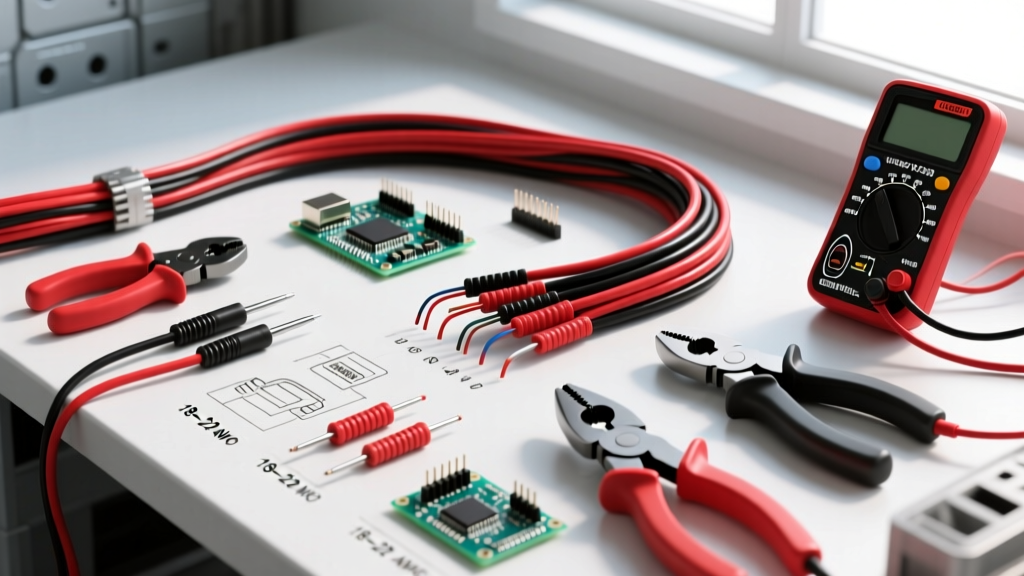
Working with 12 AWG and 10 AWG solid copper red and black wires requires precision tools to avoid nicking the conductor, which creates high-resistance hot spots. Here are the top-tier tools recommended for 2026:
1. Wire Strippers: Klein Tools 11063W Katapult
The Klein Tools 11063W (retailing around $28) is an automatic wire stripper that excels at cleanly removing the insulation from 10-22 AWG solid and stranded wire. Unlike traditional manual gauges, the Katapult's shear-and-pull mechanism prevents the micro-fractures that often lead to conductor snapping under terminal torque.
2. Connectors: WAGO 221 Lever-Nuts
For joining red and black pigtails, traditional twist-on wire nuts are being rapidly replaced by lever connectors. The WAGO 221 Series (specifically the 412 for 2-conductor splices) costs about $0.45 per unit but guarantees a gas-tight, vibration-proof connection. They accept 24-12 AWG and feature a built-in test port for multimeter probes, eliminating the need to unwrap a wire nut to check for voltage.
3. Torque Screwdriver: CDI 401SM
NEC 110.14(D) now strictly requires that terminations be torqued to the manufacturer's specifications. When terminating red and black wires into a 200A subpanel, use a calibrated torque screwdriver (like the CDI 401SM, approx. $135) set to the breaker's specified inch-pound rating (typically 35-45 in-lbs for standard residential breakers).
Step-by-Step: Prepping Red and Black Conductors
- Sheath Removal: Use a cable ripper (romex slitter) to remove the outer PVC jacket of the 12/3 NM-B cable. Leave at least 1/4 inch of jacket extending into the electrical box to protect the wire insulation from the metal box edges.
- Stripping: Strip exactly 3/4 inch of insulation from the red and black wires. This is the standard depth for most 15A and 20A receptacles and breakers. Exposed copper outside the terminal invites arc faults.
- Looping (if applicable): If terminating on a screw terminal, use needle-nose pliers to form a clockwise hook. The clockwise direction ensures the screw tightens the loop rather than pushing it outward.
- Pigtail Splicing: If the box contains multiple hot feeds, use a red WAGO 221 lever nut to splice the incoming black wires together with a 6-inch black pigtail. Repeat the exact process for the red wires. Keep neutrals (white) and grounds (bare) strictly separated in their own respective WAGO ports or bus bars.
Common Failure Modes and Troubleshooting
Even experienced DIYers make mistakes when managing electrical wiring red and black circuits. Here are the most frequent failure modes encountered in the field:
- Shared Neutral Overload: Wiring both the red and black wires to the same phase (e.g., both on L1) in an MWBC. This prevents current cancellation, causing the shared white neutral to carry the combined amperage, melting the insulation and starting a fire. Fix: Always verify red and black are on opposite bus stabs using a 2-pole breaker.
- Traveler Confusion in 3-Way Switches: Connecting the common (line/load) wire to a traveler terminal. While the switch might work intermittently, it creates unpredictable voltage states. Fix: Always identify the black (common) screw on the switch and connect the line/load to it; red and black travelers go to the brass screws.
- Backstabbing Receptacles: Pushing 12 AWG solid red or black wire into the quick-connect holes on the back of a receptacle. The internal spring-loaded grips often fail under thermal expansion. Fix: Always use the side screw terminals or pigtail with a WAGO connector.
By respecting the distinct roles of red and black conductors, utilizing modern lever-nut connectors, and strictly adhering to NEC torque and handle-tie requirements, you ensure a robust, fire-resistant electrical system that will pass any 2026 municipal inspection.