
The Unique Hostility of Below-Grade Environments
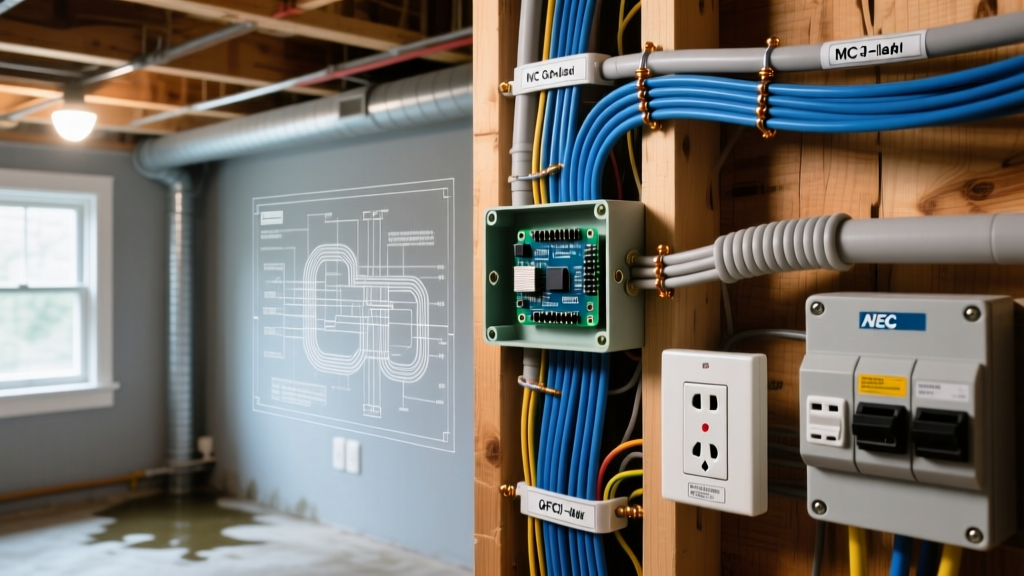
When planning electrical wiring in basement spaces, electricians and DIYers must treat the environment as fundamentally hostile to standard electrical components. Unlike above-grade rooms, basements sit below the frost line and are surrounded by soil that retains moisture year-round. Concrete walls and floors act as rigid sponges, constantly wicking groundwater and releasing it into the ambient air through vapor transmission. This chronic micro-moisture exposure, combined with the alkaline nature of curing concrete, creates a high-risk environment for insulation degradation, galvanic corrosion, and ultimately, arc faults or short circuits.
Industry data consistently shows that the leading cause of basement electrical fires is not overloaded circuits, but rather insulation degradation from chronic moisture exposure combined with physical puncture damage during drywall installation.
To execute a safe, code-compliant basement wiring project in 2026, you must move beyond basic circuit routing and focus on moisture mitigation, physical protection, and advanced fault interruption. This guide details the exact materials, National Electrical Code (NEC) mandates, and installation tolerances required to keep your below-grade electrical system safe for decades.
Mandatory NEC Code Protections for Basements
The National Fire Protection Association (NFPA) updates the NEC to address evolving safety risks. According to the National Fire Protection Association (NFPA), basement environments trigger specific code articles that do not apply to standard living spaces. Ignoring these distinctions is the most common reason basement wiring fails municipal inspections.
| NEC Article | Requirement | Application in Basement |
|---|---|---|
| 210.8(A)(5) | GFCI Protection | Mandates Ground Fault Circuit Interrupter protection for all 125V, 15A and 20A receptacles in unfinished basements. |
| 210.12(B) | AFCI Protection | Requires Arc Fault Circuit Interrupter protection for branch circuits supplying outlets in finished basement living areas. |
| 300.4(A)(1) | 1.25-Inch Setback | Wiring must be kept at least 1.25 inches back from the face of framing studs to prevent drywall screw punctures. |
| 334.15 | Exposed Cable Protection | Prohibits exposing NM-B (Romex) cable below 8 feet on unfinished basement walls; requires conduit or running through bored joists. |
The Gold Standard: Dual-Function (DF) Breakers
Historically, electricians had to choose between GFCI protection for wet areas and AFCI protection for living spaces, often requiring complex pigtail wiring or specific receptacle placements. Today, the safest approach for electrical wiring in basement circuits is the Dual-Function (DF) breaker, which combines both AFCI and GFCI protection in a single panel module.
- Eaton BR120DF: A 120V, 20A Dual-Function breaker priced around $48 to $55. Ideal for standard basement living spaces and workshops.
- Siemens Q120DF: Comparable 120V, 20A DF breaker, typically retailing for $50 to $58. Features Siemens' proprietary thermal memory for trip accuracy.
While DF breakers cost roughly 30% more than standard thermal-magnetic breakers, they eliminate the need for bulky GFCI receptacles on the wall and provide panel-level protection for the entire branch circuit, including the hidden wiring inside the walls.
Framing Clearances and Physical Protection
Basements are heavily utilized for mechanicals, meaning electrical wires share tight joist bays with HVAC ducts, plumbing drains, and gas lines. Physical protection is paramount.
Step-by-Step Boring and Fastening Rules
- Measure the 1.25-Inch Setback: When boring holes through 2x4 or 2x6 studs for framing interior basement walls, the edge of the hole must be no closer than 1.25 inches from the face of the stud. If your framing requires a tighter bore, you must install a 1/16-inch thick steel nail plate over the stud face to deflect drywall screws.
- Secure NM-B Cable Properly: Non-metallic sheathed cable must be stapled within 8 inches of every junction box and at intervals not exceeding 4.5 feet. Use insulated cable staples; bare metal staples can crush the outer PVC jacket, compromising the internal paper wrapping and leading to localized moisture ingress.
- Maintain Separation from Plumbing: Never run electrical cables directly above or below water supply lines. If crossing is unavoidable, maintain a minimum 2-inch vertical separation, and always route the electrical cable above the plumbing to prevent catastrophic shorting in the event of a pipe leak.
Material Selection Matrix: NM-B vs. Conduit Systems
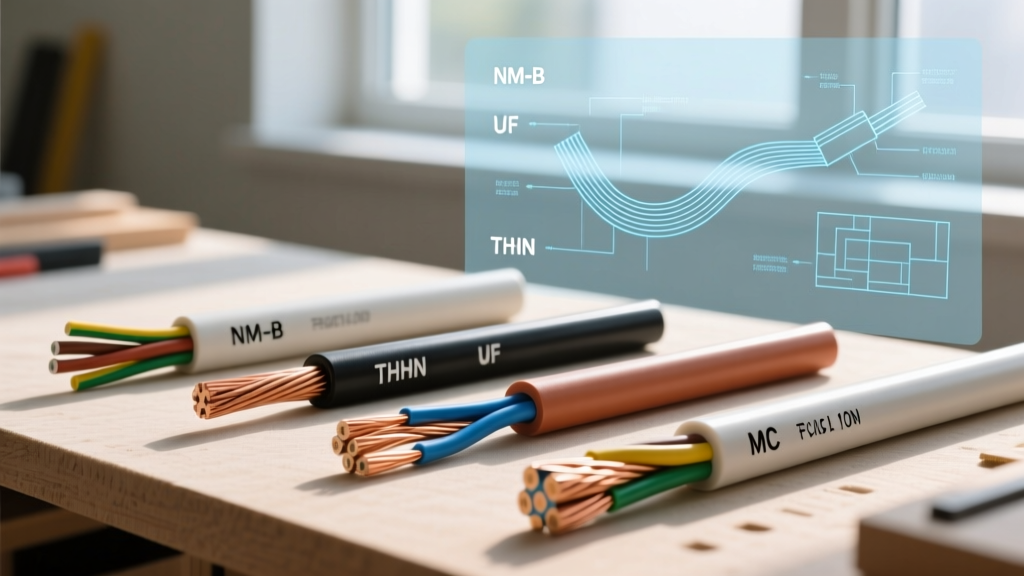
Choosing the right cable type is critical when dealing with below-grade moisture. While NM-B (commonly known as Romex) is the default for above-grade dry spaces, it is highly vulnerable to bulk water. If your basement has a history of seepage, or if you are wiring an unfinished utility area, alternative materials are required.
| Wiring Method | Moisture Resistance | Physical Protection | Approx. Cost (per 100ft) | Best Basement Application |
|---|---|---|---|---|
| NM-B (12/2) | Low (Dry locations only) | Low (Requires framing concealment) | $45 - $55 | Finished interior walls with 6-mil vapor barrier. |
| UF-B (12/2) | High (Wet/Damp rated) | Low (Jacket is tough but exposed) | $95 - $115 | Direct burial, exterior transitions, damp crawlspace edges. |
| THHN in EMT | Medium (Conduit can trap water) | Very High (Steel armor) | $120 - $150 (materials) | Unfinished ceilings, exposed shop walls, surface runs. |
| THHN in Sch 40 PVC | Very High (Watertight joints) | High (Impact resistant) | $130 - $160 (materials) | Runs against masonry walls, floor transitions, wet bars. |
Expert Tip: When running EMT (Electrical Metallic Tubing) along an exterior masonry basement wall, use PVC-coated EMT or apply a rust-inhibitive primer to the conduit. The alkaline dust from concrete, combined with high humidity, will corrode standard galvanized EMT within 5 to 7 years, eventually compromising the grounding path.
Moisture Mitigation: The 6-Mil Rule
Before closing up any basement wall, you must address vapor transmission. According to guidelines referenced by the U.S. Consumer Product Safety Commission (CPSC), moisture control is intrinsically linked to electrical safety and fire prevention.
Always install a continuous 6-mil polyethylene vapor barrier over the insulation, on the warm-in-winter side of the wall (facing the basement interior). Seal all seams with acoustic sealant or specialized vapor barrier tape. This prevents interior humid air from reaching the cold concrete wall, condensing, and dripping down onto your electrical boxes and wiring. Furthermore, ensure the bottom plate of your framed wall is pressure-treated (borate-treated lumber) and separated from the concrete slab by a composite sill sealer foam gasket.
Real-World Failure Modes to Avoid
Even with perfect code compliance, specific installation habits lead to premature failure in basements. Avoid these common edge cases:
- The Shared Neutral Trap: In older multi-wire branch circuits (MWBC), sharing a neutral wire between two hot legs was common. In modern basement renovations with AFCI breakers, shared neutrals will cause immediate nuisance tripping. Always run dedicated 12/2 or 12/3 cables with isolated neutrals back to the panel when using DF or AFCI breakers.
- Recessed Box Condensation: Mounting metal junction boxes directly against exterior concrete walls without a thermal break causes the box to sweat. The resulting water droplets pool at the bottom of the box, rusting the knockouts and degrading wire connections. Always use non-metallic (PVC) boxes on masonry, or mount metal boxes to the wooden framing, not the concrete.
- Over-tightening Cable Clamps: When feeding NM-B into a junction box, over-crimping the metal cable clamp cuts into the ground wire or the outer jacket. Use internal plastic cable clamps (push-in connectors) which are gentler on the cable and faster to install in tight basement joist bays.
Expert FAQ: Basement Electrical Safety
Can I run electrical wiring behind a basement sump pump pit?
No. NEC Article 110.11 requires electrical equipment to be suitable for the environment. The area immediately surrounding a sump pit is classified as a damp or wet location. Keep all standard receptacles and junction boxes at least 3 feet away from the sump pit, and ensure the sump pump itself is plugged into a dedicated 20A GFCI-protected receptacle mounted at least 12 inches above the floor slab.
Do I need AFCI protection for a dedicated basement freezer circuit?
This is a frequent point of contention. While NEC 210.12 requires AFCI for finished living spaces, a dedicated circuit for a freezer in an unfinished utility area typically only requires GFCI protection under 210.8(A)(5). However, if the freezer is located in a finished family room area of the basement, AFCI protection is mandated. To prevent food spoilage from nuisance AFCI trips, use a high-quality DF breaker and ensure the freezer's compressor is in good working order, as failing compressors generate arc signatures that trip sensitive breakers.