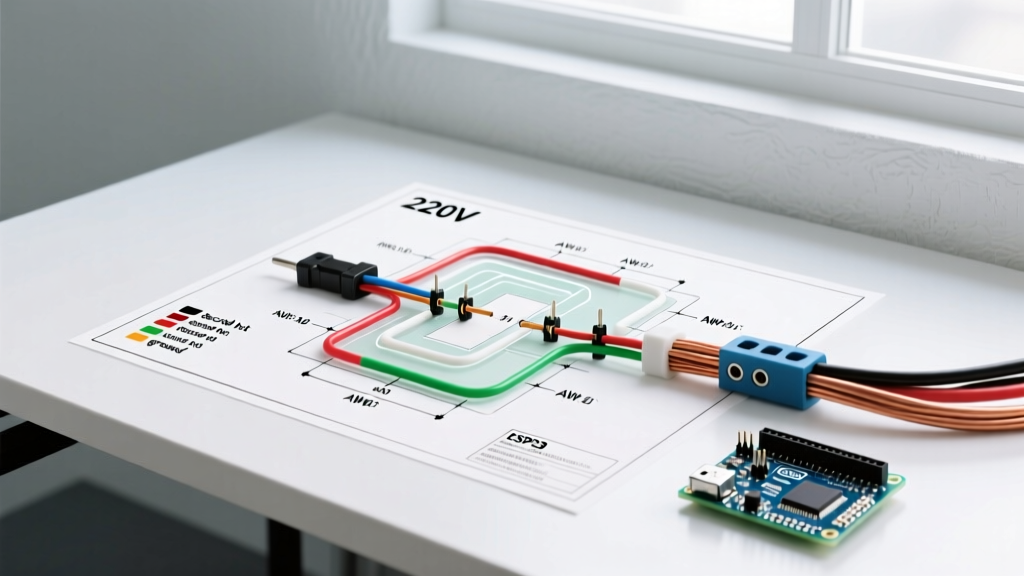

Decoding the Wiring Diagram for 220v Circuits
When homeowners and DIYers search for a wiring diagram for 220v appliances, they are usually looking to install high-draw equipment like electric vehicle (EV) chargers, welding receptacles, or heavy-duty HVAC systems. However, before pulling any wire through a stud, it is critical to address a fundamental electrical reality: in the United States and Canada, residential split-phase power is technically 240V, not 220V. The term "220V" is a legacy colloquialism dating back to the mid-20th century. Modern appliances are rated for 240V, and the National Electrical Code (NEC) governs these circuits under 240V split-phase rules.
In 2026, with the massive surge in Level 2 EV home charging installations and high-efficiency 240V heat pumps, understanding the exact wire gauge, ampacity derations, and NEC-mandated color codes is no longer optional—it is a matter of fire safety and code compliance. This guide provides the deep-dive reference data you need to execute a 240V wiring diagram safely and correctly.
NEC Wire Color Codes for 240V (220V) Configurations
The NEC strictly dictates wire color identification to prevent catastrophic cross-wiring. The color code you must follow depends entirely on whether your specific wiring diagram for 220v requires a neutral conductor.
1. The 4-Wire Setup (Modern Standard for Appliances)
Used for: Electric dryers, ranges, and ovens (NEMA 14-30, 14-50).
- Black: Hot 1 (120V to ground, 240V to Red)
- Red: Hot 2 (120V to ground, 240V to Black)
- White: Neutral (Current-carrying conductor for 120V appliance components like timers and lights)
- Bare Copper / Green: Equipment Grounding Conductor (EGC)
2. The 3-Wire Setup (Legacy / Grandfathered)
Used for: Pre-1996 dryer and range installations. Note: The NEC banned new 3-wire installations for dryers and ranges in 1996. If you are running new wire in 2026, you must use 4-wire.
- Black: Hot 1
- Red: Hot 2
- White: Combined Neutral and Ground (Bonded at the appliance, not the panel)
3. The 2-Wire Setup (Pure 240V, No Neutral)
Used for: Baseboard heaters, well pumps, air compressors, and dedicated EV chargers (NEMA 6-50 or hardwired).
- Black: Hot 1
- White (Re-identified): Hot 2. CRITICAL: You must wrap the white wire with black or red electrical tape (or paint) at both ends to re-identify it as a hot conductor. Leaving it white is a severe code violation.
- Bare Copper / Green: Equipment Grounding Conductor
⚠️ SAFETY WARNING: Never use the ground wire as a neutral, and never bond the neutral bus bar to the ground bus bar in a subpanel. According to OSHA electrical safety guidelines and NEC Article 250, neutral and ground must only be bonded at the main service disconnect. Bootleg grounds on 240V receptacles are a leading cause of fatal electric shocks.
Wire Gauge & Breaker Sizing Matrix
Selecting the correct American Wire Gauge (AWG) is dictated by the breaker size and the conductor material. The table below outlines standard copper and aluminum sizing for 240V circuits. Always size the breaker to protect the wire, not the other way around.
| Breaker Size | Copper AWG (Min) | Aluminum AWG (Min) | Common NEMA Receptacle | Typical 2026 Application |
|---|---|---|---|---|
| 20 Amp | 12 AWG | 10 AWG | NEMA 6-20R | Window AC, small power tools |
| 30 Amp | 10 AWG | 8 AWG | NEMA 14-30R / L6-30R | Electric Dryer, RV 30A Outlet |
| 40 Amp | 8 AWG | 6 AWG | NEMA 14-50R (Derated) | Older HVAC, small EV chargers |
| 50 Amp | 6 AWG | 4 AWG | NEMA 14-50R / 6-50R | EV Level 2 Charger, Welder, Range |
| 60 Amp | 6 AWG* | 4 AWG* | Hardwired / 14-60R | Heavy-duty EV chargers, subpanels |
*Note on 60A circuits: While 6 AWG THHN copper in conduit is rated for 75°C (65A), standard NM-B (Romex) 6 AWG is limited to 60°C (55A). For a 60A breaker, you must use THHN/THWN-2 in conduit or upgrade to 4 AWG NM-B.
Anatomy of a 4-Wire 220v Wiring Diagram (NEMA 14-50)
The NEMA 14-50R is the undisputed king of 240V receptacles in 2026, serving as the standard for 50-amp EV chargers and electric ranges. Here is the step-by-step logical flow for wiring this receptacle from a standard 200A main panel.
- Panel Termination: Connect the Black and Red wires to a 2-pole 50A breaker (e.g., Siemens Q250 or Eaton BR250). Connect the White wire to the Neutral bus bar. Connect the Bare copper wire to the Ground bus bar. Torque all lugs to the manufacturer's exact specification using a calibrated torque screwdriver per NEC 110.14(D).
- Receptacle Wiring: At the NEMA 14-50R, the physical layout is standardized.
- Top (X / Y): Black and Red hot wires. (Polarity between X and Y does not matter for standard split-phase AC).
- Bottom Center (W): White neutral wire.
- Bottom Semi-Circle (G): Bare ground wire. This is the U-shaped prong.
- Stripping and Torque: Strip exactly 3/4 inch of insulation. Loop the wire clockwise around the terminal screw. Torque the 14-50R terminal screws to 35-45 inch-pounds (check the specific receptacle stamp, such as Leviton or Hubbell, for exact values).
Advanced E-E-A-T: THHN vs. NM-B and Voltage Drop
A common failure mode for DIYers following a generic wiring diagram for 220v circuits is ignoring the insulation type when calculating ampacity.
- NM-B (Romex): Limited to the 60°C column in NEC Table 310.16. Therefore, 8 AWG NM-B is strictly capped at 40 Amps. You cannot use 8 AWG NM-B on a 50 Amp breaker.
- THHN/THWN-2 in Conduit: Rated for 90°C, but terminations are usually limited to 75°C. 8 AWG THHN at 75°C is rated for 50 Amps. However, NEC 210.20 and 240.4(B) do not allow "rounding up" to the next standard breaker size if the wire is exactly at the termination limit for certain applications. For a 50A EV circuit, 6 AWG THHN is the professional standard to prevent nuisance tripping and heat buildup.
Critical Failure Modes to Avoid
When auditing residential 240V installations, master electricians frequently encounter these dangerous errors:
- The "Bootleg" Ground on 3-Prong Dryers: Converting a new 4-prong dryer cord to an old 3-prong receptacle without properly removing the neutral-to-ground bonding strap on the dryer chassis. This energizes the dryer's metal body if the neutral fails.
- Undersized Grounding Conductors: Using a 10 AWG ground wire with 6 AWG hot wires. NEC Table 250.122 requires that if you upsize your hot wires for voltage drop (e.g., using 4 AWG copper for a 50A circuit), you must proportionally upsize the equipment grounding conductor.
- Ignoring GFCI Requirements: The 2023 NEC (and subsequent 2026 local adoptions) strictly requires GFCI protection for 240V EV charging receptacles in garages (NEC 625.41 and 210.8(F)). Hardwiring the EV charger directly is often preferred by professionals to bypass the nuisance tripping associated with 50A GFCI breakers on certain EV power supplies.
Frequently Asked Questions
Can I use aluminum wire for a 220v/240v circuit?
Yes, aluminum (specifically XHHW-2 or THWN-2) is highly cost-effective for 240V circuits, especially for 50A to 100A runs where copper pricing becomes prohibitive. For a 50A circuit, use 4 AWG Aluminum. Always use an anti-oxidant compound (like Noalox) on aluminum terminations and ensure your breaker and receptacle are rated "CO/ALR" or explicitly listed for 75°C aluminum terminations.
Does it matter which hot wire goes to which brass screw on a 240V outlet?
No. In a standard US split-phase 240V system, both hot legs are 120V to ground and 180 degrees out of phase with each other. Swapping the black and red wires on the X and Y terminals of a NEMA 14-50R will not affect the operation of the appliance or the direction of any internal 240V motors.
Where can I find official code updates?
Always consult the U.S. Department of Energy's wiring guidelines and your local Authority Having Jurisdiction (AHJ). Local municipal codes often have amendments that supersede the base NEC, particularly regarding permit requirements for EV charging infrastructure and subpanel installations.