
The Kitchen as the Heart of the Electrical Panel
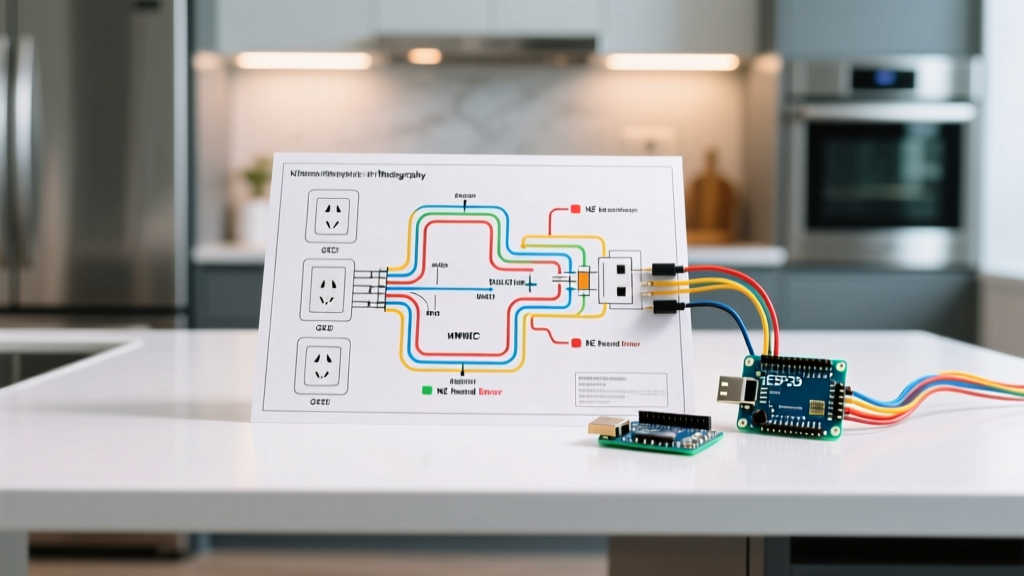
In modern residential construction, the kitchen draws the most transient, high-amperage loads of any room. A standard 2,500-square-foot home built to current codes typically allocates four to six dedicated 20-amp circuits exclusively for kitchen appliances and small-appliance branch circuits (SABCs). When a microwave trips a breaker, an island receptacle dies, or under-cabinet lights flicker under load, guessing the fault is both dangerous and inefficient. To diagnose these issues accurately, you must treat your wiring diagram for kitchen layouts as a topographical map. By cross-referencing the physical symptoms with the schematic logic of your home's branch circuits, you can isolate faults without tearing open drywall or risking arc-flash injuries.
This guide walks through advanced diagnostic techniques using standard kitchen wiring schematics, focusing on 2026 NEC compliance, specific failure modes, and the exact tools required to trace phantom voltage and cascading GFCI faults.
Decoding the Standard Wiring Diagram for Kitchen Layouts
Before grabbing a multimeter, you must understand the foundational logic of a kitchen schematic. According to the National Electrical Code (NEC), specifically Article 210.11(C)(1), a kitchen must be served by at least two 20-ampere small-appliance branch circuits. These circuits are designed to handle portable, high-wattage devices like toasters, blenders, and coffee makers.
The Anatomy of a 20A SABC
- Wire Gauge: 12 AWG copper (typically 12/2 NM-B 'Romex' for concealed runs, or 12 AWG THHN in EMT conduit for exposed island runs).
- Overcurrent Protection: 20A single-pole breaker. In 2026, dual-function AFCI/GFCI breakers (like the Square D HOM220GFIC) are standard at the panel to satisfy both arc-fault and ground-fault protection requirements for kitchen SABCs.
- Receptacles: 20A Tamper-Resistant (TR) duplex outlets. While 15A receptacles are legally permitted on a 20A circuit (provided there is more than one outlet on the yoke), 20A-rated receptacles with the T-slot neutral blade are increasingly preferred for heavy-duty appliance durability.
NEC Code Snapshot: GFCI Protection Zones
Under NEC Article 210.8(A)(6), all 125-volt through 250-volt receptacles supplying kitchen countertops must have ground-fault circuit-interrupter (GFCI) protection. This includes outlets within 6 feet of the sink's outside edge. When reading your wiring diagram, identify the 'LINE' (power source) and 'LOAD' (downstream protection) terminals on the primary GFCI receptacle. Miswiring these is the leading cause of kitchen electrical faults.
Step-by-Step Troubleshooting Using Your Diagram
When a fault occurs, your wiring diagram allows you to segment the circuit into logical nodes. Here is how to troubleshoot the two most common kitchen electrical failures using schematic tracing.
Scenario 1: The Cascading GFCI Trip
The Symptom: Plugging in a 1500W microwave into Outlet C trips the GFCI reset button located at Outlet A, but Outlet B remains live.
The Schematic Reality: A standard kitchen wiring diagram daisy-chains countertop outlets. Power enters the LINE side of Outlet A (the GFCI). The LOAD side of Outlet A feeds Outlet B, which then feeds Outlet C. If Outlet B is live but Outlet C is dead when the GFCI trips, the physical wiring contradicts the standard schematic.
The Diagnostic Fix:
- Verify the LOAD vs. LINE configuration: Use a Fluke T6-1000 FieldSense multimeter to test for voltage. Many DIY installers mistakenly wire downstream outlets to the LINE side using pigtails, which bypasses GFCI protection for the downstream devices.
- Check for Neutral-to-Ground Faults: A cascading trip often indicates a neutral-to-ground fault downstream. Disconnect the LOAD neutral wire at the GFCI. Use the multimeter's continuity setting to test between the disconnected LOAD neutral and the bare copper ground wire. If you read continuity (near 0 ohms), a pinched wire or a miswired appliance cord downstream is causing the fault.
- Calculate the Load: A 1500W microwave draws 12.5A. If a 900W coffee maker (7.5A) is running on the same LOAD side, the combined 20A load will cause thermal fatigue on the GFCI's internal contacts over time, leading to nuisance tripping even below the 20A breaker threshold. Redistribute the loads across the two separate SABCs as dictated by your panel diagram.
Scenario 2: Dead Split-Wired Dishwasher/Disposal Receptacle
The Symptom: The garbage disposal works, but the dishwasher receives no power, despite the breaker being on.
The Schematic Reality: Under-sink receptacles are frequently 'split-wired' using a 12/3 NM-B cable. The black wire (always hot) feeds the top brass terminal, while the red wire (switched hot via a wall toggle) feeds the bottom brass terminal. The white neutral is shared.
The Diagnostic Fix:
- Inspect the Brass Tab: The most common failure point in split-wired diagrams is the failure to break the connecting brass tab on the hot side of the receptacle. If the tab is intact, the switch controls both outlets, or one half dies if the switch loop is miswired.
- Verify Switch Loop Integrity: Use a non-contact voltage tester (NCVT) on the red wire at the receptacle while toggling the wall switch. If the red wire never energizes, trace the diagram back to the switch box. Look for a loose backstabbed connection on the single-pole switch, which frequently fails under the inductive load of a 1/2 HP disposal motor.
Common Kitchen Faults vs. Diagram Tracing Points
| Observed Fault | Probable Root Cause | Diagram Tracing Point |
|---|---|---|
| Receptacle melts/discolors under microwave load | Backstabbed (push-in) wire connections creating high resistance | Check receptacle node; verify side-screw terminal torque (14 in-lbs) |
| Island outlet completely dead; no breaker tripped | Loose wire nut in the junction box feeding the floor conduit | Trace 12/2 NM-B to the floor junction box (J-box) node |
| GFCI won't reset; button feels spongy | Internal GFCI relay failure due to previous short circuit | Isolate LINE side; if power is present but reset fails, replace GFCI |
| Under-cabinet LEDs flicker when blender turns on | Shared neutral overload or voltage drop on 14 AWG lighting circuit | Verify lighting is on separate 15A circuit per NEC 210.11(C)(3) |
Multi-Wire Branch Circuits (MWBC): The Hidden Kitchen Hazard
Older homes, and even some modern builds attempting to save conduit space, utilize Multi-Wire Branch Circuits (MWBCs) for kitchen countertops. An MWBC uses a 12/3 NM-B cable (Black, Red, White, Bare) to supply two separate 20A circuits sharing a single neutral wire.
Expert Warning: If an MWBC is wired to two breakers on the same electrical phase (e.g., both on Phase A), the shared neutral will carry the sum of both loads (up to 40A) rather than the difference. This will melt the 12 AWG neutral wire inside the walls and cause a fire without ever tripping the 20A breakers. The Electrical Safety Foundation International (ESFI) strongly advises verifying phase alignment and handle-tie compliance during any kitchen troubleshooting.
Troubleshooting the MWBC: Look at your panel diagram. The black and red wires must terminate on a 2-pole 20A breaker, or two single-pole breakers secured with an approved handle tie (NEC 210.4). If you are troubleshooting a dead outlet on an MWBC and find 120V on the black wire but 0V on the red wire, check the handle tie. If one breaker tripped and the handle tie is missing or broken, the second half of your kitchen circuit will remain dead until manually reset.
Essential Tools for Kitchen Circuit Tracing
To effectively map your physical wiring against your schematic, you need professional-grade diagnostic tools. Relying on cheap neon testers will lead to misdiagnosed phantom voltages.
- Fluke T6-1000 Electrical Tester: Allows for non-contact voltage and current measurement through the wire insulation using FieldSense technology. Crucial for verifying if a LOAD wire is energized without unscrewing the receptacle.
- Klein Tools RT600 Receptacle Tester: Specifically designed to test GFCI and AFCI functionality. It will pulse the circuit to intentionally trip the GFCI, verifying that the LINE/LOAD wiring matches your diagram.
- Wiha Insulated Torque Screwdriver (set to 14 in-lbs): The NEC requires terminal screws to be tightened to the manufacturer's specifications. Under-torqued 12 AWG wires on kitchen receptacles will loosen due to thermal expansion from high-draw appliances, causing arcing faults.
FAQ: Kitchen Wiring Diagram Queries
Do I need an AFCI breaker for kitchen circuits in 2026?
Yes. Under current NEC guidelines, all 120V, single-phase, 15A and 20A branch circuits supplying kitchens require Arc-Fault Circuit Interrupter (AFCI) protection. When troubleshooting a breaker that trips immediately upon resetting, consult your diagram to ensure you aren't dealing with an AFCI nuisance trip caused by a faulty appliance motor (like an aging refrigerator compressor) rather than a true wiring fault.
Can I put the refrigerator on a GFCI outlet?
The NEC does not require GFCI protection for a dedicated refrigerator receptacle unless it is installed within 6 feet of the sink's edge. However, if your wiring diagram shows the refrigerator plugged into a downstream LOAD terminal of a countertop GFCI, a tripped GFCI will kill power to the fridge, spoiling food. Always trace the diagram to ensure the refrigerator is on its own dedicated 20A circuit, wired directly from the panel without passing through a countertop GFCI's LOAD terminals. For more on appliance safety, refer to the Consumer Product Safety Commission (CPSC) electrical safety guidelines.
Why does my kitchen island outlet have no power?
Island outlets are notorious for hidden junction boxes. Because NM-B cable cannot be run where subject to physical damage (like under a floor joist where it might be exposed), the wiring diagram usually shows a transition point where 12/2 NM-B transitions to 12 AWG THHN wires inside rigid or EMT conduit running up the side of the island cabinet. Troubleshoot by locating this transition J-box in the basement or crawlspace directly beneath the island; wire nuts here frequently vibrate loose or were improperly stripped during construction.