
The Farmall H Electrical Evolution
International Harvester produced over 420,000 Farmall H tractors between 1939 and 1953. Originally equipped with a 6-volt, positive-ground electrical system utilizing a 4-brush generator, these tractors were engineering marvels of their era. However, as we navigate 2026, the original 6V architecture struggles to support modern agricultural implements, high-lumen LED work lights, and electronic monitoring accessories. For restorers and working farmers alike, understanding the correct wiring diagram for Farmall H applications is the foundational step in executing a reliable 12-volt, negative-ground conversion.
Why the Original 6-Volt Positive Ground Fails Today
The original 6V positive-ground system suffers from severe voltage drop over long wire runs, especially when insulation degrades. Furthermore, 6V generators require high RPMs to begin charging, meaning the battery slowly drains during idle-heavy tasks like spraying or PTO-driven milling. Converting to a 12V negative-ground system using an internally regulated alternator resolves these issues, providing consistent 14.2V output at idle and compatibility with universally available modern components.
⚠️ CRITICAL SAFETY WARNING: Before cutting a single wire, disconnect the battery ground strap. When converting from positive to negative ground, you MUST reverse the battery cables, reverse the ammeter connections, and polarize the ignition system. Failure to reverse the ammeter will result in a dead short and melted wiring harness upon startup.Core Components of the 12-Volt Conversion
Executing a proper 12V swap requires more than just dropping in a new battery. You must address the charging source, the ignition circuit, and the starting solenoid. Below is the definitive parts list required for a professional-grade conversion.
- Alternator: Delco-Remy 10-SI (63 Amp or 94 Amp). Part number 1100556 is the industry standard for agricultural swaps due to its internal voltage regulator and robust diode trio.
- Ignition Coil: Standard Motor Products UC12 (12V internal resistor) OR retain the original 6V coil and install a 1.8-ohm ceramic ballast resistor.
- Starter Solenoid: Standard Motor Products ST-308 (12V, heavy-duty continuous duty).
- Ammeter: NAPA M-4644 (12V, 50-amp discharge/charge) or a digital volt meter rated for 8-16V.
Step-by-Step Wiring Diagram Execution
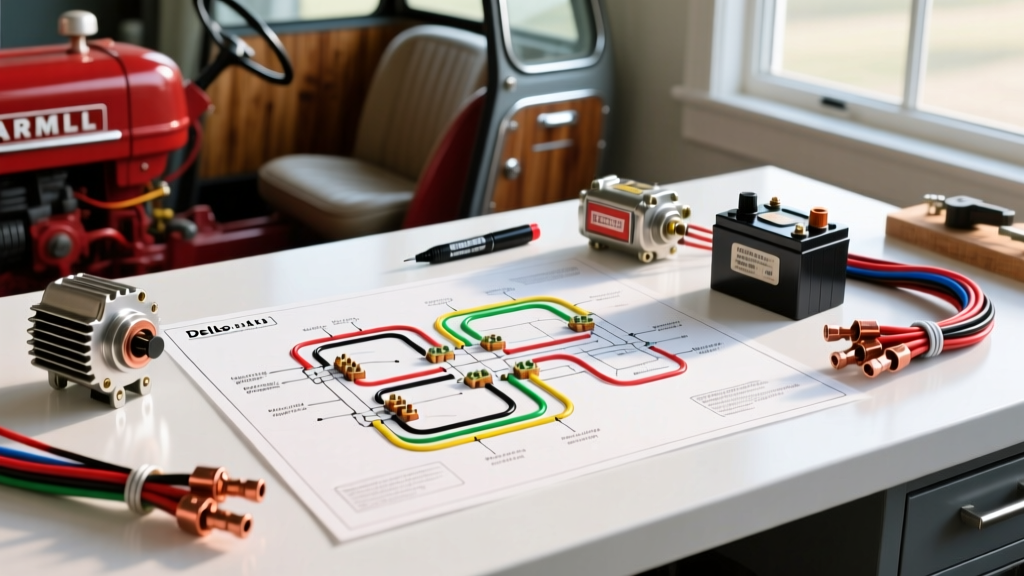
Because visual schematics can vary based on the specific year and dashboard configuration of your Farmall H, the following text-based wiring diagram provides the exact node-to-node routing required for a 12V negative-ground system.
Phase 1: The Delco 10-SI Alternator Integration
The Delco 10-SI features a 3-pin connector on the rear, but only two terminals are actively used in a tractor application.
- BAT Terminal (Threaded Post): Run a 10 AWG red wire directly from the alternator BAT terminal to the battery side of the starter solenoid. Do NOT route this through the ammeter or ignition switch; it must handle full alternator output.
- Terminal #1 (Excitation): Run a 14 AWG wire from Terminal #1 to the ignition switch output post. Insert a 194-style indicator bulb (idiot light) in this line. The bulb provides the initial resistance needed to excite the alternator's rotor. Once the engine starts, the alternator self-excites and the light goes out.
- Terminal #2 (Voltage Sense): Run a short 14 AWG jumper wire from Terminal #2 directly back to the BAT terminal. This tells the internal regulator to sense voltage at the alternator output, which is ideal for short-harness tractors like the Farmall H.
Phase 2: Ignition Coil and Ballast Resistor Logic
The ignition circuit is where most Farmall H conversions fail. If you apply 12V directly to an original 6V coil, the points will pit and burn out within 3 hours of operation.
- Route A (Using a 12V Coil like the UC12): Run a 14 AWG wire from the ignition switch directly to the positive (+) terminal of the coil. The negative (-) terminal goes to the distributor points. No external resistor is needed.
- Route B (Retaining the Original 6V Coil): Run a 14 AWG wire from the ignition switch to one side of a 1.8-ohm ceramic ballast resistor. Run a second wire from the other side of the resistor to the positive (+) terminal of the 6V coil. This drops the voltage to a safe 6V-7V operating range.
Phase 3: Starter Solenoid and Grounding
Mount the new 12V ST-308 solenoid to the starter housing or frame. Connect the heavy 1/0 AWG battery cable from the negative (-) terminal of the new 12V battery to the solenoid's battery post. Run another 1/0 AWG cable from the solenoid's starter post to the starter motor. Finally, ensure the engine block is grounded to the frame using a minimum 2 AWG braided copper strap to prevent starter current from seeking a path through the throttle linkage or steering shaft bearings.
Farmall H Wire Gauge and Routing Matrix
Adhering to SAE International standards for low-tension primary cable (J1128) is critical to prevent voltage drop and harness fires. Use the following matrix for your harness build:
| Circuit Function | Wire Gauge (AWG) | Standard Color Code | Max Continuous Load |
|---|---|---|---|
| Battery to Solenoid | 1/0 AWG | Black (Negative Ground) | 300A+ (Cranking) |
| Alternator BAT to Solenoid | 10 AWG | Red | 65A |
| Ignition Switch to Coil | 14 AWG | Purple or Yellow | 15A |
| Headlights (LED Upgrade) | 16 AWG | Blue | 10A |
| Ammeter Shunt/Feed | 10 AWG | Red/Black Trace | 50A |
Advanced Troubleshooting: Edge Cases and Failure Modes
Even with a perfect wiring diagram for Farmall H applications, real-world variables introduce faults. Here is how to diagnose the most common conversion anomalies.
1. The Ammeter Pegs Hard Negative at Idle
Root Cause: The ammeter is wired backwards relative to the new negative-ground battery, OR the alternator is overcharging due to a bad internal regulator.
Fix: Swap the two 10 AWG wires on the back of the ammeter. If the issue persists, test the alternator BAT terminal with a multimeter. If voltage exceeds 14.8V at 1500 RPM, the Delco 10-SI voltage regulator diode trio has failed and the alternator must be rebuilt or replaced.
2. Starter Motor Overheats and Seizes
Root Cause: The original 6V starter motor is now receiving 12V. While a 6V starter can survive on 12V for short cranking bursts (under 10 seconds), prolonged cranking will melt the armature solder and destroy the field coils.
Fix: If your Farmall H engine is tired and requires extended cranking, you must upgrade to a dedicated 12V starter (such as a late-model IH 300 Utility starter) or install a 12V gear-reduction mini starter, which draws 40% less amperage and spins 3x faster.
3. Ignition Points Pit Rapidly (White Chalky Residue)
Root Cause: Missing ballast resistor on a 6V coil, or a failing condenser inside the distributor.
Fix: Verify 7V at the coil positive terminal while the engine is running. If you read 12V, you have bypassed the resistor. Additionally, ensure the distributor condenser (capacitor) is rated for 12V operation (typically 0.22 to 0.28 microfarads). Consult the Yesterday's Tractors technical archives for specific IH magneto vs. battery-distributor timing nuances.
2026 Parts Sourcing and Cost Breakdown
Budgeting for a professional conversion requires accurate 2026 market pricing. Avoid cheap, unbranded offshore alternators; their diode bridges fail rapidly under the high-heat conditions of a tractor engine bay.
- Delco 10-SI 63A Alternator (Premium Reman): $75 - $95
- 12V Coil (Standard Motor Products UC12): $28 - $35
- Heavy Duty Solenoid (ST-308): $32 - $45
- Group 19 12V Agricultural Battery: $110 - $140
- Marine-Grade Tinned Copper Wire Kit (10/14/16 AWG): $65
- Total Estimated Conversion Cost: $310 - $380
Expert Maintenance Protocols
Once your 12V system is operational, implement these maintenance steps to ensure longevity. Apply dielectric grease (specifically a silicone-based compound compliant with NFPA electrical safety guidelines for moisture exclusion) to all spade terminals and the alternator connector. The Farmall H's open-cowl design exposes the wiring harness to rain, fertilizer dust, and UV radiation. Wrap the entire engine-bay harness in split-loom tubing and secure it with UV-resistant nylon zip ties every 6 inches. Finally, check the braided engine ground strap annually; corrosion here is the number one cause of slow-cranking complaints in converted tractors.
Frequently Asked Questions
Do I need to change the dash light bulbs?
Yes. If your Farmall H has dash illumination, the original 6V bulbs will blow instantly on a 12V system. Replace them with 12V equivalents (typically 1816 or 194 bulbs) or upgrade to 12V LED wedge bulbs for lower current draw.
Can I keep the original voltage regulator on the firewall?
No. The Delco 10-SI alternator is internally regulated. The original 6V mechanical voltage regulator must be bypassed entirely. You can leave it mounted on the cowl for aesthetic restoration purposes, but no wires should connect to it.