
The SAE J560 Standard: Decoding the 7-Way Pinout Matrix
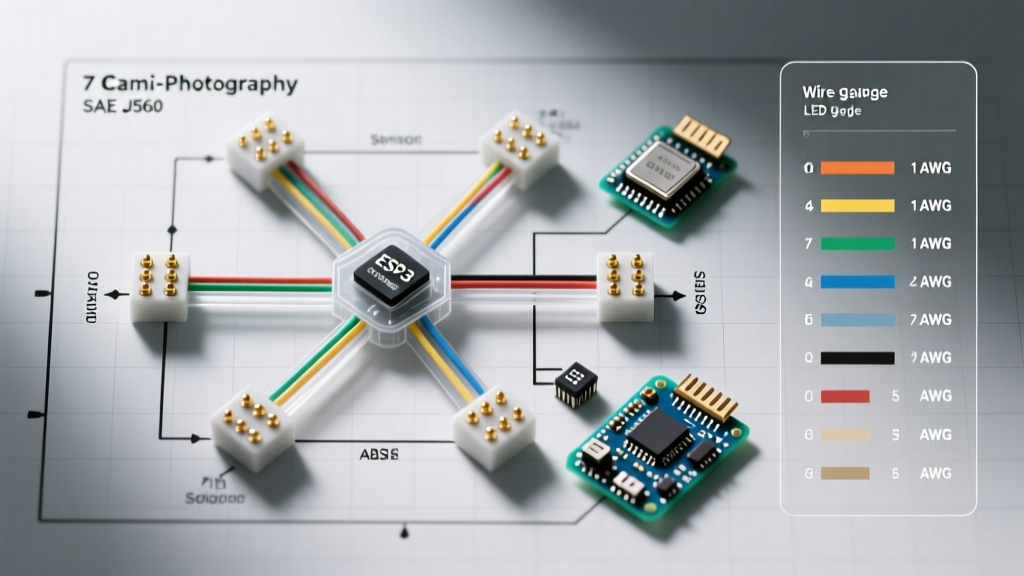
When referencing a wiring diagram for semi trailer applications, you are working with a 12-volt, heavy-duty commercial circuit designed to withstand high vibration, moisture, and extreme temperature fluctuations. The SAE J560 standard dictates not only the pinout functions but also the specific wire gauges required to prevent voltage drop over the 50-to-65-foot length of a standard dry van or flatbed trailer.
| Pin | Circuit Function | Standard Wire Color | Min. AWG |
|---|---|---|---|
| 1 | Ground (Return) | White | 10 AWG |
| 2 | Clearance, Side Markers, ID | Black | 12 AWG |
| 3 | Left Turn & Hazard | Yellow | 12 AWG |
| 4 | Stop Lamps | Red | 12 AWG |
| 5 | Right Turn & Hazard | Green | 12 AWG |
| 6 | Tail Lamps, License Plate | Brown | 12 AWG |
| 7 | Auxiliary, ABS, Telematics | Blue | 12 AWG |
Heavy-Duty Wire Gauge & Voltage Drop Calculations
A common failure point in custom-built or repaired trailers is undersized ground wiring. SAE J560 mandates a 10 AWG white wire for Pin 1 (Ground). Why? The ground circuit must handle the cumulative return current of all active trailer lighting. If a driver engages the hazard flashers and steps on the brakes simultaneously, the ground wire may carry upwards of 15 amps.
Using standard copper wire (which has a resistance of roughly 1.588 ohms per 1,000 feet for 12 AWG), a 60-foot run to the rear of the trailer (120 feet round-trip) will experience a voltage drop. If you undersize the ground to 12 AWG, the voltage drop at 15 amps exceeds 2.8 volts. This leaves only 9.2 volts at the rear clearance lights, causing them to dim and triggering 'Trailer Lamp Out' faults on the tractor's dashboard.
Upgrading to SXL or GXL Cross-Linked Wire
For modern 2026 fleet builds, avoid standard PVC-jacketed wire. Specify GXL (General Cross-Linked) or SXL (Special Cross-Linked) polyethylene insulated wire. GXL wire features a thinner insulation wall, allowing for tighter bending radii inside the trailer harness, while withstanding engine bay and road-salt temperatures up to 125°C without becoming brittle.
ABS, Telematics, and Auxiliary Circuit Integration
Pins 6 (Brown) and 7 (Blue) are the backbone of modern trailer intelligence.
- Pin 7 (Blue - Auxiliary/ABS): Provides continuous 12V power from the tractor to power the trailer's Anti-Lock Braking System (ABS) ECU and modern telematics trackers (e.g., Samsara or Geotab gateways). The ABS ECU requires a minimum of 9.5V to initialize and perform its self-diagnostic lamp check upon startup.
- Pin 6 (Brown - Tail/Marker): While traditionally just for tail lamps, modern wiring diagrams often route Pin 6 through a secondary relay to power interior cargo LEDs, ensuring the cargo area is illuminated whenever the tractor's parking lights are engaged.
Multiplexed Electrical Systems (PWM) vs. Standard Wiring
If your semi-trailer is being paired with modern Volvo VNL or Mack Anthem tractors (2020-2026 models), you must account for Pulse Width Multiplexing (PWM). These tractors do not send a simple 12V analog signal to the trailer. Instead, the Body Control Module (BCM) sends a high-frequency multiplexed signal to monitor circuit integrity and detect burnt-out bulbs based on current draw.
If you upgrade a standard halogen trailer to all-LED lighting without a PWM adapter, the tractor will read the ultra-low current draw of the LEDs as a 'blown bulb' and will hyper-flash the turn signals or completely cut power to the circuit to prevent a perceived short.
The Fix: Install a smart PWM filter module, such as the Phillips Perma-Check adapter or an inline Grote multiplexing converter, between the 7-way receptacle and the main trailer harness. These modules simulate the electrical resistance of halogen bulbs while safely passing the PWM signal to the LED drivers.
Step-by-Step Nosebox Termination & Weatherproofing
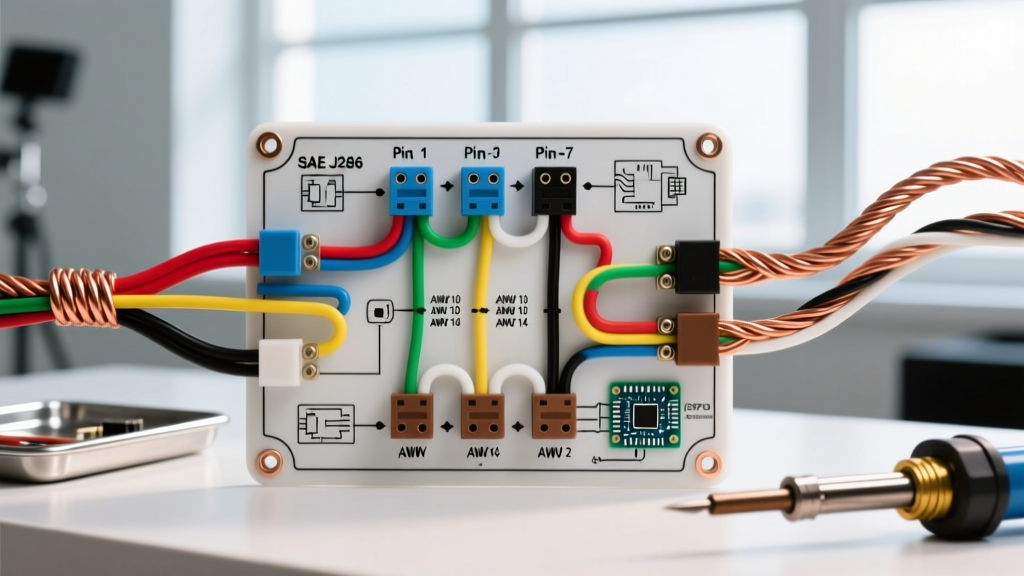
The 'nosebox' (where the tractor pigtail plugs into the trailer) is the #1 point of failure due to water ingress and 'pin drag' (when the tractor plug pushes the trailer pins backward, breaking the internal solder joints).
- Prep the Harness: Strip exactly 5/16' of insulation from your 7-way SXL harness. Do not nick the copper strands.
- Crimp & Solder: Use a calibrated ratcheting crimper (e.g., H-DTCE) for the terminal pins. Follow up with a quick solder dip to eliminate micro-voids between the wire strands and the brass terminal.
- Apply Dielectric Grease: Coat the terminal pins with Novagard G661 silicone dielectric grease. This specific compound prevents galvanic corrosion between dissimilar metals without washing out during high-pressure fleet washes.
- Install a Spring-Loaded Receptacle: Use a QCP (Quick-Change Plug) receptacle like the Phillips 15-700 ($65-$85 retail). The internal spring-loaded pins automatically push back against the tractor plug, eliminating pin drag and maintaining constant electrical tension.
Troubleshooting Matrix: LED Upgrades & FMCSA Compliance
According to FMCSA 49 CFR Part 393, all commercial trailers must meet specific photometric lighting requirements. When upgrading to LED, ensure your lamps are DOT/SAE compliant, not just 'off-road' rated.
| Symptom | Root Cause | Actionable Solution |
|---|---|---|
| Tractor Dash shows 'Trailer Lamp Out' but all LEDs work | LEDs draw too little current for the tractor's BCM to detect the circuit. | Install inline load resistors (10-ohm, 50W) or a smart PWM bypass module. |
| Left turn signal hyper-flashes on tractor | Mismatched flasher relay or high-resistance ground on Pin 1. | Clean nosebox ground lug; verify 10 AWG ground wire continuity to chassis. |
| ABS fault code on tractor dash upon startup | Voltage drop on Pin 7 (Blue) preventing ABS ECU initialization. | Test voltage at trailer nosebox Pin 7 with brakes applied; must read >10.5V. |
| Corrosion buildup inside nosebox receptacle | Failed rubber grommet or lack of dielectric grease. | Replace grommet; pack receptacle cavity with Novagard G661 grease. |
Frequently Asked Questions (FAQ)
Can I use a standard 7-way RV plug on a commercial semi-trailer?
No. The SAE J286 (RV) standard places 12V constant power on Pin 4 and Electric Brakes on Pin 2. The SAE J560 (Semi) standard places Stop Lamps on Pin 4 and Clearance Lights on Pin 2. Plugging an RV trailer into a semi-tractor will instantly blow the tractor's lighting fuses and potentially fry the Body Control Module.
How do I test the Blue (Pin 7) ABS circuit without a trailer?
Use a digital multimeter set to DC Voltage. Probe Pin 7 (Blue) and Pin 1 (White/Ground) at the tractor receptacle with the ignition ON and engine RUNNING. You should read between 13.2V and 14.1V. If you read 0V, check the tractor's dedicated ABS fuse (usually a 30A maxi-fuse in the power distribution center).
What is the best sealant for trailer harness splice joints?
For any splices made along the trailer sub-frame, use dual-wall adhesive-lined heat shrink (e.g., 3M MDT or Raychem). The inner wall melts and bonds to the wire insulation, creating a watertight seal that prevents capillary action from drawing road salt water down the copper strands.
For more in-depth commercial vehicle electrical standards and harness routing techniques, consult the Phillips Industries Technical Resources library, which provides CAD drawings and torque specs for heavy-duty nosebox assemblies.