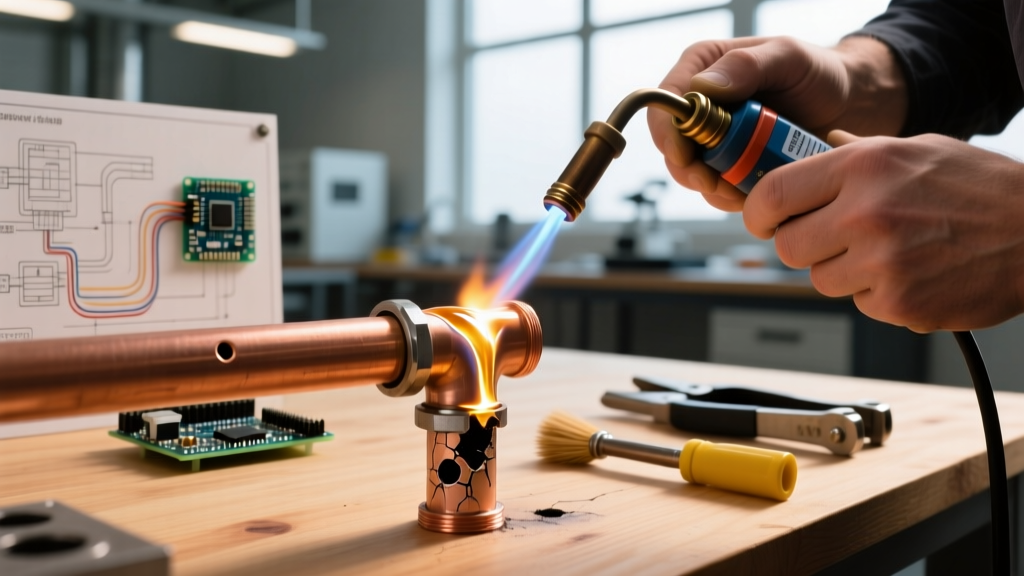

The Physics Problem: Why Propane Struggles with Copper
Soldering copper pipe with propane torch setups is a staple of residential plumbing, but it comes with inherent thermodynamic challenges. Propane (C3H8) burns at a maximum theoretical temperature of roughly 3,600°F in ambient air. While this is more than enough to melt lead-free 95/5 tin-antimony solder (which flows at approximately 450°F), copper is an exceptional thermal conductor with a thermal conductivity rating of about 400 W/m·K.
When you are soldering 1/2" Type M copper, a standard 14.1 oz propane cylinder delivers adequate BTUs. However, when stepping up to 3/4" or 1" Type L copper, the mass of the pipe and the fitting acts as a massive heat sink. The pipe dissipates the heat faster than the propane flame can deliver it, resulting in cold joints, flux burn-off, and eventual pinhole leaks. Understanding how to manipulate heat transfer is the key to mastering propane soldering in 2026.
Diagnostic Matrix: Identifying Propane Solder Defects
Before tearing apart a failed joint, diagnose the exact failure mode. Use this troubleshooting matrix to identify why your propane solder joint failed.
| Defect Symptom | Root Cause | Propane-Specific Fix |
|---|---|---|
| Solder balls up and refuses to enter the joint | Flux burned off before capillary action temperature was reached. | Switch to Oatey No. 95 Tinning Flux; keep the inner blue cone 1.5 inches from the copper. |
| Solder melts but joint leaks under pressure | Trapped moisture in the line created a steam pocket, preventing solder adhesion. | Use dissolvable Oatey FlowGuard plugs or the "white bread" trick to block upstream water. |
| Solder only coats the outside rim | Heat was applied to the pipe instead of the fitting; capillary action reversed. | Apply the flame directly to the thickest part of the fitting, not the pipe. |
| Joint turns black and crusty | Overheating caused the flux to carbonize and oxidize the copper surface. | Use a swirl-flame torch tip to distribute heat evenly rather than concentrating it. |
| Solder sucks back out of the joint as it cools | Thermal shock from a wet rag quenching the pipe too rapidly. | Air cool the joint; if a damp rag is necessary, wait until the solder loses its liquid shine. |
Advanced Troubleshooting: Fixing the 3 Most Common Propane Failures
Failure 1: The "Heat Sink" Stall on 3/4" and 1" Pipes
When soldering larger diameter lines, DIYers frequently experience the "heat sink stall." The propane torch heats the pipe, but the heavy brass or copper fitting absorbs the heat, preventing the entire assembly from reaching the 450°F flow point. By the time the fitting is hot enough, the flux on the pipe has burned away, oxidizing the copper and blocking capillary action.
The Fix: Abandon standard water-soluble paste flux for larger lines. Upgrade to a tinning flux like Oatey No. 95 (approx. $14 for a 2 oz tub). Tinning flux contains microscopic powdered solder particles suspended in the flux. Even if the flux boils and spatters slightly before the joint is fully heated, the residual tin powder bridges the gap and promotes capillary draw. Additionally, apply a heat-sink paste like Oatey Kwik-Sil ($15) to adjacent soldered joints to prevent them from de-soldering while you focus the propane flame on the new fitting.
Failure 2: Flux Burn-Off and Solder Balling
Propane torches with standard pencil flames concentrate intense heat on a single millimeter of copper. This localized superheating vaporizes the flux instantly, leaving bare, oxidized copper that solder will not stick to. You will see the solder bead up and roll off the pipe like water on a hot skillet.
The Fix: You must manage the flame envelope. If you are using a standard pencil-flame torch (like the basic Bernzomatic ST2200), you must keep the torch moving in a circular motion around the fitting to distribute the heat. Better yet, upgrade to a trigger-start torch with a swirl combustion chamber, such as the Bernzomatic TS8000 (retailing around $48 in 2026). The swirl flame wraps around the circumference of the pipe, heating the entire fitting evenly and preventing localized flux burn-off.
Failure 3: Micro-Leaks from Trapped Line Moisture
Water is the ultimate enemy of a solder joint. Even a few drops trapped in a vertical drop or a low spot in the line will boil when hit with a propane torch. The resulting steam expands 1,600 times its liquid volume, pushing outward through the capillary space and blowing microscopic holes in the cooling solder. These pinhole leaks often don't appear until the system is pressurized to 60+ PSI.
The Fix: Never attempt to "out-heat" water with a propane torch; you will only warp the copper. Drain the system completely. If gravity draining isn't enough, use commercial dissolvable test plugs like the Oatey FlowGuard system, which block water flow and dissolve safely once the water is turned back on. In a pinch, tightly wadded white bread pushed into the pipe will block the water and easily dissolve through your faucet aerators later—just be sure to remove the aerators before turning the water back on.
Optimizing Your Propane Setup for Maximum BTU Output
Many plumbers blame the propane fuel when the actual issue is cylinder thermodynamics. As liquid propane vaporizes into gas inside the cylinder, it absorbs ambient heat. In a cold basement or during winter rough-ins, the 14.1 oz cylinder will literally freeze over with condensation and frost. This drops the internal vapor pressure from roughly 100 PSI down to 40 PSI, starving your torch of fuel and drastically reducing your BTU output.
Pro Tip: Never use a heat gun or torch to warm a freezing propane cylinder—this is a severe explosion hazard. Instead, keep a bucket of 90°F tap water on site and submerge the bottom half of the spare propane cylinders. This maintains the vapor pressure and ensures a steady, high-BTU fuel flow to your torch head.
Furthermore, ensure your torch head is clean. Solder splatter and carbon buildup inside the brass burner tube will disrupt the air-to-fuel mixture, resulting in a lazy, yellow flame instead of a sharp, roaring blue cone. Use a piece of 18-gauge copper wire to clear the burner orifice before every major soldering session.
Propane vs. MAP-Pro: When to Switch Fuels
While troubleshooting soldering copper pipe with propane torch setups is entirely possible, there are scenarios where propane simply lacks the thermal mass to get the job done efficiently. According to the Copper Development Association, proper joint preparation and adequate heat application are non-negotiable for long-term joint integrity. If you are consistently failing on 1" or 1.25" lines, it is time to switch to MAP-Pro (yellow cylinder).
- Fuel Composition: Propane is C3H8; MAP-Pro is Propylene (C3H4). MAP-Pro burns roughly 130°F hotter (3,730°F vs 3,600°F) and transfers heat significantly faster.
- Cost Efficiency: Propane cylinders cost about $4.50; MAP-Pro cylinders cost around $9.50. Use propane for 1/2" and 3/4" lines to save money, but switch to MAP-Pro for 1"+ lines or when soldering near existing joints where speed is critical to prevent de-soldering.
- Equipment Compatibility: Most modern premium torches (like the TS8000) are rated for both gases. However, cheap pencil-flame torches may melt their internal O-rings when used with MAP-Pro. Always check the manufacturer's rating.
Expert FAQ
Can I use a propane torch to solder copper in tight joist spaces?
Yes, but you must use a flame shield (like a fiberglass heat mat) to protect the wood. In tight spaces, a standard torch head won't fit. Use a micro-torch extension or a specialized tight-space soldering iron (like the Milwaukee M12 Cordless Soldering Iron) for 1/2" lines, as swinging a propane torch in a 14-inch joist bay risks burning the structural framing.
Why does my solder joint look dull and grainy instead of shiny?
A dull, grainy appearance indicates a "disturbed joint." This happens when the copper pipe was bumped, twisted, or vibrated while the solder was in its plastic (semi-solid) cooling phase. The crystalline structure of the solder fractured. You cannot fix this by simply melting more solder over it; you must disassemble the joint, clean it with 120-grit emery cloth, re-flux, and resolder.
Is it safe to use 50/50 solder on my home's drinking water lines?
No. 50/50 solder contains 50% lead and is strictly prohibited by the Safe Drinking Water Act and modern 2026 plumbing codes for potable water systems. It is only intended for non-pressurized drain lines or HVAC applications. You must use 95/5 (Tin/Antimony) or lead-free silver-bearing solder for any copper pipe carrying drinking water. Refer to the Oatey Soldering Resources for exact melting points and code-compliant alloy specifications.
Final Thoughts on Propane Soldering
Troubleshooting soldering copper pipe with propane torch equipment ultimately comes down to respecting the thermodynamics of the materials. By managing your heat sink, upgrading to tinning flux for larger diameters, and maintaining your cylinder vapor pressure, you can achieve professional-grade, leak-free sweat joints using standard propane. Always prioritize proper ventilation and keep a Class B fire extinguisher nearby, as outlined in standard OSHA welding and cutting safety guidelines.