
The Metallurgy and Thermal Challenges of Architectural Copper
Copper gutters are the pinnacle of architectural roofing, offering a lifespan that routinely exceeds 100 years while developing a protective, aesthetically striking verdigris patina. However, the longevity of a copper gutter system is entirely dependent on its seams and joints. In 2026, with 16oz cold-rolled copper sheet prices hovering between $18 and $22 per square foot, material mistakes are costly. More importantly, soldering copper gutters presents a unique thermodynamic challenge that standard electronics or plumbing soldering techniques cannot overcome.
Copper possesses a thermal conductivity of approximately 400 W/m·K. This means it pulls heat away from your soldering iron and dissipates it across the sheet metal almost instantly. When working with standard 16oz (0.0216 inches thick) or 20oz (0.027 inches thick) architectural copper, a standard 60W electronics iron will result in an immediate cold joint. Success requires high-mass heat application, specialized fluxes, and an understanding of the 'plastic range' of architectural solders.
Decoding Solder Alloys: Why 50/50 Remains King
While the plumbing industry has aggressively transitioned to lead-free alloys, the architectural sheet metal industry—guided by the Copper Development Association (CDA)—still heavily favors 50/50 Tin-Lead (Sn50/Pb50) for flat-lock seams and gutter endcaps. The reason lies in the metallurgical 'plastic range'.
| Solder Alloy | Solidus (Melts) | Liquidus (Flows) | Plastic Range | Wipeability | 2026 Cost / lb |
|---|---|---|---|---|---|
| 50/50 Tin-Lead | 361°F (183°C) | 421°F (216°C) | 60°F | Excellent (Standard) | $35 - $42 |
| 95/5 Tin-Antimony | 464°F (240°C) | 482°F (250°C) | 18°F | Poor (Brittle) | $45 - $55 |
| SAC305 (Lead-Free) | 423°F (217°C) | 432°F (225°C) | 9°F | Very Poor | $50 - $65 |
The 60°F plastic range of 50/50 solder is the secret to the wiping technique. In this semi-solid state, the solder behaves like a thick paste, allowing the roofer to mold, smooth, and build up the joint with a cotton rag. Lead-free alternatives like SAC305 snap from solid to liquid in a 9-degree window, making the traditional architectural 'wipe' virtually impossible and leading to sagging or capillary failure on vertical downspout seams.
The LEED Compliance Caveat
For projects requiring strict LEED environmental compliance in 2026, lead-free architectural solder is mandatory to prevent lead runoff into municipal water systems. In these cases, 95/5 Tin-Antimony is used, but the joint design must shift from 'wiped' seams to 'sweated' (capillary) lap joints, requiring much tighter tolerances and higher heat input.
Flux Selection: The Chemistry of the Seam
You cannot solder architectural copper with rosin-core flux. The surface oxidation on outdoor copper requires a highly aggressive, water-soluble acid flux.
- Zinc Chloride (Killed Spirits): The traditional choice. Made by dissolving pure zinc metal in muriatic (hydrochloric) acid until the chemical reaction ceases. It is highly effective, cheap, and leaves a residue that can be easily neutralized.
- Commercial Paste Fluxes: Products like Harris Stay-Clean or Rubyfluid contain zinc chloride and ammonium chloride suspended in a paste base. These are preferred for vertical gutter joints as they do not run off the metal before the heat is applied.
Expert Warning: Never use carbon-steel wire brushes or standard steel wool to prep copper seams prior to soldering. Embedded carbon steel particles will rust rapidly, causing galvanic corrosion and black streaks down your copper gutters. Always use stainless steel wool or 3M Scotch-Brite pads.
Essential Equipment for High-Mass Copper
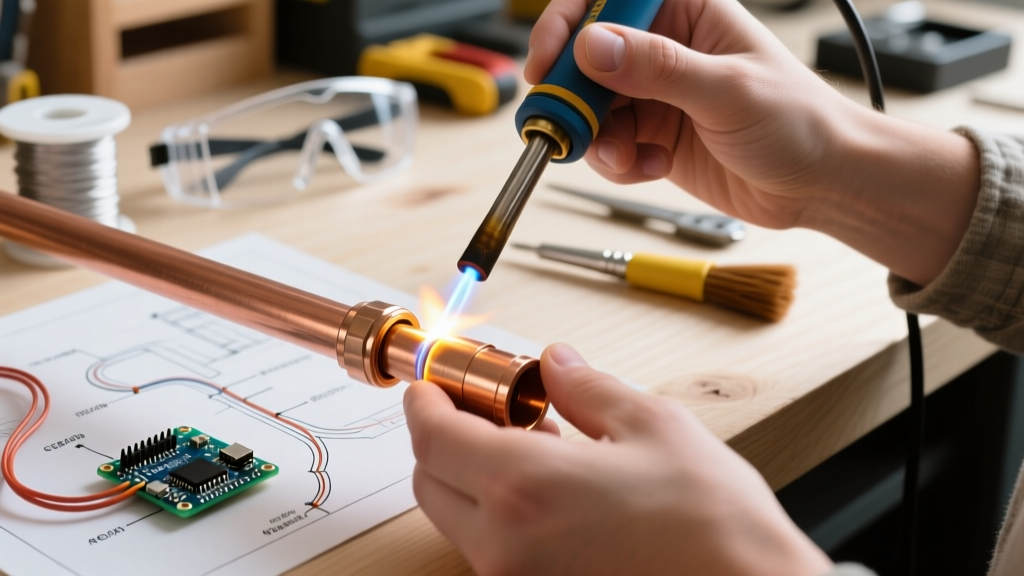
Forget standard soldering stations. Soldering copper gutters requires tools that can dump massive amounts of BTUs into the metal to overcome its thermal conductivity.
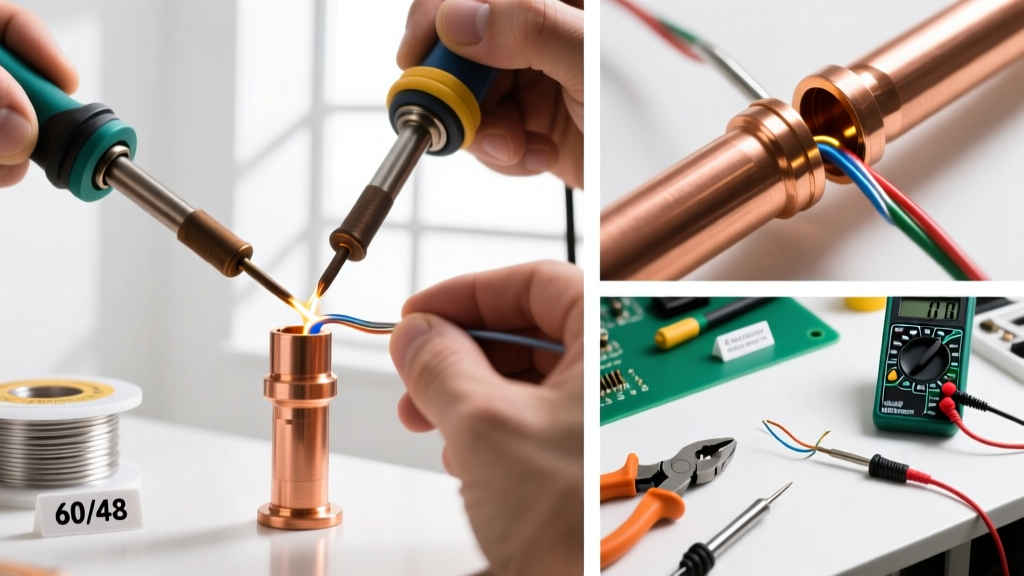
- The Iron: The industry standard is the American Beauty 8220 (800W) Electric Soldering Iron (retailing around $280-$310). Its massive copper bit holds enough thermal mass to maintain temperature while wiping a 12-inch seam. For traditionalists, a 2 lb copper hatchet iron heated by a MAP-Pro torch is still widely used.
- The Torch: A Bernzomatic TS8000 triggered torch fueled by MAP-Pro gas is essential for pre-heating thick 20oz copper seams and maintaining the temperature of traditional hatchet irons. Standard propane lacks the flame temperature required for efficient pre-heating in cold or windy conditions.
- Solder Bars: Use 1/2-inch or 5/8-inch solid 50/50 solder bars, not wire. Wire lacks the volume needed for architectural seams.
- Wiping Pads: Heavy-duty, tightly woven cotton rags (like cut-up denim or heavy flannel) heavily saturated with tallow or specialized wiping grease to prevent the solder from sticking to the fabric.
Step-by-Step: The Wiped Seam Technique
The wiped seam is the hallmark of a master coppersmith. Follow these precise steps for a watertight, structurally sound gutter endcap or flat-lock seam.
Step 1: Mechanical Preparation
Clean the mating surfaces of the copper down to bright, shiny metal using a stainless steel wire brush or abrasive pad. The cleaned area should extend 1/2 inch beyond the intended solder joint. Wipe with denatured alcohol to remove oils from fingerprints.
Step 2: Fluxing and Tinning
Apply a generous coat of zinc chloride paste flux to both mating surfaces. Using your 800W iron and a solder bar, melt a thin layer of solder directly onto the copper surfaces (tinning). You should see the solder 'flash' and wet the copper instantly, creating a mirror-like finish. If the solder beads up, the copper is not clean enough or the iron is too cold.
Step 3: Sweat and Wipe
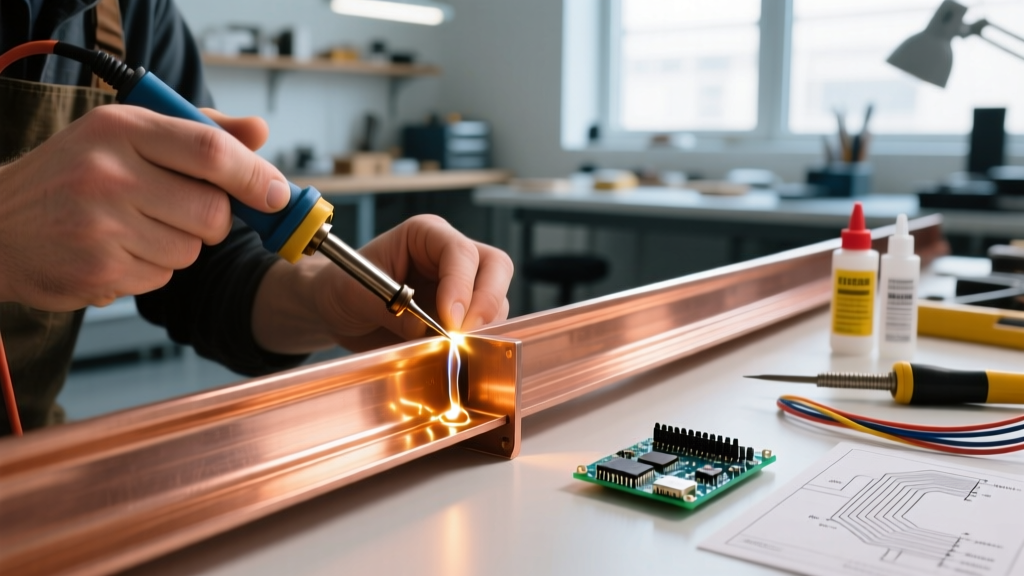
Clamp or weight the tinned pieces together. Apply flux to the exterior seam. Touch the hot iron to the seam while feeding the solid solder bar. As the solder melts and flows into the capillary gap, use your tallow-greased cotton rag to wipe the semi-solid solder smooth, building up a slight convex bead over the joint. Keep the iron moving to prevent burning the flux or melting the base copper.
Step 4: Neutralization
Acid flux residue will corrode the copper and ruin the patina if left untreated. While the joint is still warm (but not hot enough to flash-boil water), wash the area with a baking soda and water solution (1/4 cup baking soda to 1 quart of water) using a stiff nylon brush, then rinse thoroughly with clean water.
Troubleshooting Common Failure Modes
Even experienced roofers encounter issues when environmental variables change. Here is how to diagnose and fix the most common soldering copper gutters failures, referencing guidelines from the Sheet Metal and Air Conditioning Contractors' National Association (SMACNA).
- Cold Joints (Grainy/Dull Appearance): Caused by insufficient heat or moving the joint before the solder fully solidifies. Fix: Re-flux, apply more heat with the MAP-Pro torch to pre-warm the copper, and re-flow the solder with the iron.
- Burned Flux (Black, Crusty Residue): The iron was too hot, or held in one spot too long, carbonizing the zinc chloride. Burned flux acts as a physical barrier to solder wetting. Fix: Allow the metal to cool, mechanically scrape off the black residue with a brass brush, re-clean, and start over.
- Capillary Starvation: Solder fails to draw into the lap joint. Usually caused by improper joint clearance. Architectural copper expands and contracts significantly; if the lap joint is clamped too tightly (zero clearance), the solder cannot wick in. Maintain a 0.005 to 0.010-inch gap using wire spacers during sweating.
Safety, Toxicity, and Environmental Compliance
Soldering copper gutters involves severe hazards that require strict adherence to OSHA lead safety standards. Melting 50/50 solder generates lead oxide fumes, and zinc chloride flux produces highly corrosive hydrogen chloride gas when heated.
Always wear a NIOSH-approved P100 respirator equipped with organic vapor/acid gas cartridges when soldering outdoors, especially in low-wind conditions where fumes can pool. Heavy leather welding gloves are mandatory; a splash of molten 400°F solder or boiling acid flux will cause instantaneous third-degree burns. Finally, collect all solder dross and flux-contaminated water; never allow acid flux or lead residue to wash directly into storm drains or unprotected soil beds, as local EPA runoff regulations carry severe financial penalties for architectural contractors.