
Beyond 60/40: The Metallurgy of High-Reliability Alloys
When transitioning from hobbyist prototyping to IPC Class 3 high-reliability rework—such as aerospace, medical devices, and automotive ECUs—selecting the correct soldering wire types is no longer a matter of simple convenience. Basic 60/40 (Sn60/Pb40) or generic lead-free wires lack the precise metallurgical properties required to survive thermal cycling, vibration, and long-term electromigration. In 2026, advanced micro-soldering demands a rigorous understanding of alloy phase diagrams, solidus/liquidus temperatures, and flux core chemistry.
The cost of specialized solder wire has also shifted. While standard Sn63/Pb37 eutectic wire remains relatively affordable at $45 to $60 per 1lb spool, advanced SAC305 (Tin-Silver-Copper) formulations now hover between $115 and $140 per pound due to fluctuations in silver and tin spot markets. Understanding exactly which alloy justifies this premium is critical for rework station profitability and assembly reliability.
SAC305: The Lead-Free Baseline and Its Limitations
SAC305 (Sn96.5/Ag3.0/Cu0.5) is the undisputed industry standard for commercial lead-free assemblies. With a melting point of 217°C, it requires aggressive thermal profiling. When using advanced active-tip stations like the JBC CD-2BQE with C245 handles, operators typically set the iron to 350°C to ensure rapid wetting without exceeding the thermal mass limits of the pad.
However, SAC305 is not a universal panacea. Its high silver content makes it susceptible to silver leaching when reworking components with silver-palladium (AgPd) terminations, commonly found in RF microwave modules and specialized MLCCs. The molten tin in SAC305 aggressively dissolves the silver from the component pad, leading to catastrophic dewetting and open circuits.
Sn62/Pb36/Ag2: The Anti-Leaching Specialist
To combat silver leaching in high-reliability leaded applications, engineers turn to Sn62/Pb36/Ag2. The addition of 2% silver saturates the molten solder matrix, effectively neutralizing the chemical gradient that pulls silver from the component termination. This alloy is eutectic (melting sharply at 179°C) and is explicitly mandated by NASA Electronic Parts and Packaging (NEPP) guidelines for reworking precious-metal terminations in satellite and deep-space avionics.
Low-Temperature and High-Temperature Extremes
For heat-sensitive substrates like flexible polyimide (Kapton) or IoT sensors with embedded plastics, Sn42/Bi58 is the premier choice. Melting at a mere 138°C, it allows rework at tip temperatures below 200°C, virtually eliminating the risk of delamination or component popcorning. Conversely, for high-temperature environments (e.g., downhole drilling sensors), Sn95/Sb5 (melting at 232°C-240°C) or Sn10/Pb88/Ag2 (melting at 268°C) provide the necessary thermal fatigue resistance.
Critical Warning: Never mix Bismuth-based low-temperature soldering wire types with lead-bearing finishes. The resulting Sn-Pb-Bi ternary eutectic forms a low-melting phase (approx. 96°C) that will liquefy under normal operating temperatures, causing immediate joint failure.
Flux Core Chemistry: Decoding IPC J-STD-004
The alloy is only half the equation; the flux core dictates wetting behavior, oxidation removal, and post-solder cleanliness. According to IPC J-STD-004 standards, fluxes are categorized by composition (RO, OR, IN, RE) and activity level (L, M, H). For advanced rework, choosing the right flux core is paramount to preventing electrochemical migration (ECM) and dendritic growth.
| IPC Classification | Flux Type | Activity Level | Best Application Scenario | Cleaning Requirement |
|---|---|---|---|---|
| ROL0 | Rosin, Low Activity | None | Class 3 aerospace, cleanroom environments, no-clean mandates. | None (Benign residue) |
| ROL1 | Rosin, Mild Activity | Low | Standard SMT rework, slightly oxidized pads. | Optional (Aesthetic) |
| REL1 | Resin, Mild Activity | Low | High-density BGA rework requiring extended thermal soak. | Optional |
| ORH1 | Organic, High Activity | High | Heavily oxidized through-hole, ENIG pad rescue, RF shielding. | Mandatory (DI Water) |
Flux Core Percentage: The Wetting vs. Residue Trade-off
Advanced soldering wire types are manufactured with varying flux core percentages, typically 1.1%, 2.2%, and 3.3%.
- 1.1% Core: Ideal for micro-soldering 0201 and 01005 passives. The minimal flux prevents excessive residue from wicking under ultra-fine-pitch components, which could interfere with automated optical inspection (AOI) or cause parasitic capacitance in RF circuits.
- 2.2% Core: The versatile standard for 0603 to 1206 SMDs and standard SOIC/QFP IC rework. Provides a balanced wetting envelope.
- 3.3% Core: Reserved for heavy-gauge through-hole, large thermal planes, and heavily oxidized legacy boards. The high flux volume sustains boiling activity longer, cutting through thick copper oxide layers before the solder liquidus is reached.
Wire Geometry: Diameter and Profile Selection
The physical geometry of the solder wire directly impacts thermal transfer and volumetric control. Using a 0.031" (0.8mm) wire on an 0402 pad guarantees an instant solder bridge and thermal shock to the component.
Precision Diameter Mapping
Expert rework technicians maintain a spool library mapped strictly to component pitch and pad volume:
- 0.010" - 0.015" (0.25mm - 0.38mm): Mandatory for 01005 passives, micro-BGA sphere replacement, and 0.3mm pitch QFN thermal pad stitching. Requires microscopic precision and ultra-fine tweezers.
- 0.020" (0.50mm): The sweet spot for 0402 and 0201 components, as well as standard 0.5mm pitch TQFP rework.
- 0.031" (0.80mm): Standard through-hole and large SMD connectors.
- 0.062" (1.5mm) and above: Heavy power electronics, XT90 battery connectors, and thick copper busbars.
Flat Ribbon vs. Round Wire
For specialized thermal management, flat ribbon solder wire is an advanced alternative. When reworking large ground planes or multi-layer RF shields, flat wire maximizes the surface area contact between the soldering iron tip and the solder. This accelerates heat transfer, reducing the dwell time required to reach liquidus and minimizing the thermal degradation of the surrounding FR4 substrate.
Thermal Profiling and Edge Case Troubleshooting
Even with premium metallurgically optimized solder wire, advanced rework fails if thermal dynamics are ignored. Here are the most common edge cases encountered in high-reliability labs and their precise solutions.
Flux Exhaustion and Dewetting
Symptom: The solder balls up, refuses to flow onto the pad, and forms a convex, high-contact-angle bead.
Root Cause: Flux exhaustion. The operator has applied heat for too long, boiling off all the rosin activators before the solder could fully wet the copper.
Solution: Do not simply feed more solder wire onto the joint; the new flux will not adequately clean the already-oxidized pad. Remove the iron, apply a high-activity external tack flux (such as Amtech NC-559-V2-TF), and reheat. Alternatively, switch to a wire with a higher flux core percentage (e.g., from 1.1% to 2.2%) for that specific thermal mass.
Tin Whisker Mitigation in Pure Tin Alloys
Symptom: Microscopic crystalline structures growing from the solder joint months after assembly, risking short circuits in high-impedance analog circuits.
Root Cause: Using pure tin (Sn100) or high-tin alloys without proper annealing or secondary metal doping.
Solution: Avoid pure tin wire for long-lifecycle Class 3 products. Always use alloys doped with trace elements like Bismuth, Antimony, or Lead (where RoHS exemptions apply) to disrupt the tin crystal lattice and relieve internal compressive stresses that drive whisker growth.
Cold Joints on High-Layer-Count Boards
Symptom: Dull, grainy appearance on a through-hole barrel connection on a 12-layer PCB.
Root Cause: The internal copper planes act as massive heat sinks, pulling thermal energy away from the barrel faster than the iron can supply it, causing the solder to freeze before fully alloying with the barrel wall.
Solution: Utilize a high-thermal-capacity iron (e.g., Hakko FX-951 with a heavy chisel tip or JBC C245-K). Pre-heat the board from the bottom side using an IR preheater set to 120°C to reduce the thermal delta. Use a 3.3% flux core wire to ensure the flux remains active long enough to penetrate the deep barrel.
Conclusion: Building Your Advanced Spool Library
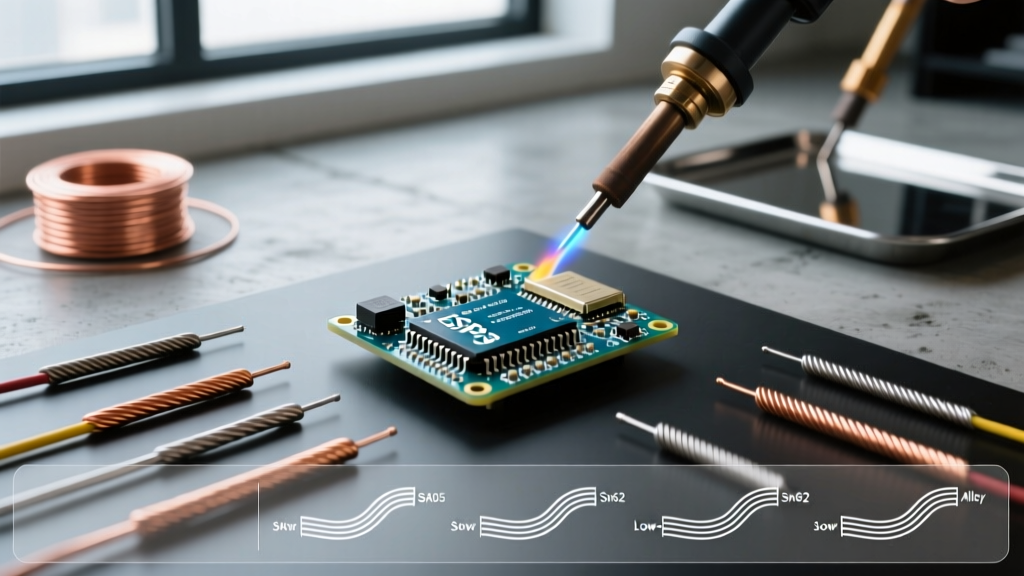
Mastering advanced soldering wire types requires moving away from the "one-spool-fits-all" mentality. By strategically stocking SAC305 for standard lead-free, Sn62 for silver-bearing terminations, Sn42/Bi58 for heat-sensitive flex circuits, and matching the flux core to your specific IPC cleaning requirements, you elevate your rework from simple repairs to certified, high-reliability manufacturing. Invest in the correct metallurgy, respect the thermal profiles, and your Class 3 assemblies will withstand the harshest environments on Earth—and beyond.