
The Intersection of Metallurgy and Microelectronics
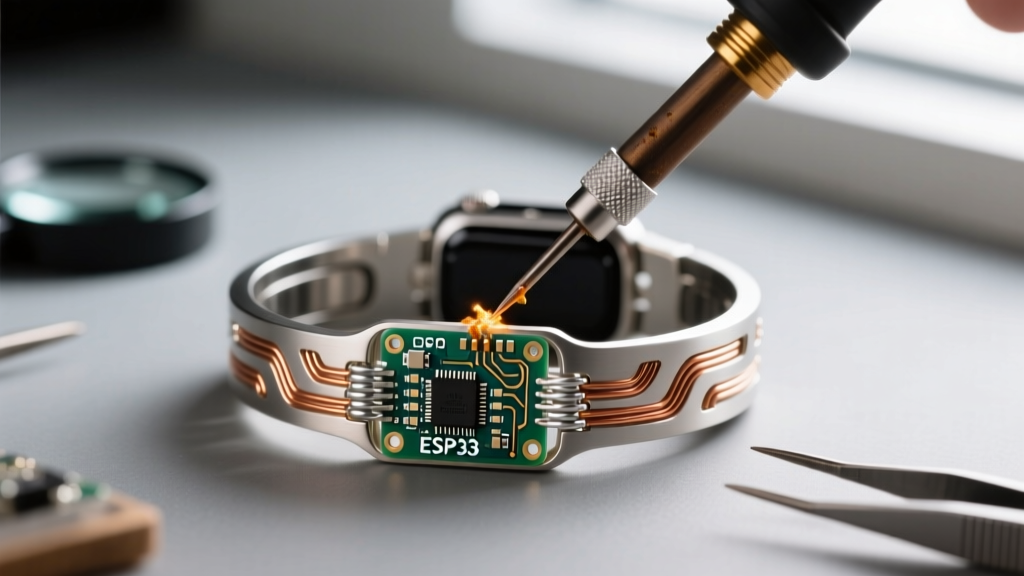
As wearable technology evolves in 2026, the line between high-end horology and smart jewelry has completely blurred. For the advanced maker and electronics artisan, executing complex soldering jewelry ideas requires bridging two distinct disciplines: the metallurgical finesse of precious metalworking and the strict thermal tolerances of microelectronics assembly. Integrating microcontrollers, haptic motors, and micro-LEDs into sterling silver, brass, or titanium settings is not as simple as applying flux and heat. The thermal mass of a heavy silver signet ring will rapidly wick heat away from a micro-soldering tip, leading to cold joints, while excessive localized heat will instantly destroy surface-mount components.
This guide explores advanced techniques for smart jewelry fabrication, focusing on thermal management, specialized solder alloys, and three high-level project architectures that push the boundaries of wearable tech.
The Thermal Mass Paradox: Sterling silver (92.5% Ag, 7.5% Cu) has a thermal conductivity of roughly 315 W/(m·K)—nearly eight times higher than stainless steel. When you apply a 350°C soldering tip to a silver bezel to attach a flex-PCB, the silver acts as a massive heatsink, dropping the tip temperature below the solder's liquidus point before the joint can properly wet.
3 Advanced Soldering Jewelry Ideas for Tech Integration
1. The Haptic Signet Ring (LRA Motor & Flex-PCB Integration)
Traditional eccentric rotating mass (ERM) motors are too bulky for modern rings. Linear Resonant Actuators (LRAs), like the 8mm Z-axis haptic motors used in premium smart rings, offer precise vibration profiles. The challenge is soldering the motor's delicate flex-circuit to a curved, skin-safe contact pad embedded in the ring's inner band.
- Preparation: Mill a 0.5mm recess into the inner band of the sterling silver ring. Clean the copper contact pads with isopropyl alcohol and apply a no-clean, rosin-based tacky flux (e.g., Amtech NC-559-V2-TF).
- Thermal Isolation: Apply high-temperature Kapton tape around the LRA motor housing to prevent heat transfer to the internal neodymium magnets, which lose magnetization above 80°C (Curie temperature threshold for certain NdFeB grades).
- Soldering Execution: Use a JBC C115-112 nano-spatula tip set to 320°C. Because of the silver's thermal wicking, you must pre-heat the ring's shank using a localized hot air pencil (set to 150°C) to reduce the thermal delta. Tin the flex-PCB pads with low-temperature Indalloy 1E (118°C melting point), then reflow the joint in under 1.5 seconds to prevent delamination of the flex substrate.
2. Thermochromic Smart Pendant (ATTiny85 & Enamel Sequencing)
Thermochromic enamel changes color when heated. By embedding a microscopic Kanthal resistance wire beneath a layer of transparent enamel, and driving it with an ATTiny85 SOIC-8 chip hidden in the pendant's bail, you create a color-shifting necklace. The critical engineering hurdle is the sequence of operations: traditional jewelry soldering (using hard, medium, and easy silver solders) requires torch temperatures exceeding 700°C, which will vaporize any pre-attached electronic components.
- Metallurgical Phase: Construct the pendant housing and solder the structural bail using Hard Silver Solder (e.g., StaySilv 45, flowing at ~745°C) with a butane micro-torch. Pickle the piece in warm Sparex #2 to remove oxidation.
- Enameling Phase: Apply the thermochromic enamel and fire in a kiln at 650°C. Let it cool slowly to prevent thermal shock.
- Electronic Phase: Once the metal is completely finished and polished, attach the ATTiny85 PCB to the pre-tinned internal shelf using a conductive, silver-filled epoxy (e.g., MG Chemicals 8331) rather than traditional solder. This eliminates the risk of melting the enamel or damaging the IC with a soldering iron. Final wire connections to the battery contacts are then made using Sn96.5/Ag3.0/Cu0.5 (SAC305) lead-free solder.
3. Fiber-Optic Gemstone Illumination (Side-Firing Micro-LEDs)
Illuminating a faceted gemstone from within requires routing light through a 0.5mm optical fiber attached to a 0402-sized side-firing LED. Soldering 0402 components (1.0mm x 0.5mm) directly to a brass setting requires microscopic precision.
Instead of attempting to solder directly to the brass bezel, fabricate a 0.2mm thick phosphor-bronzon flex-disc. Solder the 0402 LED and its current-limiting resistor to the flex-disc on a flat silicone heating pad. Once the assembly is verified under a stereo microscope, the flex-disc is adhered to the brass setting using UV-curable optical adhesive. This hybrid approach ensures perfect electronic joints without fighting the thermal mass of the brass jewelry setting.
Solder Alloy Selection Matrix for Mixed-Media Jewelry
Choosing the correct alloy is paramount. You must balance skin safety (avoiding lead and nickel), melting temperature, and joint strength. Adhering to guidelines similar to the IPC J-STD-001 standards for electronic assemblies ensures long-term reliability, even when adapted for wearable form factors.
| Alloy Designation | Composition | Melting Point | Skin Safety | Best Jewelry Use Case | Est. Cost (2026) |
|---|---|---|---|---|---|
| SAC305 | 96.5% Sn, 3% Ag, 0.5% Cu | 217°C - 220°C | Excellent | Standard PCB-to-contact pad joints in smart rings. | $85 / lb |
| Indalloy 1E | 48% Sn, 52% In | 118°C | Excellent | Heat-sensitive components (LRAs, Flex-PCBs) on silver. | $450 / lb |
| Sn63/Pb37 | 63% Sn, 37% Pb | 183°C | Poor (Avoid) | Prototyping only. Never use for skin-contact wearables. | $35 / lb |
| Sn96.5/Ag3.5 | 96.5% Sn, 3.5% Ag | 221°C | Excellent | High-shear strength joints for structural battery contacts. | $95 / lb |
Advanced Thermal Management & Tooling
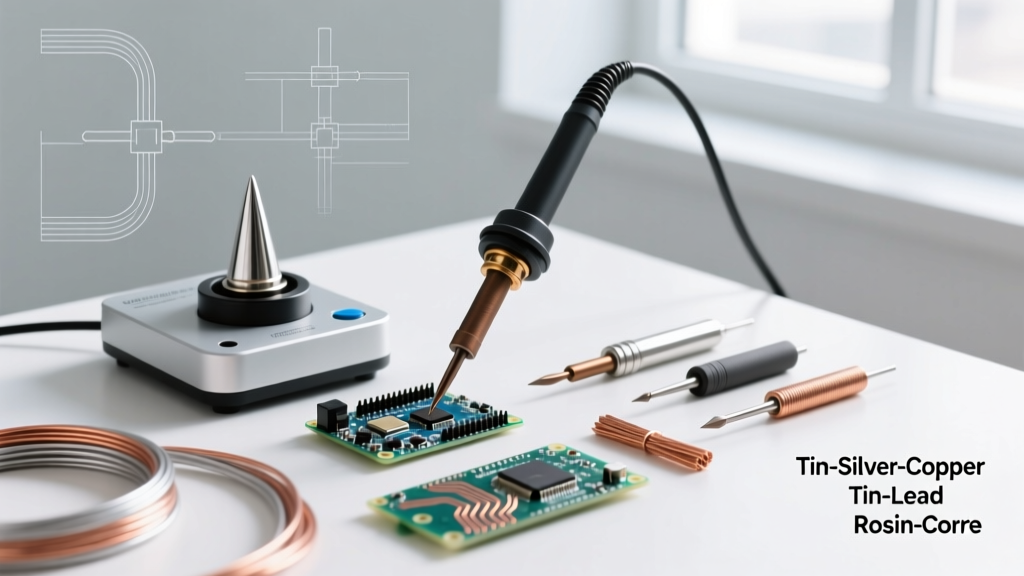
To execute these advanced soldering jewelry ideas, standard $50 hobby irons will fail. The high thermal conductivity of precious metals demands active thermal recovery systems. In 2026, the industry standard for high-mass micro-soldering remains the JBC CD-2BE station paired with the C115 cartridge series.
Tooling Spotlight: JBC vs. Hakko for Silver Jewelry
While the Hakko FX-951 (~$350) is a phenomenal station for standard FR4 PCBs, its T12-style tips struggle to recover heat when pressed against a 15-gram sterling silver ring. The JBC system (~$585 for the station, $55 per tip) heats the element directly inside the tip shaft. When a JBC C115-112 spatula tip touches cold silver, the station detects the microsecond temperature drop and dumps localized current into the tip, recovering 320°C in under 0.8 seconds. This prevents the operator from lingering and accidentally cooking nearby ICs.
Troubleshooting Edge Cases & Failure Modes
Even with premium tooling, mixed-media jewelry soldering presents unique failure modes that pure electronics or pure jewelers rarely encounter.
- Silver Firestain (Copper Oxidation): When heating sterling silver in the presence of oxygen, the copper in the alloy oxidizes below the surface, creating a dark, stubborn stain. Solution: Always use a reducing flame if torch soldering, or apply a heavy layer of boric acid and alcohol flux before applying heat to create an oxygen barrier.
- Component Popcorning: Moisture trapped inside the plastic housing of micro-ICs (like the ATTiny85) expands rapidly when exposed to 220°C soldering temperatures, cracking the chip from the inside. Solution: Bake all microcontrollers in a convection oven at 125°C for 4 hours prior to assembly, following strict moisture sensitivity level (MSL) protocols outlined in NASA Workmanship Standards.
- Galvanic Corrosion at the Joint: If you use a high-silver solder to connect a copper wire to a stainless steel clasp, the dissimilar metals will create a galvanic cell when exposed to sweat (an electrolyte), rapidly corroding the joint. Solution: Use dielectric grease or a conformal coating (e.g., MG Chemicals Silicone Modified Conformal Coating) to hermetically seal the solder joint from skin contact and moisture.
Conclusion
Mastering advanced soldering for smart jewelry requires a fundamental shift in mindset. You are no longer just joining wires; you are managing complex thermodynamics across dissimilar materials. By selecting the correct low-temperature or lead-free alloys, utilizing active-thermal tooling, and sequencing your metallurgical and electronic assembly phases correctly, you can create durable, skin-safe, and technologically advanced wearables that stand up to the rigors of daily use. As micro-components continue to shrink, the artisan who masters these thermal boundaries will define the next generation of smart jewelry.