
The Reality of Hand Soldering SMD Devices in Modern Electronics
As surface-mount technology (SMT) continues to dominate the electronics manufacturing landscape, the ability to execute precision rework and prototyping by hand is a defining skill for professional engineers and advanced hobbyists. While automated reflow ovens handle high-volume production, soldering SMD devices manually remains critical for rapid prototyping, field repairs, and low-volume bespoke assemblies. In 2026, with component footprints shrinking to 0201 (0.6mm x 0.3mm) and IC pitches tightening to 0.4mm, the margin for error is effectively zero. This guide bypasses basic tutorials and dives directly into the professional-grade methodologies, thermal profiling, and specialized tooling required to achieve IPC-A-610 Class 3 reliability standards on your workbench.
The Professional's Toolkit: Beyond the Standard Iron
You cannot achieve professional results with entry-level gear. The thermal recovery rate of your soldering station is the single most critical factor when soldering SMD devices, particularly when working with multi-layer PCBs that act as massive heat sinks.
- Soldering Station: The JBC CD-2BE (approx. $595) or Hakko FX-951 (approx. $285) are industry benchmarks. JBC's cartridge system integrates the heating element directly into the tip, offering near-instantaneous thermal recovery. For lead-free SAC305 solder, this prevents the dreaded 'cold joint' when transitioning between pins.
- Micro-Tweezers: Standard tweezers will crush delicate components. Invest in Rubis 5-SA titanium anti-magnetic tweezers (approx. $45), which offer microscopic precision and resist solder adhesion.
- Flux Chemistry: Stop using cheap liquid fluxes. Professionals use high-tack, no-clean gel fluxes classified as ROL0 (Resin, Low-activity, 0% halides). Amtech NC-559-V2-TF or Chip Quik NC191 (approx. $28 per syringe) provides the necessary surface tension to hold 0402 passives in place while preventing oxidation during extended heating.
- Solder Wire & Paste: For hand soldering, 0.3mm (0.012") diameter Sn63/Pb37 wire with a 2% to 3% flux core is ideal. For reflow-style hand work, Chip Quik SMD291AX solder paste (approx. $35) in a 10cc syringe is the gold standard.
Hand Soldering vs. Hot Air Rework: A Strategic Matrix
Knowing when to use a micro-pencil iron versus a hot air rework station (like the Quick 861DW) is a hallmark of expertise. Below is a decision matrix for soldering SMD devices based on component topology.
| Component Type | Preferred Method | Tooling Specifics | Primary Risk Factor |
|---|---|---|---|
| 0402 / 0201 Passives | Micro-Pencil Iron | 0.3mm conical tip, tacky flux | Component displacement, tombstoning |
| SOIC / SOP (0.65mm+ pitch) | Drag Soldering (Iron) | Gull-wing / Mini-wave tip | Pin bridging |
| QFN / BGA (Bottom termination) | Hot Air / Preheater | Syringe paste, PCB preheater (120°C) | Insufficient reflow, thermal pad voiding |
| Large Electrolytic Caps | High-Wattage Iron | Heavy chisel tip (4mm+), 400°C | Pad delamination, component heat damage |
Mastering the Drag Soldering Technique for Fine-Pitch ICs
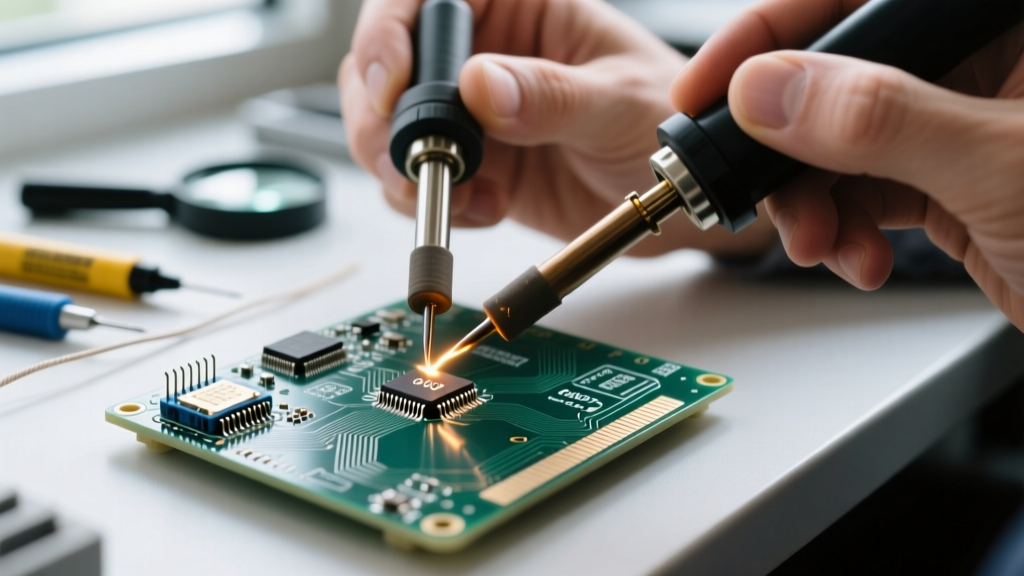
Drag soldering is the most efficient method for soldering SMD devices with gull-wing leads, such as QFP and SOP packages with pitches down to 0.5mm. The secret is not in the solder, but in the flux and the tip geometry.
- Prep the Pads: Apply a thin, even layer of Amtech gel flux across all pads. Do not use liquid flux; it evaporates too quickly under the heat of a drag operation.
- Tack the Corners: Place the IC and tack two opposite corner pins using a standard 0.5mm chisel tip and minimal solder. Verify alignment under a digital microscope before proceeding.
- Select the Right Tip: Switch to a gull-wing or mini-wave tip (e.g., Hakko T18-JL02 or JBC C245-945). These tips feature a small recess that holds a controlled amount of molten solder via capillary action.
- The Drag Motion: Load the tip with a tiny amount of fresh solder. Set your station to 340°C (for leaded). Tilt the PCB at a 15-degree angle. Start at one end of the pin row and drag the tip smoothly across the leads. Gravity and surface tension will pull the solder off the tip and onto the fluxed pads.
- Wick the Excess: Inevitably, the last few pins will bridge. Apply a fresh dab of flux, lay a high-quality desoldering braid (like Goot Wick CP-301W) over the bridged pins, and gently press with a clean chisel tip. The braid will absorb the excess solder, leaving perfectly distinct joints.
"According to the IPC standards for acceptability of electronic assemblies, a proper drag-soldered joint must exhibit a smooth, concave fillet with visible wetting to both the component lead and the PCB pad, without any evidence of lifting or dewetting."
Conquering 0402 and 0201 Micro-Passives
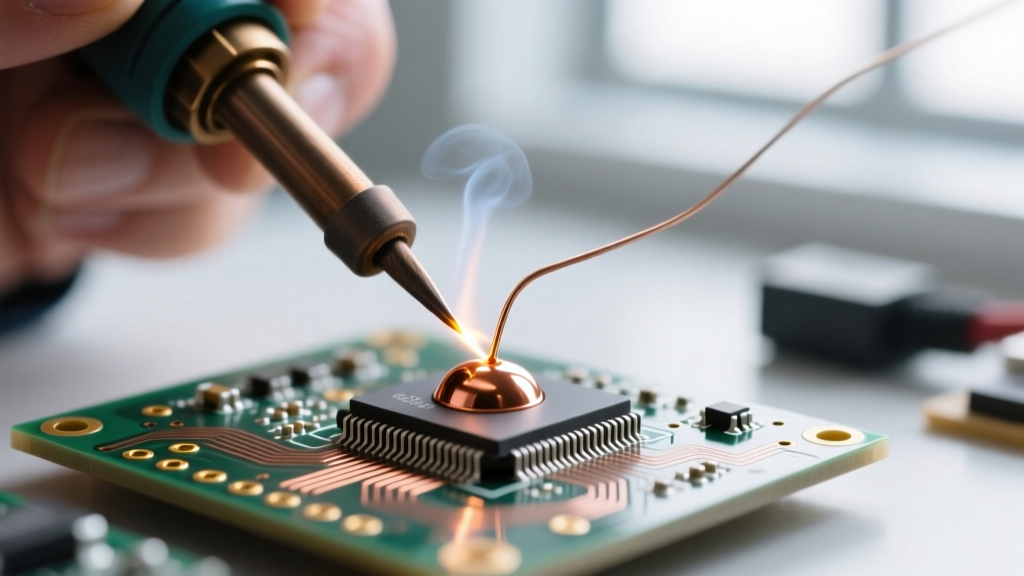
When soldering SMD devices at the 0201 scale (0.6mm x 0.3mm), traditional tweezers are often too bulky. Professionals use a specialized technique involving a dental pick or a vacuum pickup pen. Apply a microscopic dot of tacky flux to one pad using a syringe needle. Place the component using a fine tungsten probe. Touch your micro-pencil tip (pre-tinned with a microscopic bead of solder) to the fluxed pad and the component terminal simultaneously for exactly 0.5 to 1 second. Once tacked, inspect the alignment. If true, apply a minuscule amount of 0.3mm solder wire to the opposite pad. The thermal mass of a 0201 component is so low that excessive heat will instantly vaporize the flux core, leading to a dry joint.
Thermal Profiling: Leaded vs. Lead-Free Alloys
Temperature optimization is non-negotiable. The NASA Electronic Parts and Packaging (NEPP) program extensively documents the thermal degradation risks associated with improper profiling in aerospace-grade SMT assemblies. On the bench, you must adapt your station's temperature to the specific alloy's liquidus point, plus an offset for thermal transfer inefficiency.
- Sn63/Pb37 (Leaded Eutectic): Melts at 183°C. Set your iron to 320°C - 340°C. This provides enough delta-T to melt the solder rapidly without lingering on the pad and risking intermetallic compound (IMC) overgrowth, which makes joints brittle.
- SAC305 (Lead-Free): Melts at 217°C. Set your iron to 360°C - 380°C. Lead-free solder has poor wetting characteristics compared to leaded. You must use a high-activity flux (like ROL1) and a tip with a specialized lead-free coating (such as JBC's LF series) to prevent rapid tip oxidation and pitting.
Troubleshooting Common SMD Failure Modes
Even seasoned engineers encounter defects. Identifying the root cause is the first step to remediation. Consult the JBC soldering tip selection guides to ensure your tip geometry isn't contributing to these issues.
| Defect | Root Cause Analysis | Professional Remediation |
|---|---|---|
| Tombstoning | Uneven heating of the two pads, causing one side to reflow first and pull the component upright via surface tension. | Ensure thermal relief on ground-plane connected pads. Use a PCB preheater set to 100°C to minimize the thermal gradient across the board. |
| Solder Bridging | Excessive solder volume, insufficient flux, or dragging too slowly during fine-pitch operations. | Do not panic. Add fresh gel flux over the bridge. Use a 2mm flat desoldering wick to absorb the excess. Never scrape with the iron tip. |
| Pad Lifting | Excessive dwell time (iron on pad for >3 seconds) or using mechanical force to remove a component while solder is semi-solid. | Use a hot air station at 300°C with low airflow to lift the part evenly. If the pad is lifted, repair using epoxy and jumper wires per IPC-7711/7721 standards. |
| Dewetting | Oxidized pads, contaminated surfaces, or exhausted flux core in the solder wire. | Clean pads with 99% isopropyl alcohol (IPA) and a lint-free swab. Apply aggressive RA (Rosin Activated) flux, re-tin the pads, and clean again before placing the SMD. |
Inspection and Quality Control
You cannot improve what you cannot see. Relying on the naked eye or a cheap magnifying glass is unacceptable for modern SMD rework. Invest in a high-quality digital microscope, such as the Andonstar AD409 Pro (approx. $250) or a traditional trinocular stereo microscope (e.g., AmScope SM-4TZ at approx. $400). Inspect every joint for the 'concave fillet' rule. A joint that looks like a convex ball of solder is a cold joint or suffers from too much volume; it must be wicked and redone. By integrating these professional techniques, precise thermal management, and rigorous inspection protocols, soldering SMD devices by hand transitions from a frustrating chore into a highly reliable, repeatable engineering process.