
The Metallurgical Barrier: Why Soldering Aluminium Fails
If you have ever attempted to join aluminium wire to a copper PCB pad or repair an aluminium chassis, you likely watched your solder bead up and roll right off the surface. Soldering aluminium is notoriously frustrating for DIYers and professionals alike, primarily due to a hidden metallurgical barrier. Unlike copper or brass, aluminium reacts with oxygen almost instantaneously upon exposure to air, forming a microscopic but incredibly resilient shell of aluminum oxide (Al₂O₃).
The Aluminum Oxide (Al₂O₃) Paradox
To understand why your joints fail, you must look at the thermal properties of the materials involved. Base aluminium melts at roughly 660°C (1,220°F). However, the aluminum oxide layer that coats it melts at an astonishing 2,072°C (3,762°F). Standard electronics solder (like Sn60/Pb40) melts at a mere 188°C (370°F). When you apply a soldering iron, the solder melts, but the oxide shell remains entirely solid. The liquid solder is essentially trapped against a ceramic-like barrier, preventing the metallurgical wetting required for a true electrical and mechanical bond.
Furthermore, aluminium possesses a thermal conductivity of approximately 237 W/m·K—nearly five times higher than stainless steel. This means heat is rapidly wicked away from your joint into the surrounding metal, resulting in cold joints if your iron lacks the thermal mass to compensate. According to joining guidelines published by Lincoln Electric, overcoming this thermal sink and the oxide layer requires specialized chemical fluxes, mechanical abrasion, or acoustic disruption.
Troubleshooting Matrix: Diagnosing Your Failed Joints
Before discarding your workpiece, diagnose the specific failure mode. Use the matrix below to identify why your soldering aluminium attempt failed and how to correct it on the next pass.
| Symptom | Root Cause | Corrective Action |
|---|---|---|
| Solder balls up and rolls off | Intact Al₂O₃ oxide layer preventing wetting. | Apply specialized ZnCl₂ or fluoroaluminate flux; use mechanical abrasion under the molten pool. |
| Joint crumbles when cooled | Gallium embrittlement or incorrect alloy phase. | Avoid gallium-based pastes on structural parts; switch to Sn95/Ag5 or specialized Al solder wire. |
| Iron tip pits and corrodes | Acid flux creep on the copper/plated tip. | Use a dedicated sacrificial tip; clean with brass wool immediately after use; never leave flux on the iron. |
| Solder solidifies before wetting | Thermal mass sinking heat faster than iron can supply. | Upgrade to an 80W+ station; use a heavy chisel tip (e.g., Hakko T18-D32); pre-heat the workpiece. |
| Wetting occurs, but joint is high-resistance | Flux residue trapped in the joint matrix. | Scrub with isopropyl alcohol and a stiff brush; ensure proper flux activation temperatures were reached. |
Specialized Fluxes and Alloys: What Actually Works?
Standard rosin (RMA) flux is entirely useless for aluminium. Rosin is designed to dissolve mild copper oxides at low temperatures. To breach the aluminum oxide layer, you need highly active, corrosive fluxes or advanced mechanical methods.
⚠️ Safety Warning: Zinc chloride and fluoroaluminate fluxes release highly corrosive and toxic fumes when heated. Always solder aluminium in a well-ventilated area using a fume extractor with an activated carbon filter. Wear safety glasses to prevent flux spatter from reaching your eyes.
- Zinc Chloride Liquid Flux: The traditional chemical method. It aggressively etches the oxide layer but leaves a highly corrosive residue that must be neutralized and washed with hot water and a baking soda solution immediately after soldering.
- Novacan Tix Flux & Alusol Wire: Specialized commercial products designed specifically for aluminium. These contain proprietary fluoroaluminate compounds that break down oxides at lower temperatures (around 250°C) without the extreme corrosiveness of raw zinc chloride.
- Super Alloy 1: A popular multi-metal flux-coated rod. While excellent for pot metal and thick aluminium castings, it requires a propane or MAPP gas torch (reaching ~350°C) rather than a standard electronics soldering iron.
- Sn95/Ag5 (Tin/Silver) Alloy: When paired with the correct aluminium flux, a 95% Tin / 5% Silver alloy provides a much stronger mechanical bond and higher melting point (221°C) than standard leaded solders, making it ideal for high-vibration environments.
Step-by-Step Recovery: Fixing a Cold or Brittle Joint
If you have an existing aluminium joint that is brittle, high-resistance, or visually deformed, follow this recovery protocol to salvage the connection:
- Desolder and Clean: Use a high-wattage desoldering braid (copper wick) soaked in standard rosin flux to remove the old, failed solder. The rosin won't bond to the aluminium, but it will lift the old tin/silver alloy.
- Mechanical Preparation: Abrade the aluminium surface with 400-grit sandpaper or a fiberglass scratch pen to remove heavy corrosion. Do this immediately before applying flux.
- Apply Specialized Flux: Coat the abraded area with your chosen aluminium flux (e.g., Novacan Tix).
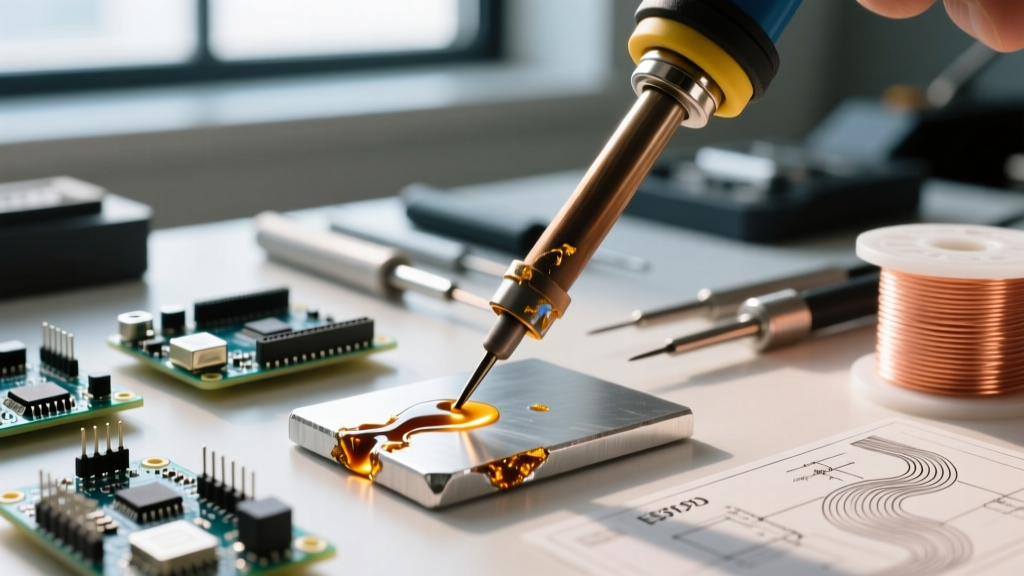
- The Scratch Technique: Apply your iron (set to 350°C with a heavy chisel tip) and feed the solder. While the solder is molten, take a stainless steel wire brush or a fiberglass pen and scratch the aluminium surface through the liquid solder pool. The liquid solder acts as a sealant, preventing oxygen from reaching the metal while you mechanically shatter the oxide layer beneath.
- Neutralize: Once the joint cools, scrub the area with a baking soda and water solution to neutralize the acidic flux, followed by an isopropyl alcohol rinse.
Advanced Alternative: Ultrasonic Soldering in 2026
As of 2026, ultrasonic soldering technology has become highly accessible for advanced DIYers and specialized repair shops. Ultrasonic soldering irons feature a transducer built into the tip that vibrates at high frequencies (typically 20kHz to 60kHz). This acoustic cavitation literally shatters the aluminum oxide layer at a microscopic level while the solder is in its liquid state, allowing the molten alloy to wet the bare aluminium instantly. The American Welding Society (AWS) recognizes ultrasonic soldering as a premier method for joining sensitive components where chemical fluxes cannot be tolerated, such as in aerospace or medical electronics. While an entry-level ultrasonic iron costs between $150 and $300, it entirely eliminates the need for corrosive chemicals and post-solder cleaning.
Frequently Asked Questions (FAQ)
Can I use standard plumbing solder on aluminium?
No. Plumbing solder (often Sn95/Sb5 or Sn/Ag) is designed for copper pipes. More importantly, the flux core inside plumbing solder is formulated for copper oxides, not aluminum oxide. Furthermore, plumbing fluxes (like Tinning Flux) contain petroleum jelly and zinc chloride blends that will not activate properly at the thermal mass of thick aluminium, leading to guaranteed joint failure and severe corrosion over time.
Does ultrasonic soldering completely eliminate the need for flux?
Yes, in most cases. The acoustic cavitation disrupts the oxide layer faster than it can reform, allowing bare solder to wet the metal. However, for heavily oxidized or dirty cast aluminium, a mild pre-clean or a drop of specialized flux is still recommended to ensure optimal capillary action. Data from the NASA Technical Reports Server (NTRS) on spacecraft electronics manufacturing frequently highlights fluxless ultrasonic soldering as a critical method for preventing outgassing in vacuum environments.
Why did my soldering iron tip turn black and pit after one use?
Aluminium fluxes are highly acidic and will eat through the iron plating on standard soldering tips. If you are using zinc chloride or aggressive fluoroaluminate fluxes, you should dedicate a specific, inexpensive chisel tip solely for aluminium work. After the joint is complete, immediately wipe the tip on damp brass wool and re-tin it with standard leaded solder to protect the iron core from corrosion.
Is brazing better than soldering for aluminium structural repairs?
For load-bearing structural repairs (like bicycle frames or automotive brackets), yes. Brazing utilizes Zn/Al alloys that melt around 380°C (716°F), requiring a torch but yielding a joint strength that approaches the base metal. However, for PCB repairs, wire splicing, or electrical connections, low-temperature soldering with Sn/Ag alloys and specialized flux is mandatory to prevent melting the surrounding insulation or delaminating circuit boards.