
Why T12 Cartridge Tips Dominate the Workbench in 2026
If you are building your first serious electronics workbench in 2026, the legacy ceramic heater soldering irons of the past decade are no longer the standard. The industry and hobbyist gold standard has decisively shifted to T12 soldering tips. Originally popularized by Hakko's professional FX-951 station, the T12 cartridge format has been widely adopted by open-source and smart soldering stations, making professional-grade thermal recovery accessible to beginners.
Unlike older soldering irons where the heating element and the tip are separate components, T12 tips integrate the heater, the temperature sensor (thermocouple), and the soldering surface into a single, unified cartridge. This results in heat-up times of under 10 seconds and near-instantaneous thermal recovery when touching large copper ground planes.
Expert Insight: The closed-loop PID temperature control enabled by the integrated thermocouple in T12 tips means the station can detect a temperature drop the millisecond the tip touches a cold component, pushing maximum wattage to the heater instantly. This prevents the 'cold solder joint' failures common in beginner projects.
The Anatomy of a T12 Tip: What Makes Them Different?
Before buying your first set, it is crucial to understand the physical architecture of a T12 cartridge. At the base of the tip, you will find a 4-pin connector:
- Pins 1 & 4: Power the internal ceramic heating element.
- Pins 2 & 3: Connect to the internal thermocouple for real-time temperature feedback.
Because the sensor is located millimeters from the very point of the tip, the temperature reading is incredibly accurate. According to IPC J-STD-001 soldering standards, maintaining precise thermal profiles is critical for preventing thermal damage to sensitive SMD components and ensuring proper intermetallic compound (IMC) formation in the solder joint.
The 4 Essential T12 Tip Shapes for Beginners
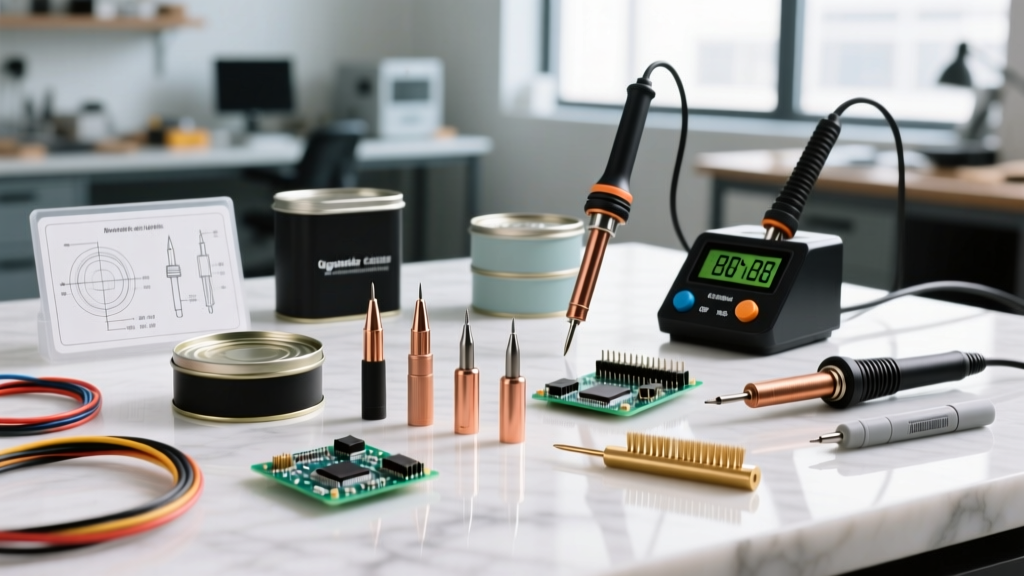
Walking into a digital soldering supply store can be overwhelming, as there are hundreds of T12 tip variations. For a beginner tackling through-hole components, basic SMD (Surface Mount Device) work, and wire tinning, you only need four specific shapes.
1. T12-D24 (Chisel Tip)
The D24 is the ultimate workhorse. Featuring a 2.4mm flat chisel edge, it provides an excellent balance between precision and thermal mass. Best for: Tinning 22AWG to 18AWG wires, soldering standard through-hole resistors and capacitors, and soldering larger SMD pads like 1206 or 0805 footprints. Pro Tip: Use the flat face for maximum heat transfer on thick wires, and the sharp edge for precision alignment on PCB pads.
2. T12-BC2 (Bevel / Hoof Tip)
The BC2 features a 2mm angled, scooped face. This concave shape naturally holds a small pool of molten solder, making it incredibly forgiving for beginners. Best for: Drag soldering SOIC and SOP integrated circuits, and reworking through-hole joints where you need to gather excess solder away from the pad.
3. T12-K (Knife Tip)
Shaped like a literal knife blade, the K tip offers multiple working edges in one cartridge. Best for: Cleaning up solder bridges between tight IC pins (using the sharp point), and applying heat to large surface areas using the flat side of the blade. It is highly versatile but requires a slightly lighter touch to avoid gouging delicate PCB pads.
4. T12-JL02 (Bent Mini-Wave)
This specialized tip features a steep bend ending in a tiny, scooped wave profile. Best for: Reworking tight spaces where the iron handle would otherwise bump into tall components like electrolytic capacitors or USB connectors. It is a favorite for drone repair and dense microcontroller boards.
Genuine Hakko vs. Third-Party Clones: 2026 Market Data
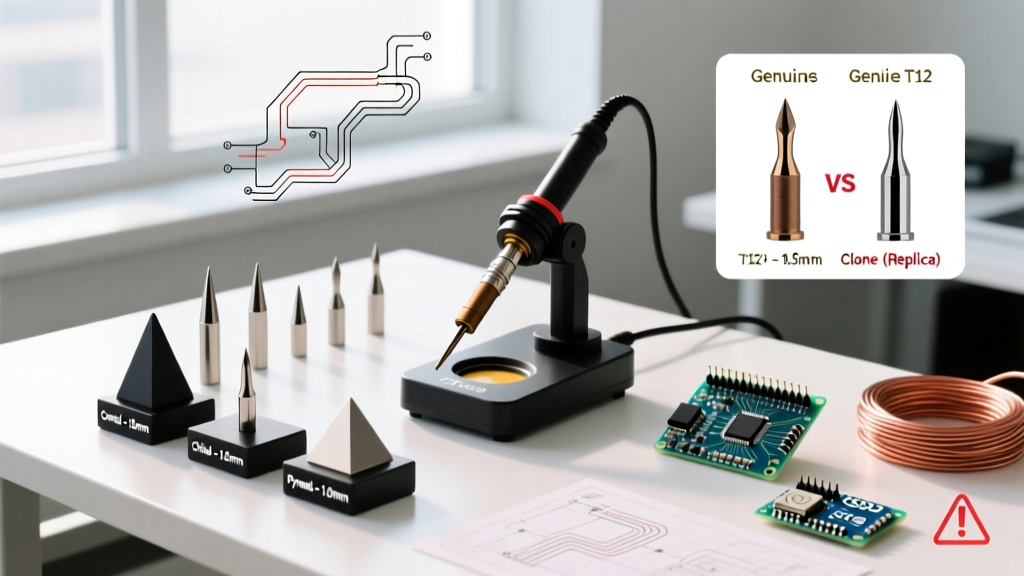
The T12 patent landscape has evolved, leading to a massive market of third-party 'clone' tips from brands like KSGER, Quicko, and generic AliExpress sellers. While genuine Hakko tips remain the benchmark for longevity, premium clones have closed the gap significantly for hobbyist use. Below is a comparative breakdown based on current 2026 market testing.
| Feature | Genuine Hakko T12 | Premium Clones (KSGER/Quicko) | Budget Unbranded Clones |
|---|---|---|---|
| Average Price (USD) | $28.00 - $35.00 | $5.00 - $9.00 | $1.50 - $3.00 |
| Heat-Up Time (to 350°C) | 6 - 8 Seconds | 8 - 12 Seconds | 15 - 25 Seconds |
| Iron Plating Thickness |