
The Big Box Store Dilemma: Pre-Packaged vs. Custom Kits
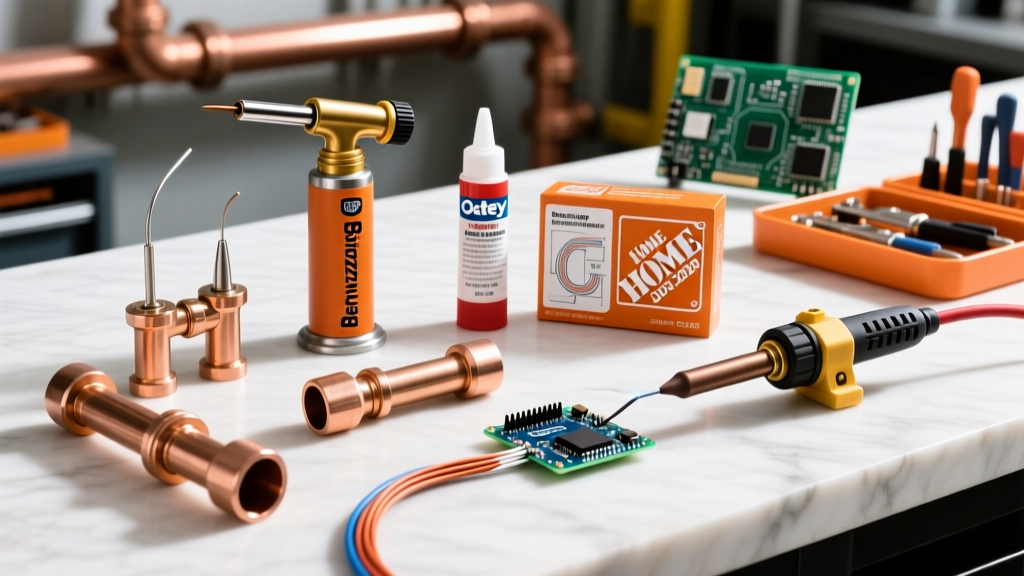
Walking into the plumbing aisle to find a reliable copper pipe soldering kit Home Depot stock can be overwhelming for beginners and frustrating for seasoned pros. The big-box retailer primarily carries consumer-grade, pre-packaged blister kits alongside professional loose components. In 2026, the pre-packaged 'starter kits'—often bundling a low-tier butane torch with acidic flux—are fundamentally unsuited for modern potable water plumbing. To achieve code-compliant, leak-free sweat joints, you must ignore the all-in-one blister packs and build a custom kit from the individual SKUs available on the shelves. This guide breaks down the exact torches, fuels, fluxes, and solders you need to pull from Home Depot's inventory to assemble a professional-grade copper soldering rig.
Torch Head & Cylinder Breakdown: Bernzomatic Dominance
Home Depot's torch inventory is heavily dominated by the Bernzomatic brand. When selecting a torch head for copper pipe soldering, the critical metric is not just maximum temperature, but thermal transfer rate and flame envelope. You need a torch that can heat a 3/4-inch or 1-inch copper fitting to 450°F before the flux burns off.
Bernzomatic TS8000 High Heat (Model 3479438)
Priced between $85 and $95 in 2026, the TS8000 is the undisputed champion of the Home Depot plumbing aisle. It features an instant-on trigger ignition and a swirl flame design that wraps around the copper fitting, providing even heat distribution. When paired with a yellow MAP-Pro cylinder, the TS8000 reaches a maximum flame temperature of 3,730°F. More importantly, its high BTU output allows you to sweat a 1/2-inch joint in roughly 5 to 8 seconds, drastically reducing the risk of 'flux burnout'—a common failure mode where the flux oxidizes before the solder melts.
Bernzomatic TS4000 (Model 345049)
Retailing for about $55 to $65, the TS4000 is a step down. It uses a standard trigger start and a pencil-point flame rather than a swirl flame. While adequate for 1/2-inch pipes in tight spaces, the TS4000 struggles to maintain the thermal mass required for 3/4-inch and 1-inch copper lines, often leading to cold joints where the solder fails to fully penetrate the capillary space.
The Fuel Debate: MAP-Pro vs. Propane
Never buy the green propane cylinders for soldering copper. Propane burns at roughly 3,600°F and lacks the aggressive thermal transfer needed for plumbing. Always select the yellow MAP-Pro (propylene) cylinders. The extra $8 per cylinder is a non-negotiable investment for professional results.
The Consumables: Oatey Flux and Solder Options
The second half of your copper pipe soldering kit Home Depot build relies on the Oatey brand, which holds a near-monopoly on the retailer's flux and solder shelves.
Flux: Oatey No. 5 Paste Flux (Model 30134)
For standard residential potable water lines, Oatey No. 5 is a water-soluble, petroleum-free paste flux. It cleans the copper at lower temperatures and flushes out easily once the system is pressurized. Avoid Oatey's tinning fluxes (which contain powdered solder) for standard sweat joints; they are overkill for beginners and can cause bridging that masks incomplete capillary draw.
Solder: 95/5 vs. Silver-Bearing
Home Depot stocks two primary lead-free options for potable water:
- Oatey Safe Flo 95/5 (Model 31114): Composed of 95% tin and 5% antimony. It melts at 452°F and is the standard for 90% of residential copper sweating. Priced around $22 for a 1/2 lb spool.
- Oatey Silver-Bearing Lead-Free (Model 31124): Contains a trace amount of silver, lowering the melting point slightly to 433°F and improving flow characteristics. At $35 per spool, it is worth the upgrade for overhead soldering or tight joist bays where heat control is difficult.
Expert Warning: Never use 50/50 solder (tin/lead or tin/copper blends not rated for potable water) on domestic water lines. Even if it is labeled 'lead-free', 50/50 alloys lack the structural integrity to handle the thermal expansion and water hammer pressures of modern residential plumbing systems.
2026 Comparison Matrix: Home Depot Copper Soldering Gear
| Component | Model / SKU | 2026 Price Range | Best Application | Pro Verdict |
|---|---|---|---|---|
| Torch Head | Bernzomatic TS8000 | $85 - $95 | 1/2' to 1' Copper Lines | Essential. Swirl flame prevents cold joints. |
| Torch Head | Bernzomatic TS4000 | $55 - $65 | 1/2' Lines, Tight Spaces | Avoid for main lines. Pencil flame is too slow. |
| Fuel Cylinder | Bernzomatic MAP-Pro | $14 - $18 | All Copper Sweating | Mandatory. Propane lacks BTU output. |
| Flux | Oatey No. 5 Paste | $6 - $8 | Potable Water Lines | Water-soluble, easy cleanup, code-compliant. |
| Solder | Oatey Safe Flo 95/5 | $20 - $25 | Standard Residential | Industry standard. Reliable capillary draw. |
| Abrasive | Oatey #120 Emery Cloth | $4 - $6 | Surface Preparation | Superior to wire brushes for deep oxidation. |
Pro-Level Execution: Overcoming Big Box Kit Limitations
Having the right gear from Home Depot is only 40% of the equation. The remaining 60% relies on metallurgical preparation and thermal management. Here is the exact workflow to ensure your custom kit performs flawlessly.
Step 1: Precision Abrasion (The 0.004-Inch Rule)
Copper sweat fittings rely on capillary action, which requires a joint clearance of exactly 0.004 to 0.006 inches. If you use a standard wire brush attached to a drill, you risk removing too much material, widening the gap, and destroying the capillary draw. Instead, use the Oatey #120 grit emery cloth sold in the plumbing aisle. Wrap it around the pipe end and twist by hand until the copper shines like a new penny. Wipe it with a clean, dry rag immediately to remove microscopic abrasive dust.
Step 2: Flux Application and Capillary Protection
Apply a thin, even layer of Oatey No. 5 flux to the outside of the pipe and the inside of the fitting. Less is more. Excess flux will boil and create steam pockets inside the joint when heated, leading to pinhole leaks. Assemble the joint and give it a slight 1/4-inch twist to spread the flux evenly and eliminate air pockets.
Step 3: Thermal Management and the 'Sweep' Technique
When using the TS8000 and MAP-Pro, do not hold the flame in one static spot. This will cause localized overheating, burning the flux and oxidizing the copper (turning it black). Instead, 'sweep' the flame back and forth across the fitting, focusing the heat on the fitting, not the pipe. The fitting has more mass and needs to reach the melting temperature of the solder (approx. 450°F) to draw the alloy in. Touch the solder to the opposite side of the joint from the flame. When the joint is hot enough, the solder will instantly flash and be sucked into the fitting via capillary action.
Safety, Code Compliance, and Ventilation
When soldering indoors, the vaporized flux and extreme heat pose significant hazards. The OSHA Hazard Communication Standard requires proper ventilation when working with chemical fluxes, as vaporized zinc chloride and rosin can cause severe respiratory irritation. Always use a localized exhaust fan or open cross-ventilation when sweating pipes inside wall cavities.
Furthermore, all solder and flux used on domestic water lines must comply with the Safe Drinking Water Act. The EPA National Primary Drinking Water Regulations strictly mandate the use of lead-free materials. Ensure every spool of solder and tub of flux you pull from the Home Depot shelf explicitly states 'NSF/ANSI 61' compliance. The NSF/ANSI 61 standard certifies that the materials will not leach harmful contaminants into the drinking water supply over the lifespan of the plumbing system.
Final Verdict: What to Actually Put in Your Cart
If you are searching for a copper pipe soldering kit Home Depot setup that will yield professional, inspector-approved results, bypass the pre-packaged consumer kits. Put the Bernzomatic TS8000 torch head, two yellow MAP-Pro cylinders, Oatey No. 5 paste flux, Oatey 95/5 Safe Flo solder, and a roll of #120 emery cloth in your cart. This custom assembly, totaling roughly $140 to $160 in 2026, provides the thermal dynamics and metallurgical reliability required to solder copper plumbing with absolute confidence.