
The Hidden Bottleneck in Your Soldering Kit
Every electronics hobbyist and professional technician has experienced the same frustrating rite of passage: unboxing a brand-new, highly-rated soldering station, plugging it in, and immediately struggling to make a decent joint on a simple 0.1-inch header. The culprit is rarely the heating element or the station's wattage. The bottleneck is almost always the default accessory included in the box. Most starter kits ship with a basic conical (pointed) tip, which is notoriously ineffective for 90% of general-purpose through-hole and surface-mount work.
Understanding the geometry, thermal mass, and application-specific use cases of different soldering tip types is the single most cost-effective upgrade you can make to your workspace. In this comprehensive kit review and comparison, we will dissect the core tip geometries, evaluate the replacement ecosystems of the three most popular 2026 soldering kits (Hakko, Weller, and Pine64), and identify the exact accessories you need to eliminate cold joints and pad lifting.
Anatomy of Thermal Transfer: Why Geometry Matters
Before comparing specific kits, we must understand the physics of a soldering tip. A high-quality tip consists of a high-conductivity copper core, plated with a layer of iron (typically 70 to 100 microns thick) to resist solder erosion, followed by a chromium layer to prevent solder creep, and finally a tinned working surface.
Thermal transfer is strictly a function of surface area contact and thermal mass. According to the solder joint acceptance criteria outlined by IPC (Association Connecting Electronics Industries), a proper through-hole solder joint requires a smooth, concave fillet with complete wetting. Achieving this requires the tip to transfer enough heat to both the component lead and the PCB pad simultaneously to reach the solder's liquidus temperature (typically 217°C for SAC305 lead-free alloys) within 2 to 3 seconds. If your tip geometry limits contact to a microscopic point, the thermal transfer rate plummets, forcing you to increase dwell time, which leads to pad delamination and flux burnout.
The Core Soldering Tip Types Matrix
| Tip Geometry | Common Designators | Best Application | Worst Application | Thermal Transfer Profile |
|---|---|---|---|---|
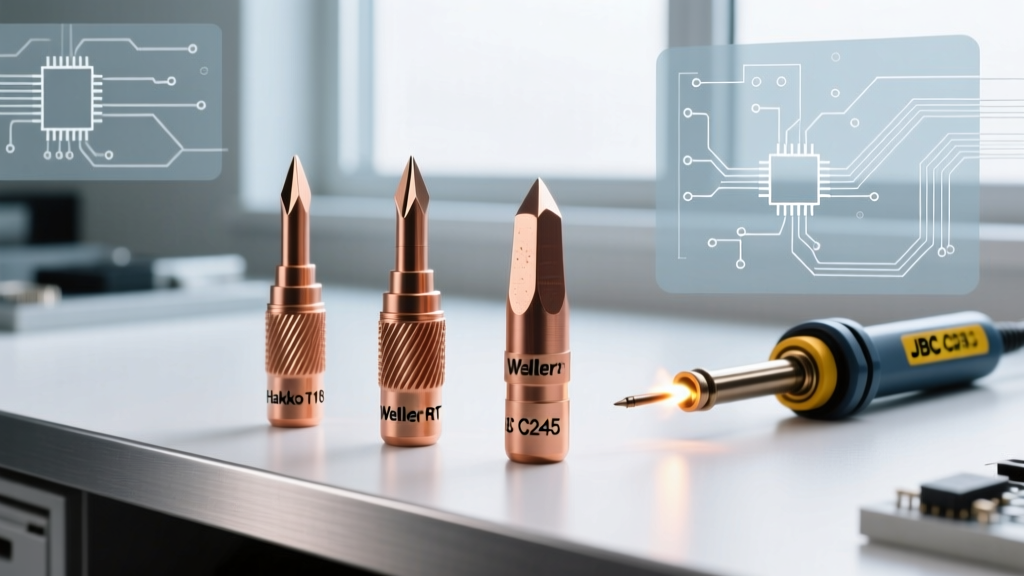
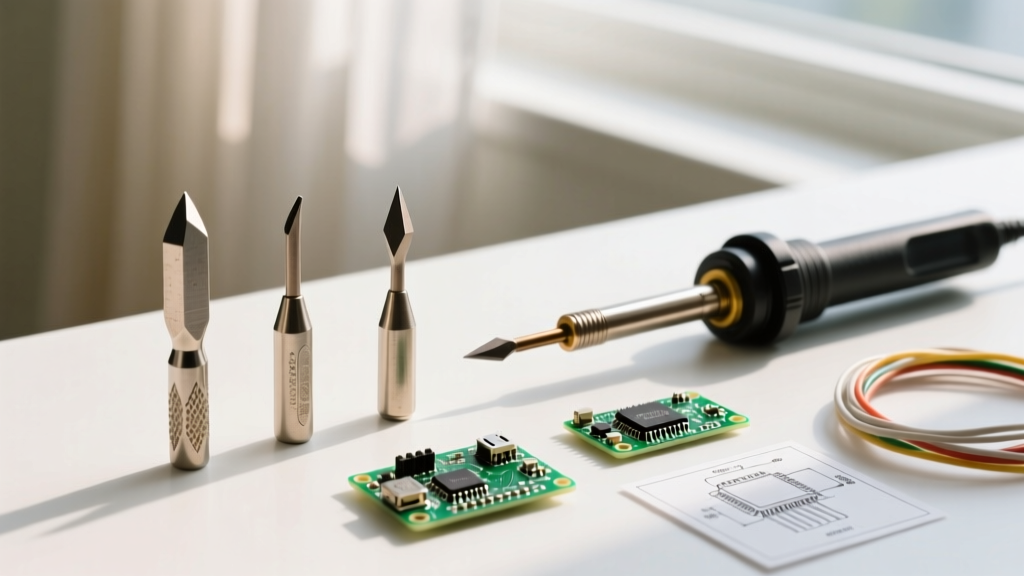
| Chisel (D-Series) | T18-D24, ETA, TS-D24 | General through-hole, 0805/0603 SMD, wire tinning | Ultra-fine pitch QFP, tight clearance areas | High surface area, excellent thermal recovery |
| Conical (B-Series) | T18-B, TS-B2, ETB | Very tight spaces, specific 1206 SMD touch-ups | Standard through-hole, ground planes, thick wires | Extremely low contact area, poor thermal mass |
| Bevel / Hoof (C-Series) | T18-C2, TS-C4, ETC | Drag soldering, SMD rework, pre-tinning pads | Precision 0402 placement, tight DIP pins | Directional heat, holds molten solder in the 'hoof' |
| Knife (K-Series) | T18-K, TS-K, ETK | 0402/0201 micro-SMD, QFP drag soldering, scraping | Heavy gauge wire termination, large ground vias | Edge-focused heat, highly maneuverable |
| Mini-Wave (J/L-Series) | T18-J02, TS-J02 | Dense SOIC/SOP drag soldering, tight pitch ICs | General purpose through-hole | Concentrated curved edge, excellent for capillary action |
Kit Ecosystem Review: Hakko vs. Weller vs. Pinecil
When investing in a soldering kit, the cost of the base station is only half the equation. The true cost of ownership lies in the replacement tip ecosystem. Let us compare the 'Big Three' kits on the market based strictly on their included tip types and the versatility of their accessory lineups.
1. Hakko FX-888D (T18 Series Ecosystem)
The Hakko FX-888D remains a benchmark in professional and prosumer labs, retailing around $110. However, it ships with the T18-B (Conical) tip. As established, this is a poor choice for general kit building. To make this station viable for 95% of DIY electronics, you must immediately purchase the T18-D24 (2.4mm Chisel) and the T18-C2 (2mm Bevel).
Pros: Genuine Hakko USA T18 tips feature exceptional iron plating longevity, often lasting years if properly tinned. The 2.4mm chisel perfectly bridges standard 0.1-inch header pins and 0805 SMD pads.
Cons: Genuine replacements are expensive (approximately $8.50 to $9.50 per tip in 2026). The T18 series lacks specialized micro-wave tips for ultra-fine pitch rework compared to newer cartridge systems.
2. Weller WE1010NA (ET Series Ecosystem)
Weller's 70W station (approx. $105) takes a slightly better out-of-the-box approach by including the ETA (0.8mm Chisel/Screwdriver) tip. This narrow chisel is phenomenal for precision 0603 SMD work and standard DIP ICs, offering a much better initial experience than Hakko's conical default. However, the 0.8mm width lacks the thermal mass required for heavy ground planes or 14AWG silicone wire.
Pros: The ET series is robust, and the ETA tip is a highly versatile 'daily driver' for micro-electronics. Weller's thermal recovery algorithms paired with the chisel geometry yield excellent results.
Cons: The ET tips are physically smaller and hold less thermal mass than Hakko's T18. For heavy-duty wiring (e.g., XT60 connectors or 10AWG battery leads), you must upgrade to the ELL (large chisel) or seek an entirely different heavy-duty station, as the 70W heater will struggle to maintain temperature even with maximum tip mass.
3. Pine64 Pinecil V2 (Pine64 / T12 Clone Ecosystem)
The Pinecil V2 has disrupted the market by offering a 65W PD-powered smart iron for roughly $26. It ships with the TS-B2 (Conical), but because it uses the ubiquitous T12 cartridge form factor, the third-party accessory market is virtually limitless and incredibly cheap ($2 to $4 per tip).
Pros: You can build a complete 10-tip arsenal (Chisel, Bevel, Knife, Mini-Wave) for under $30. The TS-C4 (Mini-Wave/Hoof) and TS-K (Knife) accessories transform this cheap iron into a drag-soldering powerhouse for QFP-48 microcontrollers.
Cons: Quality control on third-party T12 clones varies wildly. Copper cores can be off-center, and iron plating may degrade within months if exposed to high-temperature lead-free solder (350°C+). For mission-critical lab work, genuine Hakko T12 tips (approx. $25 each) are required, negating the budget advantage.
Real-World Edge Cases and Thermal Failure Modes
Selecting the wrong soldering tip type does not just make the process annoying; it introduces specific, documented failure modes. The NASA Electronic Parts and Packaging (NEPP) Program workmanship standards heavily emphasize thermal control to prevent latent defects. Here are the most common edge cases encountered in the DIY lab:
- The Ground Plane Cold Joint: Attempting to solder a capacitor to a large copper ground pour using a 1.2mm Chisel. The PCB acts as a massive heatsink, drawing heat away faster than the tip can replenish it. The solder forms a dull, grainy, convex ball (a cold joint). Solution: Switch to a 3.2mm or 4.0mm Chisel/Bevel tip to maximize thermal mass contact, and pre-heat the board if possible.
- SMD Tombstoning: Using a wide 2.4mm Chisel to solder a tiny 0402 resistor. The wide tip contacts both pads simultaneously but with uneven pressure, causing one side of the solder to reflow faster and pull the component upright (tombstoning). Solution: Use a 0.8mm Chisel or a Knife (K-Series) tip to heat one pad at a time, placing the component with tweezers before flowing the second pad.
- Flux Burnout and Bridging: Using a dry Conical tip for drag-soldering an SOIC-8 chip. The lack of surface area prevents the tip from holding a molten solder bead and flux reservoir, resulting in dry friction, oxidized solder, and massive pin bridging. Solution: Use a Bevel/Hoof (C-Series) or Mini-Wave tip, which acts as a spoon to carry molten solder and liquid flux across the pins via capillary action.
The Ultimate 3-Tip 'Must-Have' Bundle
If your current kit only includes a single conical tip, do not throw the station away. Instead, invest $25 to $30 into this specific three-tip bundle, which will cover 99% of all electronics repair, DIY wiring, and PCB assembly tasks:
- The Daily Driver (2.0mm - 2.4mm Chisel): For 90% of your work, including through-hole resistors, capacitors, DIP ICs, and 0805/0603 SMD. The flat edge allows you to use the very tip for precision work and the flat side for rapid heat transfer.
- The Heavy Lifter (3.2mm+ Chisel or Large Bevel): Reserved exclusively for thick wires (12AWG to 18AWG), large power connectors (XT60, Anderson Powerpole), and grounding lugs. The massive thermal mass prevents the iron's temperature from cratering upon contact.
- The Precision Reworker (Knife or Mini-Wave): Essential for drag-soldering multi-pin SMD chips, cleaning up solder bridges with wick, and working in tight corners where a standard chisel's width would bridge adjacent pads.
Pro-Tip for Tip Longevity: The primary cause of iron plating degradation is oxidation. Never leave your station at 350°C while idle. More importantly, always apply a thick layer of fresh, flux-cored solder to the working surface of the tip immediately before turning the power off. This sacrificial layer oxidizes instead of the iron plating, and is simply wiped off on a brass sponge during the next startup.
Final Verdict: Stop Suffering with the Included Conical Tip
The world of soldering tip types is vast, but mastering just three or four geometries will fundamentally transform your craftsmanship. While the Hakko FX-888D and Weller WE1010NA offer superior long-term build quality and genuine tip longevity, the Pinecil V2 provides an unbeatable entry point for experimenting with advanced geometries like the Mini-Wave and Knife tips without a massive financial commitment.
Review your current project queue. If you are building drones and soldering 12AWG motor leads, prioritize high-mass Bevel tips. If you are modding retro game consoles and replacing 0402 capacitors, invest in a quality Knife tip. By treating your soldering tips as highly specialized, consumable cutting tools rather than generic heating sticks, you will achieve IPC-compliant joints, reduce component damage, and drastically accelerate your workflow.