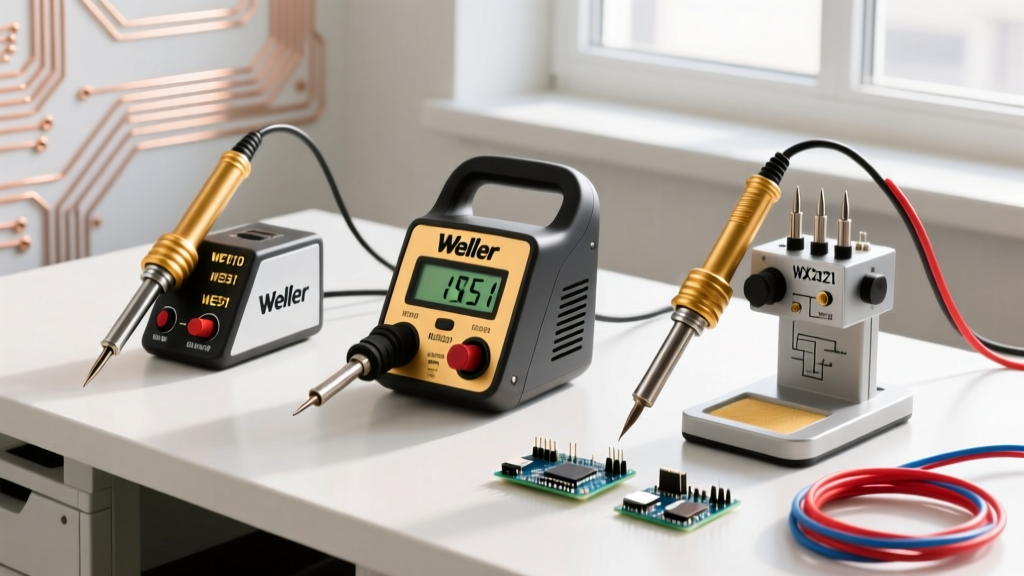

The Evolution of Weller Soldering Kits in 2026
When discussing professional and prosumer electronics workbenches, Weller soldering kits remain a dominant force. Backed by the Apex Tool Group, Weller has spent decades refining thermal recovery, tip metallurgy, and ergonomic handpiece design. However, the shift toward lead-free SAC305 (Tin-Silver-Copper) alloys and the miniaturization of components down to 01005 imperial sizes have drastically changed the requirements for a reliable soldering station. What worked for through-hole DIP chips in the 1990s will cause thermal starvation on modern multi-layer PCBs with heavy ground planes.
In this comprehensive tool-by-tool assessment, we dissect three distinct tiers of Weller soldering kits available in 2026: the legacy analog WES51, the modern digital WE1010NA, and the professional dual-channel WX2021. We will evaluate their heating architectures, tip ecosystems, and real-world failure modes to help you allocate your workshop budget effectively.
The Great Divide: Sleeve Tips vs. Active Cartridges
Before assessing individual stations, it is critical to understand the fundamental hardware split in Weller's lineup: Sleeve Tip Architecture versus Active Cartridge Architecture.
- Sleeve Tips (ET / ETA Series): Used in older or budget-friendly kits like the WES51 and WE1010. The heating element and thermocouple reside inside the handpiece wand. The copper tip is a hollow 'sleeve' that slides over the heater. This creates a microscopic air gap, resulting in slightly slower thermal transfer and a higher likelihood of oxidation-induced thermal degradation over time.
- Active Cartridges (RT / WX Series): Used in the premium WX and WT lines. The heater, thermocouple, and tip are integrated into a single, sealed solder cartridge. Because the sensor is located at the very apex of the tip, thermal response is nearly instantaneous, and the physical connection eliminates air gaps, maximizing wattage transfer to the joint.
Tool 1: Weller WES51 (The Analog Workhorse)
Despite being introduced decades ago, the Weller WES51 analog station is still sold and utilized in 2026. It operates at 50W and utilizes the PES51 iron with ET-series sleeve tips.
Performance and Quirks
The WES51 relies on a simple analog dial for temperature control, ranging from 175°C to 450°C. Its primary advantage is absolute simplicity; there are no digital menus, no firmware to corrupt, and no LCD screens to burn out. The triac-based zero-voltage switching prevents electrical spikes from damaging sensitive MOSFETs during the switching cycle.
However, its 50W output struggles heavily with modern lead-free solders on boards with internal copper pours. When attempting to solder a ground pad on a 4-layer PCB, the WES51 will often experience severe thermal droop, requiring the operator to dwell on the joint for 5 to 8 seconds. This prolonged dwell time increases the risk of pad delamination and flux burn-off, violating the rapid-heat-cycle guidelines outlined in the IPC J-STD-001 standard for high-reliability assemblies.
Verdict
At a street price of roughly $105, the WES51 is strictly recommended for hobbyists working exclusively with leaded 63/37 solder on single-layer through-hole kits. It is not viable for modern SMD rework.
Tool 2: Weller WE1010NA (The Digital Standard)
The WE1010NA represents Weller's modern entry-level digital offering, retailing around $115. It pushes 70W of power through the WSP80 iron, utilizing the newer ETA tip series. The 40% wattage increase over the WES51 is immediately noticeable during thermal recovery tests.
Feature Deep-Dive
The digital LCD and rotary encoder allow for precise 1°C temperature increments. More importantly, the WE1010NA includes a programmable auto-standby feature. If the iron is left in the WDH10 safety rest for a user-defined period (e.g., 300 seconds), the station drops the tip temperature to 150°C. This drastically reduces tip oxidation—a common failure mode where the iron-plated working surface of the ETA tip de-wets and turns black, rendering it useless.
Edge Cases and Limitations
While 70W is sufficient for 90% of DIY and light commercial SMD work, the sleeve-tip architecture of the WSP80 handpiece still introduces a thermal lag compared to cartridge systems. Furthermore, the plastic enclosure of the WE1010 power unit is lightweight and prone to sliding across the workbench if the silicone cord of the WSP80 iron catches on a heavy component reel. Users often need to affix the base with double-sided mounting tape.
Tool 3: Weller WX2021 (The Professional Powerhouse)
Stepping into the industrial tier, the Weller WX2021 is a 200W dual-channel station designed for high-volume manufacturing and complex micro-rework. Priced at approximately $650, it is a substantial investment that includes the WXMT micro-soldering tweezers and the WXP120 iron.
Mastering Micro-SMD with WXMT Tweezers
The inclusion of the WXMT tweezers is what justifies the WX2021's price tag for repair technicians. Utilizing RT pico cartridges, the WXMT allows operators to simultaneously heat both pads of 0402 and 0201 passive components. Because the RT cartridges feature integrated heating elements, the thermal mass of the tweezer tips is incredibly low, allowing for sub-second melt times on microscopic joints without transferring lethal heat to the fragile ceramic bodies of MLCC capacitors.
Power Delivery and Ecosystem
The 200W total capacity is dynamically distributed. If only one iron is active, it can draw maximum wattage for rapid thermal recovery on heavy ground planes. The station also features USB and Ethernet connectivity for logging temperature profiles, a requirement for aerospace and medical device manufacturers who must document thermal compliance for every soldered joint.
2026 Weller Soldering Kits Comparison Matrix
| Model | Max Power | Temp Range | Tip Architecture | 2026 Price | Best Application |
|---|---|---|---|---|---|
| WES51 | 50W | 175°C - 450°C | Sleeve (ET) | $105 | Through-hole, leaded hobby kits |
| WE1010NA | 70W | 200°C - 450°C | Sleeve (ETA) | $115 | General SMD, prosumer repair |
| WX2021 | 200W | 100°C - 450°C | Active Cartridge (RT) | $650 | Micro-BGA, 0201 passives, heavy planes |
Workspace Accessories and Safety Protocols
A Weller soldering kit is only as effective as the accessories supporting it. In 2026, flux fume extraction is no longer optional. The rosin and synthetic resins in modern solder wire emit volatile organic compounds (VOCs) and colophony when heated, which are known respiratory sensitizers. According to guidelines published by MIT Environment, Health & Safety, localized exhaust ventilation is mandatory to prevent occupational asthma and chronic respiratory irritation.
For the WE1010 and WX series, pairing the station with the Weller Zero Smog Guard or the inline Weller Zero Smog ELV tip extraction system is highly recommended. Furthermore, abandon the traditional wet cellulose sponge for tip cleaning. Wet sponges cause rapid thermal shock, micro-fracturing the iron plating on the tip and exposing the copper core to molten solder dissolution. Always use a dry brass wire wool pad (like the Weller WDC2) to preserve tip longevity.
Troubleshooting Common Weller Failure Modes
Even premium Weller soldering kits experience wear. Here is how to diagnose the most common bench issues:
- Erratic Temperature Readings (WES51/WE1010): If the digital display or analog dial behaves erratically, the issue is rarely the station base. It is almost always a degraded thermocouple connection inside the handpiece wand. The constant flexing of the silicone cord near the strain relief breaks the microscopic sensor wires. Replacing the PES51 or WSP80 iron wand resolves this 95% of the time.
- Tip De-wetting (All Models): If molten solder beads up and rolls off the tip rather than wetting it, the iron plating has oxidized. Never use sandpaper or a file to clean a Weller tip; you will expose the copper core, destroying it instantly. Instead, apply a generous blob of SAC305 solder and use a brass wool pad, or utilize a specialized tip tinner/activator paste to chemically reduce the oxidation layer.
- Cartridge Recognition Errors (WX Series): The WX stations use an RFID-like handshake to identify RT cartridges. If the station displays an 'E04' or tool error, the electrical contacts on the handpiece grip are likely fouled with carbonized flux residue. Wipe the metal contact rings on the wand with isopropyl alcohol (99%) and a lint-free swab to restore communication.
Final Assessment
Choosing among Weller soldering kits ultimately depends on your thermal demands and budget. The WES51 survives as a cheap, unkillable analog option for basic through-hole wiring. The WE1010NA is the undisputed king of the $100-$150 bracket, offering enough digital precision and 70W muscle for advanced hobbyists and independent repair techs. However, if your daily workflow involves high-density interconnects, micro-SMD components, or strict IPC-compliance documentation, the active-cartridge ecosystem of the WX2021 is a mandatory investment that pays for itself in reduced rework time and saved PCBs.