
For mobile electronics technicians, HVAC specialists, and automotive diagnosticians, the search for the ideal butane soldering kit power probe setup usually ends at a familiar crossroads. Do you invest $140 into the industry-standard Power Probe PPSK Master Kit, or do you save cash upfront by purchasing a $45 generic cordless butane iron from an online marketplace? In 2026, with the rising cost of field service calls and the increasing complexity of automotive wiring harnesses, the tool you carry in your bag directly impacts your bottom line and joint reliability.
This guide bypasses the marketing fluff and dives deep into the metallurgical, mechanical, and financial realities of budget versus premium butane soldering kits. We will examine catalytic heating elements, O-ring degradation, flux incineration, and the true five-year cost of ownership.
The Field Tech's Dilemma: A cold solder joint on a vehicle's CAN bus wiring harness can cause cascading module failures. According to IPC J-STD-001 soldering standards, proper wetting and thermal management are non-negotiable. Your heat source is the first point of failure.
The Engineering Divide: Catalytic vs. Open Flame
To understand the price gap between premium and budget kits, you must understand how they generate heat. They are fundamentally different technologies masquerading as the same tool.
Premium Technology: The Catalytic Heater
The Power Probe PPSK and similar high-end kits utilize a catalytic heating element. When butane gas passes through a platinum-coated ceramic mesh, it undergoes a flameless oxidation reaction. This generates intense, localized heat (up to 1050°F / 565°C at the tip) without an open flame. This is critical for field work: an open flame can easily blow away in a light breeze, scorch delicate wire insulation, or ignite nearby flammable vapors in an automotive engine bay.
Budget Technology: The Shrouded Micro-Torch
Most budget butane soldering irons (priced between $35 and $55) are essentially micro-torches with a copper shroud and a soldering tip shoved into the exhaust port. The butane burns as an open flame, heating the thick copper core of the tip. This design suffers from severe thermal lag, uneven heat distribution, and a high susceptibility to wind extinguishing the flame or blowing unburnt gas onto your workpiece.
Deconstructing the Power Probe PPSK Master Kit
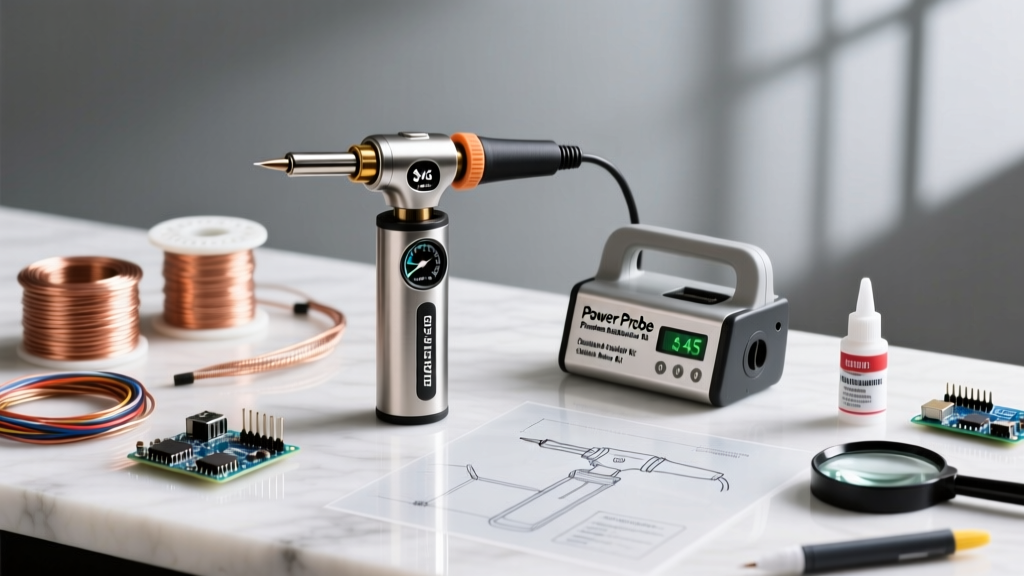
Retailing around $135 to $150 in 2026, the Power Probe Master Butane Soldering Kit (PPSK) is the benchmark for mobile technicians. Its dominance is not just brand loyalty; it is rooted in specific engineering choices.
- Piezoelectric Ignition: The PPSK uses a high-voltage piezo spark gap precisely calibrated to 3-4mm. This ensures reliable ignition of the butane-air mixture even in high-humidity environments where flint wheels fail.
- Thermal Mass and Recovery: The catalytic mesh maintains a stable thermal baseline. When you apply a 12 AWG wire to the chisel tip, the tip temperature drops momentarily, but the catalytic reaction immediately accelerates to recover the heat, preventing cold joints.
- Accessory Ecosystem: The kit includes a hot knife attachment capable of cleanly slicing through 4 AWG battery cable insulation without melting it into a toxic, ragged mess, alongside a dedicated blowtorch nozzle for heat-shrink tubing.
The Reality of $45 Budget Butane Kits
Budget kits, such as generic 125W cordless irons or entry-level blister-pack torches, serve a purpose for hobbyists or emergency glovebox backups. However, relying on them for daily professional use introduces severe variables.
The primary flaw in budget kits is the tip seating mechanism. Because the tip is heated by an open flame traveling up a central exhaust tube, any carbon buildup or slight misalignment in the tip collar causes the flame to bypass the internal core and lick the outside of the tip. This instantly oxidizes the iron plating on the copper tip, rendering it completely non-wetting within a matter of weeks. Furthermore, the flame control valves on budget units often lack the precision metering required to maintain a steady 700°F (370°C) working temperature, forcing the technician to constantly adjust the gas flow mid-solder.
Head-to-Head Specification Matrix
| Feature | Power Probe PPSK (Premium) | Generic 125W Kit (Budget) |
|---|---|---|
| Heating Method | Flameless Catalytic Mesh | Open Micro-Flame Exhaust |
| Max Tip Temperature | 1050°F (565°C) | 950°F (510°C) - Uneven |
| Heat-Up Time (to 700°F) | 30 - 40 Seconds | 60 - 90 Seconds |
| Wind Resistance | High (No open flame) | Low (Flame blows out easily) |
| Tank Runtime (Full) | 45 - 60 Minutes | 20 - 30 Minutes |
| Ignition Type | Piezoelectric Push-Button | Manual Flint Wheel / Weak Piezo |
| Avg. 2026 Street Price | $140.00 | $45.00 |
Critical Failure Modes in the Field
When evaluating the true cost of ownership, you must account for how these tools fail. Budget and premium kits experience entirely different failure modes.
Catalytic Mesh Poisoning (Premium Risk)
The most common way technicians destroy a $140 Power Probe is by using cheap, unrefined butane. Hardware store butane often contains oily impurities and mercaptans. When burned through a catalytic mesh, these oils carbonize and coat the platinum catalyst. Within three weeks, the mesh becomes 'poisoned,' and the iron will no longer heat up, even if gas is flowing. Rule: Only use 5x or 11x refined butane (like Colibri or Power Probe brand) in catalytic irons.
O-Ring Degradation and Gas Leaks (Budget Risk)
Budget kits frequently cut costs on internal seals, using standard Buna-N rubber O-rings instead of fuel-rated Viton or Fluorocarbon seals. Butane is a potent solvent; over time, it causes cheap O-rings to swell, crack, and leak. A leaking butane iron in a confined automotive dashboard or a telecommunications vault is a severe explosive hazard. According to NIOSH guidelines on soldering safety, managing flammable gas exposure and ignition sources in poorly ventilated field environments is a critical safety priority.
Flux Incineration and Cold Joints
When using a budget open-flame iron, the ambient heat radiating from the shroud often incinerates the rosin flux inside your solder wire before it can melt and clean the oxidation off the copper wire. This results in a dull, grainy 'cold joint' that will inevitably vibrate apart in a vehicle. Premium catalytic irons concentrate the heat exactly at the tip apex, allowing the flux to flow and activate properly before the solder melts, ensuring compliance with Cornell University Environmental Health and Safety protocols for reliable electronic assemblies.
The Verdict: Matching the Tool to the Trade
To determine which kit belongs in your toolbox, we must look at the 5-year Total Cost of Ownership (TCO) for a technician soldering 10 joints a day.
- The Premium Path (Power Probe PPSK): Initial cost: $140. With proper maintenance and refined butane, the unit lasts 5+ years. Replacement catalytic tips cost ~$14 each and last roughly 6 months. 5-Year TCO: ~$280.
- The Budget Path (Generic 125W Kit): Initial cost: $45. Due to O-ring leaks, valve failures, and tip burnout, the average lifespan is 6 to 8 months. Replacement tips are cheaper ($8) but degrade twice as fast. 5-Year TCO: ~$650+ (factoring in 6-8 unit replacements).
The Decision Framework:
If you are a hobbyist repairing a drone in your garage twice a month, the budget kit is perfectly adequate. However, if you are an automotive diagnostician, an avionics technician, or an HVAC controls specialist where a failed solder joint means a costly return trip to the job site, the butane soldering kit power probe premium ecosystem is not an expense—it is an insurance policy.
Expert Maintenance Protocol for 2026
Regardless of which tier you purchase, butane irons require specific maintenance to survive field conditions:
- Purge the Tank: Before refilling, always depress the fill valve with a small flathead screwdriver to vent trapped air and pressure. Air pockets in the tank cause the flame to sputter and the catalytic mesh to cool unevenly.
- Never Over-Tighten Tips: The catalytic heater element is fragile ceramic. Screwing the soldering tip in with pliers or excessive force will crack the internal mesh, permanently destroying the heating core.
- Tip Tinning: Before turning off the gas valve, melt a small amount of leaded or high-quality lead-free solder over the entire working surface of the tip. This sacrificial layer prevents ambient oxygen from oxidizing the iron plating while the tool cools down in your bag.
Ultimately, the right cordless soldering solution comes down to respecting the thermal dynamics of your work. Invest in the tool that respects your time, your safety, and the integrity of your electrical connections.