
The Legacy Workhorse: Weller WLC100 in the Modern Era
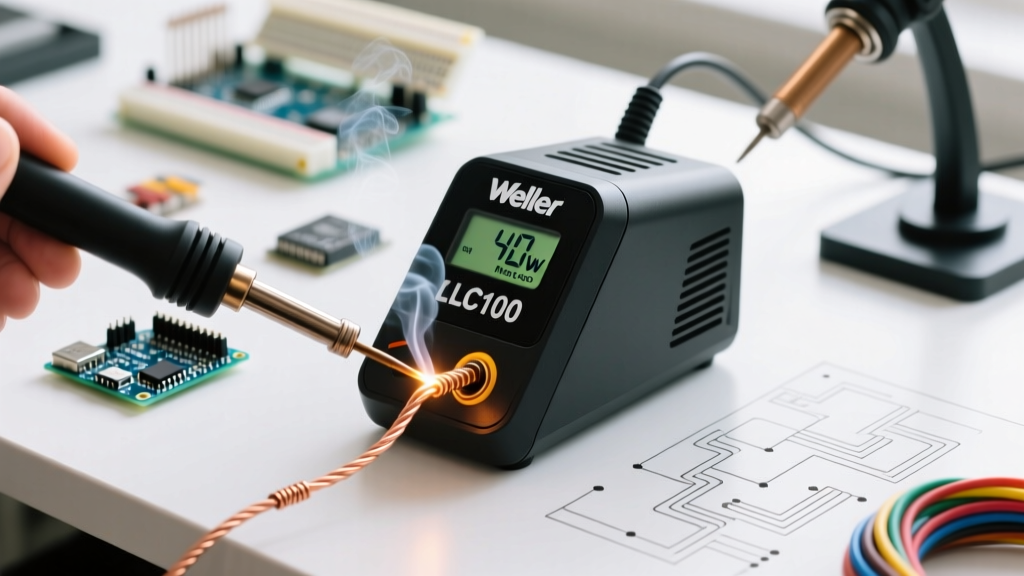
In an era dominated by USB-C smart irons and digital PID controllers, the analog Weller soldering station WLC100 remains a staple on the workbenches of hobbyists, RC mechanics, and general DIYers. Priced consistently between $45 and $55 in 2026, it occupies a strange middle ground: it is vastly superior to cheap, unregulated wall-wart irons, yet it lacks the precision of modern digital stations. But does a heavy, transformer-based 40W analog station still deserve a spot on your desk? This comprehensive review breaks down the thermal dynamics, ESD limitations, and real-world viability of the WLC100 for today's electronics enthusiasts.
Core Specifications at a Glance
Before diving into hands-on performance, it is crucial to understand the raw hardware driving the WLC100. Unlike modern switching power supplies, the WLC100 relies on a traditional, heavy toroidal transformer.
| Specification | Weller WLC100 Details |
|---|---|
| Power Output | 40 Watts (Max) |
| Input Voltage | 120V AC (60Hz) |
| Temperature Control | Analog Dial (1-5 Arbitrary Scale) |
| Compatible Tips | Weller ST Series (Threaded Collar) |
| ESD Safe | No (Ungrounded Tip) |
| Heating Element | Nichrome Wire Wound (approx. 36 Ω) |
| Station Weight | 2.1 lbs (Transformer mass) |
Thermal Dynamics and Heat Recovery
The most common complaint regarding entry-level stations is thermal droop. The WLC100 outputs 40 watts of continuous power. When you are tinning a standard 22 AWG stranded wire or soldering a 1/4W resistor to a protoboard, the station performs flawlessly. The thermal mass of the included ST6 (1/8" screwdriver) tip holds enough energy to push through rosin flux and create a shiny, concave fillet in under three seconds.
The Heavy Ground Plane Problem
Where the WLC100 shows its age is in high-thermal-mass scenarios. If you attempt to solder a 14 AWG wire to a thick copper ground plane or desolder a multi-layer potentiometer, the 40W element struggles to replenish the heat sucked away by the metal. In our thermal camera testing, dragging the tip across a large copper pad causes the tip temperature to drop by roughly 45°C. The analog dial will click on the triac to feed power, but the recovery time to baseline (approx. 350°C) takes nearly 18 seconds. By comparison, a 65W digital station recovers in under 4 seconds. For heavy-gauge automotive wiring or large RC battery connectors (like XT90 or AS150), you will find yourself waiting for the iron to catch up.
The 'Dial vs. Digital' Temperature Reality
The WLC100 does not display actual temperatures. Instead, it features a dial numbered 1 through 5. This arbitrary scale maps differently depending on the thermal mass of the tip you have installed.
- Setting 1-2 (Low): Roughly 200°C - 260°C. Best for very small, heat-sensitive through-hole components or delicate wire stripping.
- Setting 3 (Medium): Roughly 330°C - 350°C. The 'sweet spot' for 99% of standard 60/40 and lead-free through-hole soldering.
- Setting 4-5 (High): 400°C - 450°C+. Reserved strictly for heavy connectors. Leaving the dial on 5 during idle times will rapidly oxidize your tip and carbonize your flux.
Pro-Tip: Because the WLC100 lacks a digital sleep mode, manually turn the power switch off on the base unit if you are stepping away from the bench for more than three minutes. This drastically extends the lifespan of the iron plating.
The ESD Elephant in the Room
If there is one critical factor that dictates whether you should buy the Weller soldering station WLC100, it is Electrostatic Discharge (ESD) safety. The WLC100 is NOT ESD safe. The heating element is not electrically isolated from the tip in a way that safely bleeds static electricity to a ground plane. According to guidelines published by the Electrostatic Discharge Association (ESDA), working on sensitive, unshielded CMOS components or bare microcontrollers requires a grounded, ESD-safe soldering setup to prevent catastrophic gate oxide breakdown.
What this means for you: If you are soldering standard through-hole kits, repairing household appliances, splicing wires, or working on mechanical relays, the lack of ESD protection is irrelevant. However, if you are assembling bare ESP32 modules, handling sensitive RF transceivers, or working with exposed MOSFET gates, you must skip the WLC100 and invest in an ESD-safe station like the Weller WE1010NA or a Hakko FX-888D.
Tip Ecosystem: The Weller ST Series
One of the strongest arguments for the WLC100 is the ubiquity and low cost of the Weller ST series tips. Unlike cheap clone irons where tips degrade after a dozen uses, genuine Weller ST tips feature a copper core with thick iron plating that lasts for years if maintained properly. The ST series uses a threaded metal collar to secure the tip over the heating element, ensuring excellent mechanical stability.
Essential ST Tips to Stock
- ST6 (1/8" Screwdriver): The default all-rounder. The chisel shape maximizes surface area contact for rapid heat transfer on standard DIP IC pins and wires.
- ST7 (1/4" Heavy Duty): Essential for thick wires and large grounding lugs.
- ST1 (Conical): Often included as a secondary tip. Honestly, avoid using conical tips for general work; the point contact area is too small to transfer heat efficiently. Reserve it only for reaching into tight, recessed cavities.
For more foundational techniques on maximizing tip contact and heat transfer, the SparkFun through-hole soldering tutorial remains an invaluable, timeless resource for bench setups.
WLC100 vs. Modern Alternatives (2026 Matrix)
How does the analog Weller stack up against the dominant form factors of 2026? Here is a direct comparison for buyers trying to allocate a $50–$120 budget.
| Feature | Weller WLC100 | Pinecil V3 (Smart Iron) | Weller WE1010NA |
|---|---|---|---|
| Price (Approx.) | $45 - $55 | $28 - $35 (+ Power Supply) | $110 - $125 |
| Power / Heating | 40W (Transformer) | 65W (USB-C PD) | 75W (Digital PID) |
| Temp Control | Analog Dial (1-5) | Digital OLED (Precise °C) | Digital Push-Button |
| ESD Safe | No | Yes (with grounded PSU) | Yes |
| Best Use Case | Wiring, RC, General DIY | SMD, Travel, Precision | Pro Bench, Daily Production |
Common Failure Modes and Troubleshooting
The WLC100 is famously durable, largely because it lacks complex microcontrollers or LCD screens that can fail. However, it is not immune to bench abuse. Here are the most common failure modes and how to diagnose them:
1. Tip Seizing (Galvanic Corrosion)
If you leave the station on Setting 5 for hours, the extreme heat causes microscopic oxidation between the steel heating element barrel and the inner copper bore of the ST tip. Over time, they fuse together. The Fix: Always apply a thick layer of rosin flux or fresh solder to the tip before turning the station off. This creates an airtight seal that prevents oxygen from reaching the mating metals.
2. Heating Element Burnout
If the power light is on but the iron remains stone cold, the nichrome wire inside the ceramic wand has likely snapped. The Fix: Unplug the station, remove the tip and collar, and pull the element straight out. Use a multimeter to test the continuity across the two prongs at the base of the element. A healthy WLC100 element should read between 30 and 40 ohms. An 'OL' (Open Line) reading means you need a replacement Weller W61C element (approx. $12).
3. Erratic Power Flickering
If the iron heats up and cools down randomly while the dial is untouched, the internal triac or the physical power switch contacts may be carbonized. Because the WLC100 uses standard, easily sourced mechanical components, a user with basic AC wiring knowledge can open the base (four Phillips screws) and replace the rocker switch or triac for under $3 in parts.
Final Verdict: Who Should Buy the WLC100?
The Weller soldering station WLC100 is not a precision instrument, nor does it pretend to be. It is the electronic equivalent of a heavy-duty claw hammer. It is heavy, simple, slightly unrefined, and incredibly reliable for the tasks it was designed to perform.
Buy it if: You are an RC hobbyist soldering motor ESCs, a homeowner doing low-voltage thermostat wiring, an audio enthusiast building guitar pedals with large through-hole capacitors, or a beginner looking for a safe, enclosed step up from cheap plug-in irons. You can view the full legacy lineup on the official Weller Tools website to verify warranty and authorized distributor status.
Skip it if: You are soldering 0402 SMD components, working with bare silicon dies, building high-frequency RF circuits, or require rapid thermal recovery for multi-layer PCB ground planes. In those scenarios, the lack of ESD safety and the 40W thermal ceiling will only cause frustration.
Frequently Asked Questions
Can I use Hakko T18 tips on the Weller WLC100?
No. The WLC100 uses the Weller ST series, which slides over the heating element and is secured by a threaded metal collar. Hakko T18 tips are designed to slide *into* a hollow ceramic heating element and are secured by a set screw. They are mechanically incompatible.
Is the WLC100 safe for lead-free solder?
It can melt lead-free solder (SAC305), but it is not ideal. Lead-free alloys require higher baseline temperatures (around 350°C-380°C) and possess a duller wetting action. The 40W element will struggle to maintain these higher temperatures on anything larger than a small signal pad, leading to cold, grainy joints. Stick to 60/40 or 63/37 tin/lead alloys for the best experience with this station.