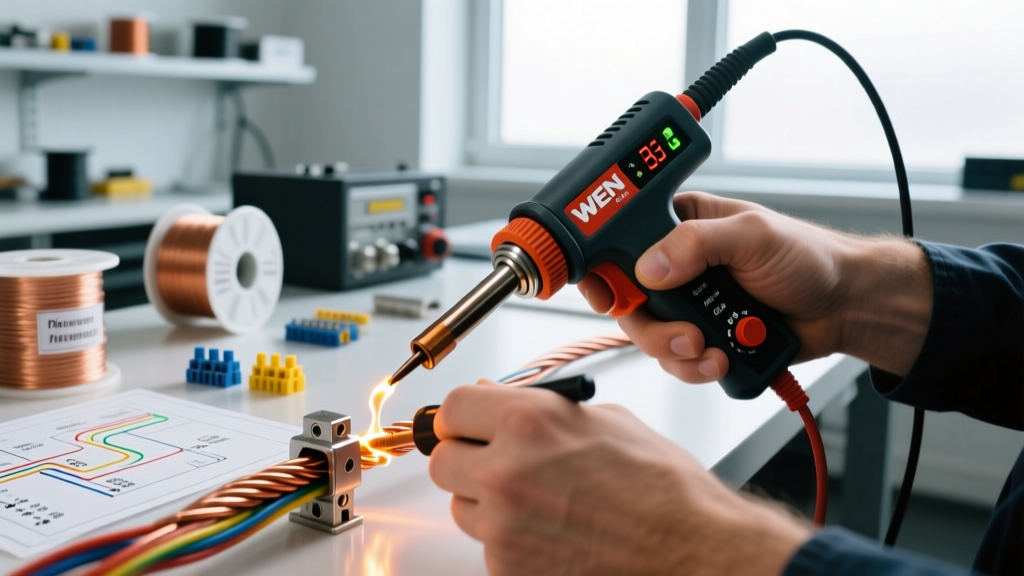

When tackling heavy-duty electrical projects in 2026, ceramic pencil irons simply do not have the thermal mass required to flow solder on thick conductors. This is where a transformer-based tool like the WEN soldering gun—specifically the widely used WEN 3940 140-Watt Dual-Wattage model—proves its worth. Priced between $28 and $35, it remains one of the most cost-effective solutions for high-amperage wiring, automotive harnesses, and thick stranded copper. However, the sheer thermal output and electromagnetic nature of transformer guns demand specific techniques to avoid damaging components or prematurely destroying the tool's copper loop tips.
Understanding the Transformer-Based Thermal Profile
Unlike temperature-controlled soldering stations that use ceramic heating elements and thermocouple feedback loops, a WEN soldering gun utilizes a step-down transformer. The primary coil connects to your 120V AC mains, while the secondary coil consists of a single, thick turn of copper that forms the tip. This design drops the voltage to a fraction of a volt (typically around 0.1V to 0.5V) while pushing massive current (often exceeding 200 amps) directly through the tip. The resistance of the copper loop generates instantaneous heat.
The Dual-Wattage Trigger Mechanism
The WEN 3940 features a two-stage trigger switch. Understanding how to modulate this is critical for expert-level work:
- Stage 1 (Approx. 100W): Pulling the trigger halfway engages the 100-watt tap. Use this for pre-heating larger terminals, maintaining heat on 12 AWG to 10 AWG wires, or keeping the gun warm between rapid successive joints.
- Stage 2 (140W): Pulling the trigger fully engages the 140-watt tap. This delivers maximum current for rapid heat penetration into heavy-gauge wires (8 AWG to 4 AWG) and large brass grounding lugs.
Expert Warning: Never use a transformer-based WEN soldering gun on sensitive solid-state electronics, CMOS chips, or microcontrollers. The high-current alternating magnetic field generated at the tip loop can induce parasitic voltages in nearby circuit traces, and the lack of grounded thermal regulation can easily fry MOSFET gates via electrostatic discharge (ESD). Reserve this tool strictly for heavy wiring, passive electromechanical components, and thick-gauge harnesses.
Expert Techniques for Heavy-Gauge Wire Soldering
Soldering 6 AWG or 4 AWG stranded copper requires more than just holding the gun to the wire. Copper is an exceptional heat sink; if you apply solder too early, it will melt on the outside while the core remains cold, resulting in a weak, high-resistance 'cold joint'. Follow this precise sequence for heavy conductors:
- Mechanical Prep: Strip the wire and twist the strands tightly. Insert the wire into the terminal (e.g., a ring terminal or Anderson Powerpole housing). Crimp it mechanically first. Solder should provide conductivity and corrosion resistance, not mechanical strength. The IPC J-STD-001 standard dictates that wires must be mechanically secured before soldering.
- Flux Application: Apply a generous amount of high-activity rosin paste flux to the exposed copper strands and the terminal barrel. Do not rely solely on the rosin core inside your solder wire for heavy-gauge joints.
- Thermal Coupling: Engage Stage 2 (140W) on your WEN soldering gun. Press the flattened side of the copper loop firmly against the terminal barrel, not just the wire. The barrel has more mass and needs the heat first.
- Feed and Flow: After 3 to 5 seconds, touch the rosin-core solder (use 60/40 or 63/37 tin/lead for optimal wetting, or a high-silver SAC305 if lead-free is mandated) to the opposite side of the joint from the gun tip. When the flux violently boils and the solder wicks instantly into the strands, the joint is at thermal equilibrium.
- Cool Down: Remove the solder, then remove the gun. Hold the wire completely still for 8 to 10 seconds until the solder crystallizes into a dull, frosty finish. Moving it while semi-solid causes a disturbed joint.
Matching Tip Geometry to Wire Gauge
The stock tip on a WEN soldering gun is a simple copper loop. However, WEN and third-party manufacturers offer different tip profiles. Selecting the right geometry drastically reduces your heating time and prevents localized overheating of wire insulation.
| Tip Type | Optimal Wire Gauge (AWG) | Avg. Heat Time (140W) | Best Use Case |
|---|---|---|---|
| Standard Round Loop | 14 AWG – 10 AWG | 2.5 – 4.0 seconds | Standard automotive wiring, RC battery connectors (XT60/XT90). |
| Flattened / Paddle Loop | 8 AWG – 4 AWG | 4.0 – 7.0 seconds | Welding cable lugs, EV battery busbars, heavy marine wiring. |
| Pointed / Needle Tip | 18 AWG – 14 AWG | 1.0 – 2.0 seconds | Thick stranded hook-up wire, large potentiometer lugs, heavy relays. |
Proactive Maintenance: Beating Thermal Cycling Fatigue
The most common failure point on any WEN soldering gun is the terminal block where the copper tip meets the secondary transformer winding. The tool undergoes extreme thermal cycling—heating to 800°F (426°C) and cooling to room temperature dozens of times an hour. This causes the brass retaining screws to expand and contract, eventually loosening them.
A loose screw creates a microscopic air gap, introducing high electrical resistance. This resistance generates localized, extreme heat that will melt the plastic housing or vaporize the copper tip at the joint. To prevent this:
- Torque Check: Every 10 hours of use, unplug the gun and check the tip screws. Snug them firmly with a flathead screwdriver, but do not overtighten, as the brass threads can strip easily in the aluminum block.
- Oxidation Removal: If you see black carbon buildup or green copper oxide around the terminal block, remove the tip. Sand the contact faces of the copper loop with 400-grit sandpaper until bright copper is visible. Wipe with isopropyl alcohol before reassembly.
- Continuous Tinning: The working end of the tip will pit and oxidize. Never file a pitted tip; filing removes the protective iron plating (if equipped) or exposes raw copper which will dissolve into tin-lead solder via leaching. Instead, keep the working end heavily coated in a thick layer of rosin-core solder when stored.
Diagnostic Troubleshooting for WEN Guns
Even with meticulous care, transformer guns exhibit specific failure modes. Here is how to diagnose them based on auditory and visual cues:
Symptom: Loud, Aggressive Buzzing with Zero Heat
Diagnosis: Open circuit in the secondary winding or at the tip joint. The transformer is trying to push current but cannot complete the circuit, causing the laminated iron core to vibrate violently under the magnetic load.
Solution: Check if the tip has snapped at the bend. If intact, remove the tip, clean the terminal contacts, and reseat it tightly. If the internal secondary bus bar has cracked (rare but possible from dropping the tool), the gun must be replaced or rewound.
Symptom: Intermittent Heating and Visible Arcing at the Tip Base
Diagnosis: High-resistance joint due to loose retaining screws or severe oxidation.
Solution: Immediately release the trigger. Continuing to pull the trigger will melt the ABS plastic housing. Clean the contacts and tighten the screws as outlined in the maintenance section.
Symptom: Tip Heats, but Solder Balls Up and Refuses to Wet
Diagnosis: Severe tip oxidation or 'leaching' (where the solder has eaten away the copper, leaving a rough, porous surface).
Solution: While the gun is warm (Stage 1), aggressively rub the tip in a block of sal ammoniac (ammonium chloride) or a heavy-activated brass wire sponge. Apply fresh flux and immediately re-tin with a thick coat of 63/37 solder.
Frequently Asked Questions
Can I use my WEN soldering gun for copper plumbing pipes?
No. While a 140W WEN gun generates high heat, it is highly localized. Soldering a 1/2-inch or 3/4-inch copper water pipe requires heating the entire circumference of the fitting evenly to allow capillary action to draw the solder. A transformer gun will melt the solder on one side while the opposite side remains cold, leading to a leaking joint. Always use a propane or MAPP gas torch for plumbing, adhering to NFPA safety guidelines for open flames.
Is it safe to leave the WEN 3940 plugged in between joints?
It is safe from an electrical fire standpoint, provided the trigger is not engaged. However, leaving it plugged in with the trigger resting in the 'Stage 1' position will rapidly degrade the tip and waste electricity. Always release the trigger completely when not actively flowing solder.
Where can I find replacement parts and official schematics?
WEN Products maintains an excellent support network. You can order replacement tips, trigger switches, and indicator bulbs directly through the official WEN Products website. Always ensure you are buying pure copper tips; cheap aluminum-clad knockoffs will fail within minutes of use.
Mastering a WEN soldering gun requires respecting its raw thermal output and understanding the physics of transformer-based heating. By modulating the dual-wattage trigger, matching the tip geometry to your wire gauge, and strictly maintaining the terminal block connections, you can achieve flawless, high-amperage joints that will outlast the lifespan of the equipment they power.