
The Weller Ecosystem: Navigating the 2026 Lineup
When outfitting an electronics workbench, the debate between budget-friendly tools and professional-grade equipment is a constant friction point. For decades, Weller has sat at the apex of this conversation, offering a lineage of tools that range from entry-level analog dials to high-frequency, digitally controlled rework powerhouses. In 2026, the landscape of Weller soldering stations is more segmented than ever, forcing makers, repair technicians, and production engineers to carefully evaluate the true cost-to-value ratio of their thermal tools.
Choosing between a sub-$150 budget station and a $600+ premium WX series unit is not merely a matter of brand prestige; it fundamentally alters your workflow, thermal recovery times, and total cost of ownership. This analysis dissects the metallurgical, electronic, and ergonomic differences between Weller’s budget and premium tiers to help you make an informed, data-driven investment.
The Budget Contenders: WE1010NA and the Legendary WES51
Weller’s entry-level segment is dominated by two distinct philosophies: the modern digital interface and the legacy analog workhorse. Both offer reliable, ESD-safe performance for general-purpose through-hole and standard surface-mount device (SMD) soldering, but they achieve this through vastly different internal architectures.
Weller WE1010NA: The Modern Digital Entry Point
Priced at approximately $115 in 2026, the WE1010NA is Weller’s answer to the modern hobbyist and light repair technician. It delivers 70 watts of power and features a crisp LCD interface that allows for precise temperature setting, standby modes, and password-protected temperature lockouts. It utilizes the widely available ETA series tips, which are standard iron-plated copper tips. While the thermal recovery is adequate for 0805 and 0603 components, the 70W ceiling means the station will struggle with heavy multi-layer ground planes, often resulting in cold solder joints if the user dwells too long on the pad.
Weller WES51: The Analog Workhorse
The WES51 remains a staple in educational labs and legacy repair shops. At around $125, this 50-watt analog station relies on a proprietary sensor and zero-voltage switching to minimize electrical noise. It uses the older ET and SMT series tips. The primary drawback of the WES51 in a modern context is its calibration process; adjusting the temperature offset requires opening the chassis and turning a physical trim potentiometer. Furthermore, the analog dial lacks the granular precision required for modern low-temperature solder pastes (like Sn42/Bi58), which demand strict thermal profiling to prevent component damage.
Expert Insight: According to the IPC J-STD-001 standards for soldered electrical assemblies, excessive dwell time on a pad due to underpowered thermal recovery can cause pad lift and delamination on FR-4 substrates. A budget station's slower recovery directly increases the risk of violating these thermal excursion limits when working on high-mass joints.
The Premium Tier: WX102 and WX202 Rework Powerhouses
Stepping into the premium tier means crossing the $350 threshold, where Weller introduces advanced inductive heating concepts, proprietary tip metallurgy, and rigorous compliance with aerospace and medical manufacturing standards.
Weller WX202: The Apex of Precision Soldering
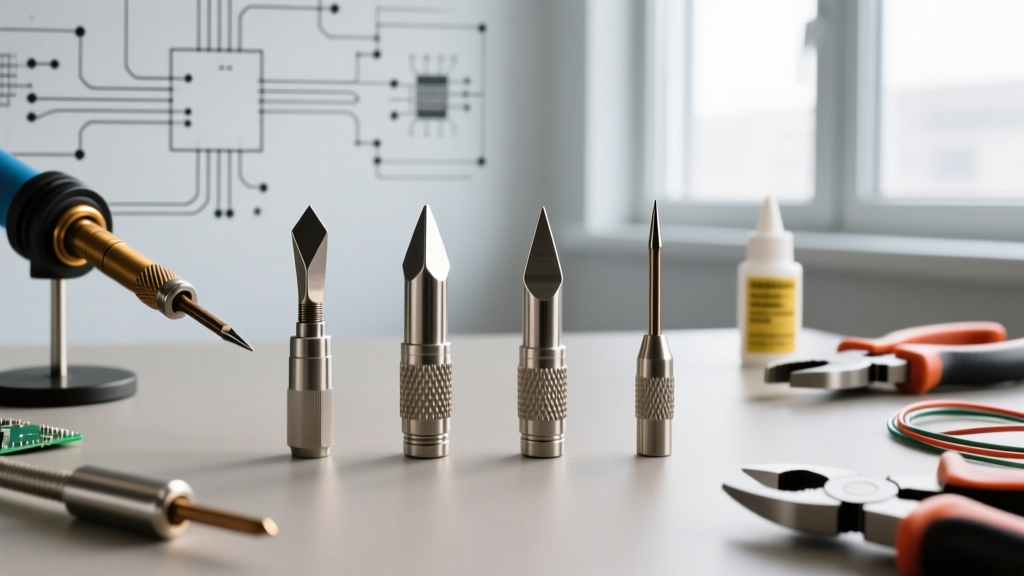
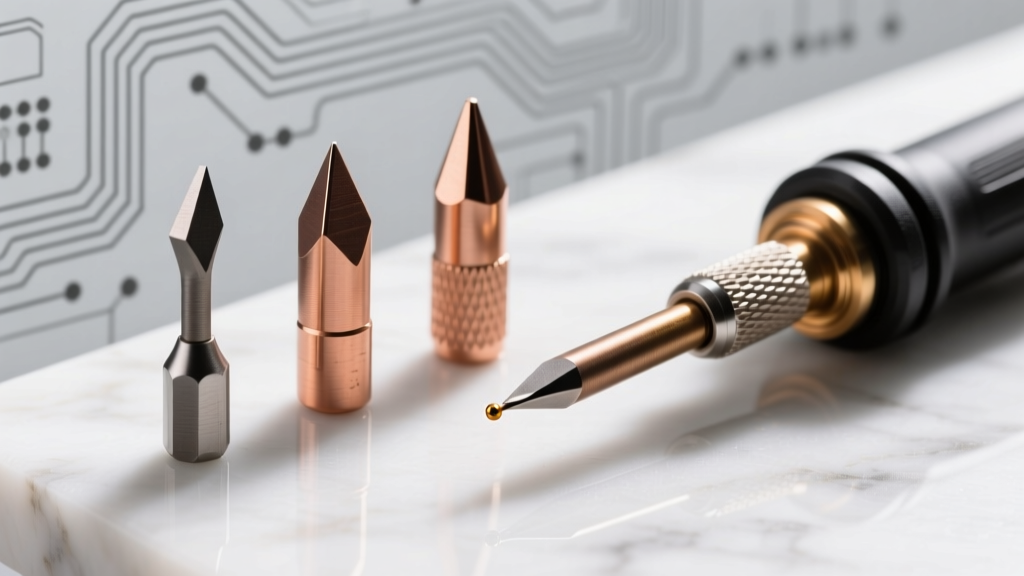
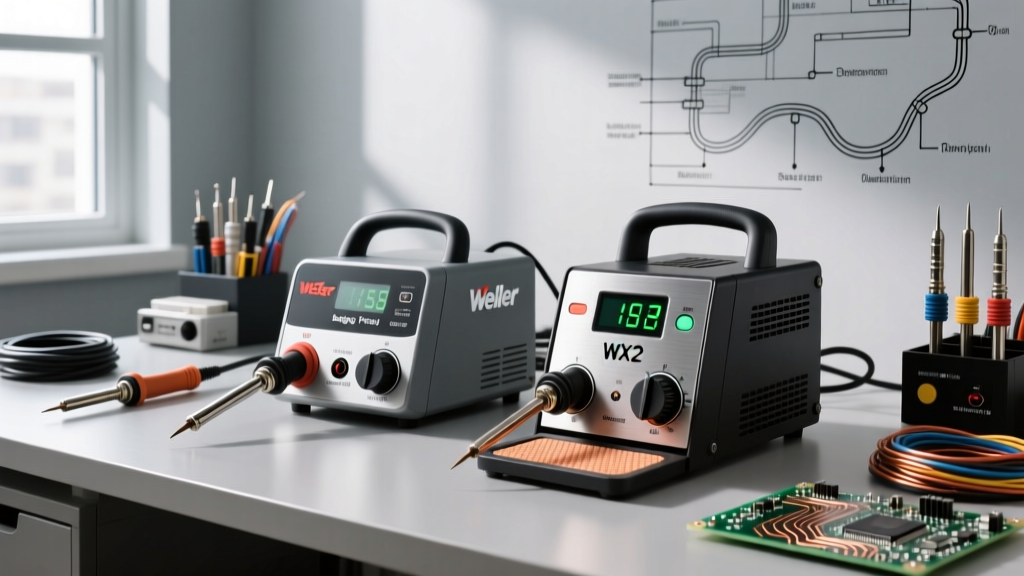
The WX202 is a 200-watt digital marvel that retails for approximately $649. It is designed for high-volume production environments and complex micro-BGA rework. The defining feature of the WX series is its compatibility with XNT and XNTA tip geometries. These tips feature a proprietary nano-coating that prevents solder wetting on the non-working surfaces of the tip, effectively funneling all thermal energy directly into the joint. This coating extends tip life by up to three times compared to standard ETA tips, despite the XNT tips costing roughly $25 each versus $8 for ETA tips.
ESD Compliance and Premium Build Quality
When handling highly sensitive CMOS components or RF modules, electrostatic discharge (ESD) is a silent killer. Premium Weller stations are engineered to meet the stringent ANSI/ESD S20.20 guidelines. The WX202 features a hardwired, low-impedance ground path from the very tip of the iron, through the silicon grip, down the cord, and directly to the earth ground of the chassis. Budget stations offer ESD safety, but the premium series guarantees a tip-to-ground resistance of strictly less than 2 ohms, with a tip-to-ground potential of less than 1mV, ensuring absolute safety for sub-3nm logic gates.
Head-to-Head Specification Matrix
To visualize the hardware disparities across the 2026 Weller lineup, review the core specifications below:
| Model | Power Output | Tip Series | Temp Range | Est. Price (2026) | Best Use Case |
|---|---|---|---|---|---|
| WE1010NA | 70W | ETA | 120°F - 850°F | $115 | Hobbyist, Basic SMD |
| WES51 | 50W | ET / SMT | 350°F - 850°F | $125 | Education, Through-Hole |
| WX102 | 200W | XNT | 120°F - 850°F | $399 | Pro Repair, Dense PCBs |
| WX202 | 200W (Dual Port capable) | XNT / XNTA | 120°F - 850°F | $649 | Production, Micro-Rework |
Thermal Recovery and Tip Technology: Where the Money Goes
The most significant differentiator between Weller's budget and premium stations is thermal recovery time—the speed at which the heater element compensates for the heat sink effect of a cold solder joint or a copper pour.
- Budget Tier (WE1010NA): When applying an ETA DL (chisel) tip to a 4-layer PCB ground via, the 70W heater takes approximately 8 to 12 seconds to recover its baseline temperature. This lag forces the operator to increase the dial temperature preemptively, risking thermal shock to adjacent components.
- Premium Tier (WX202): Utilizing a 200W power supply paired with an XNT A (active) tip, the sensor sits millimeters from the joint. The station detects the temperature drop and injects 200 watts of instantaneous power, achieving full thermal recovery in under 1.5 seconds. This allows the operator to run the station at a lower baseline temperature (e.g., 650°F instead of 750°F), drastically reducing tip oxidation and flux burn-off.
For a deeper dive into how tip geometry affects thermal transfer, Weller's official soldering knowledge base provides extensive whitepapers on matching tip mass to joint thermal requirements.
Total Cost of Ownership: Maintenance and Calibration
A true budget vs. premium analysis must account for long-term maintenance. Budget stations like the WES51 require manual calibration. If the internal thermocouple drifts, a technician must use a specialized tip thermometer and adjust a physical potentiometer inside the unit. In a commercial environment, this downtime costs money.
Conversely, the WX series features digital auto-calibration and tool recognition. When you plug a WX iron into the base station, the unit reads the microchip embedded in the iron's connector, automatically loading the specific thermal profile and calibration data for that exact tip. This plug-and-play telemetry eliminates manual calibration entirely, justifying the higher upfront capital expenditure for any lab billing out at standard engineering consulting rates.
Cost-to-Value Analysis: Which Tier Should You Choose?
Selecting the right Weller soldering station depends entirely on your daily operational demands:
- The Maker and Hobbyist: If you are assembling Arduino shields, repairing vintage audio equipment, or working primarily with through-hole components, the WE1010NA is the undisputed champion. The $115 price point leaves ample budget for quality flux and solder wire, which are equally critical to joint integrity.
- The Independent Repair Technician: If your daily workflow involves swapping USB-C ports on smartphones or replacing capacitors on dense laptop motherboards, the WX102 ($399) is the minimum viable investment. The 200W output and XNT tip longevity will pay for themselves in saved time and reduced tip replacement costs within six months.
- The Production Lab and Aerospace Contractor: For IPC Class 3 assemblies, medical device manufacturing, or high-volume micro-BGA rework, the WX202 ($649) is mandatory. The strict ESD compliance, digital telemetry, and sub-second thermal recovery are non-negotiable requirements for passing modern quality assurance audits.
Final Verdict
The gap between budget and premium Weller soldering stations in 2026 is defined by thermal algorithms, tip metallurgy, and digital integration. While the WES51 and WE1010NA remain exceptional tools for foundational electronics work, they lack the instantaneous thermal response required for modern, high-density PCB architectures. Upgrading to the WX series is not merely a luxury; it is a fundamental shift toward precision, repeatability, and adherence to stringent industry standards. Evaluate your typical joint thermal mass, calculate your annual tip expenditure, and choose the tier that aligns with your engineering ambitions.