
The Physics of Plastic Welding vs. Metal Soldering
While the tool looks identical, using a soldering iron for plastic welding relies on entirely different material science than joining copper or brass. Metal soldering uses a lower-melting-point filler alloy to bond two base metals without melting them. Plastic welding, however, is an autogenous process: you are melting the base polymers themselves to fuse their molecular chains. When searching for the best soldering iron for plastic welding, thermal mass, precise temperature regulation, and tip geometry are vastly more critical than in electronics work. A standard 40W fixed-temperature iron will scorch ABS and fail to penetrate thick HDPE. In this 2026 guide, we evaluate the top irons and stations specifically configured for hot-knife plastic joining, repair, and fabrication.
Critical Material Science: Polymer Melt Thresholds
Unlike eutectic metal alloys that melt at a single discrete temperature, thermoplastics have a glass transition phase and a broader melting range. According to data from the British Plastics Federation, exceeding the thermal degradation threshold of a polymer will break its molecular chains, resulting in a brittle, cloudy weld with zero tensile strength. You must match your iron's operating temperature to the specific plastic.
| Polymer | Glass Transition | Ideal Welding Temp | Degradation Threshold |
|---|---|---|---|
| PLA (Polylactic Acid) | 60–65°C | 170–190°C | > 220°C |
| ABS (Acrylonitrile Butadiene) | 105°C | 210–230°C | > 260°C |
| PVC (Polyvinyl Chloride) | 80°C | 160–190°C | > 200°C (Releases HCl) |
| HDPE (High-Density Polyethylene) | -120°C | 130–150°C | > 180°C |
Top 4 Soldering Irons for Plastic Welding (2026 Roundup)
1. Hakko FX-601-02 (Best Overall Precision)
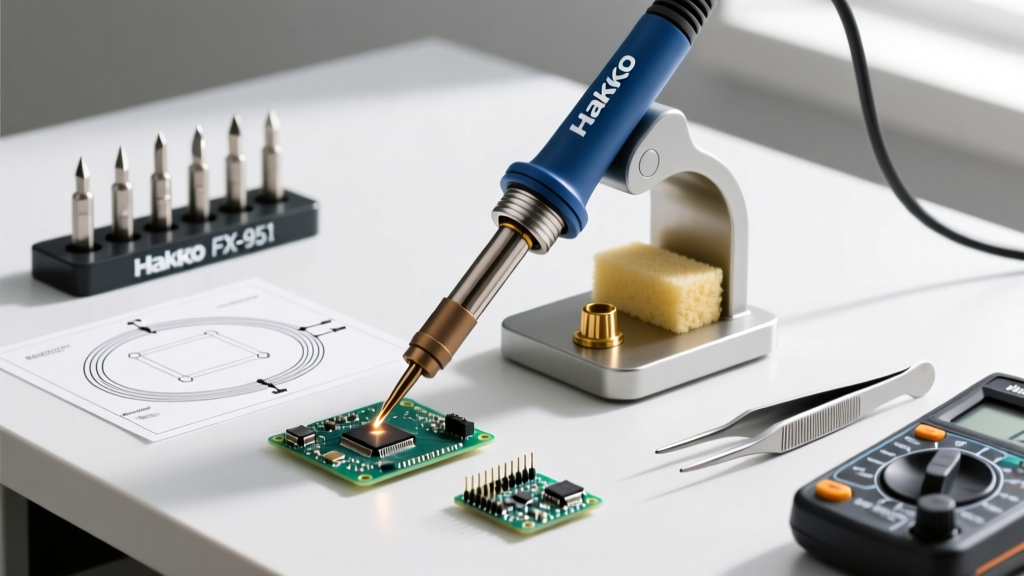
The Hakko FX-601 remains the undisputed champion for benchtop plastic fabrication. Unlike traditional stations, this is a 67W adjustable iron with the temperature dial built directly into the handle. For plastic welding, the immediate thermal feedback is crucial. When dragging a spatula tip through a thick ABS joint, the tip loses heat rapidly; the FX-601’s ceramic heater recovers in under 4 seconds. Pro-Tip: Swap the standard conical tip for a Hakko T19-D24 chisel or, ideally, file down an old T18-B tip into a flat 5mm spatula to maximize surface contact area. Priced around $78 in 2026, it offers industrial reliability at a hobbyist price point.
- Pros: Rapid thermal recovery, lightweight, accepts cheap interchangeable tips.
- Cons: Dial on handle can be accidentally bumped during heavy downward pressure.
2. Pine64 Pinecil V2 (Best Smart/Portable Option)
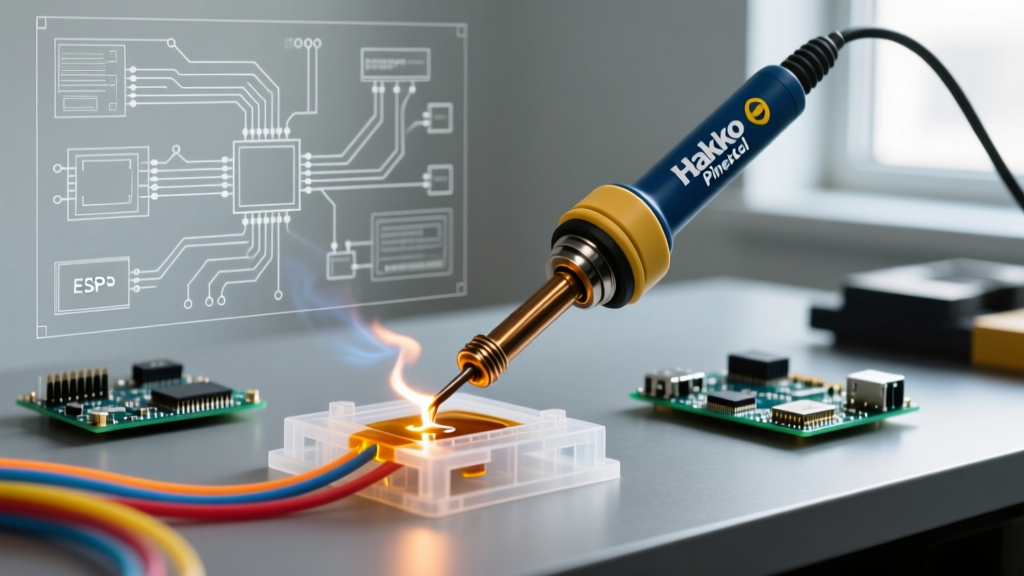
The Pinecil V2 has disrupted the market by packing a RISC-V processor and PD (Power Delivery) negotiation into a $26 shell. Powered by a 65W USB-C laptop charger, it offers exact digital temperature control down to the single degree. This is a massive advantage for PLA and PETG welding, where a 10°C overshoot causes stringing and warping. You can set custom PID profiles specifically for different plastics. To use it for welding, you must purchase a third-party flat 'hot knife' spatula tip compatible with the TS100/Pinecil mount. The failure mode here is power starvation: if your USB-C brick doesn't support 20V/3.25A PD, the iron will stall during high-thermal-mass HDPE welds.
- Pros: Exact digital temp control, open-source firmware, ultra-portable.
- Cons: Requires a separate high-wattage USB-C PD power brick.
3. American Beauty 3158 (Best Heavy-Duty Industrial)
If you are welding 1/4-inch thick HDPE geomembranes, repairing polypropylene automotive bumpers, or joining thick PVC pipes, hobbyist irons will fail. The American Beauty 3158 is a 100W industrial brute. It features a massive thermal mass tip that doesn't flinch when plunged into thick, heat-sinking plastics. It operates best when paired with an external rheostat to dial back the voltage for thinner materials. At roughly $185, it is an investment for professionals doing structural plastic repairs where cold joints could lead to catastrophic mechanical failure.
- Pros: Unmatched thermal mass, penetrates thick sections easily, rugged build.
- Cons: Heavy, requires external controller for low-temp plastics like PLA.
4. Weller WES51 Analog Station (Best Continuous Bench Use)
The Weller WES51 (50W) is a legendary analog station. While 50W sounds low, the WES51’s closed-loop thermocouple feedback maintains rock-steady temperatures during long, continuous weld seams. The heavy die-cast base provides a stable anchor, and the ESD-safe foam grip prevents hand fatigue during hour-long fabrication sessions. For plastic welding, outfit the WES51 with a custom flat-blade tip. The analog dial prevents the accidental digital misclicks that can instantly melt through a thin PVC sheet.
- Pros: Extremely stable continuous heat, heavy base prevents tipping, simple interface.
- Cons: Slower initial heat-up time compared to modern digital irons.
Head-to-Head Comparison Matrix
| Model | Wattage | Temp Range | Best Tip Style | Est. Price (2026) |
|---|---|---|---|---|
| Hakko FX-601 | 67W | 200–540°C | T19 Spatula / Chisel | $78 |
| Pinecil V2 | 65W (PD) | 50–450°C | Flat Hot-Knife Blade | $26 (+$20 PSU) |
| American Beauty 3158 | 100W | Fixed High (Rheostat) | Heavy Chisel / Knife | $185 |
| Weller WES51 | 50W | 177–454°C | Custom Flat Blade | $110 |
Pro Technique: The Scarf Joint and Filament Filler
The biggest mistake beginners make when using a soldering iron for plastic welding is attempting a simple butt joint (pushing two flat 90-degree edges together). This yields a weld with only 10% of the base material's tensile strength. Instead, use a Scarf Joint.
- Bevel the Edges: Use a rasp or sandpaper to bevel both joining edges at a 45-degree angle. This doubles the surface area for molecular entanglement.
- Tack Weld: Use the tip of your iron to melt small anchor points every 2 inches to hold the joint aligned.
- The Filament Filler Trick: Do not just melt the base material. Feed 1.75mm 3D printer filament (matched to your base plastic, e.g., ABS filament for an ABS part) into the V-groove of the scarf joint as you drag the hot iron over it. The filament acts as a filler rod, filling gaps and adding structural bulk to the weld bead.
- Dwell Time: Keep the iron moving at roughly 1 inch per second. Dwell times exceeding 2 seconds in one spot will cause thermal degradation and burn-through.
Safety Warning: PVC and Toxic Off-Gassing
CRITICAL WARNING: Never weld PVC (Polyvinyl Chloride) without active, localized fume extraction. When PVC exceeds 200°C, it undergoes dehydrochlorination, releasing Hydrogen Chloride (HCl) gas. When HCl contacts the moisture in your eyes and lungs, it forms hydrochloric acid.
According to guidelines published by NIOSH (National Institute for Occupational Safety and Health), exposure to hydrogen chloride gas can cause severe respiratory tract irritation, pulmonary edema, and chemical burns. Furthermore, OSHA's Hazard Communication standards mandate that workshops processing halogenated polymers must utilize activated carbon and HEPA filtration systems. If you must weld PVC with a soldering iron, keep the temperature strictly below 180°C, work in a highly ventilated area, and wear a respirator equipped with acid-gas cartridges (such as 3M 6006).
Frequently Asked Questions
Can I use rosin flux on plastic?
Absolutely not. Rosin flux is designed to dissolve metal oxides to allow liquid solder to wet a metallic surface. Plastics do not oxidize in the same way, and flux will not lower the surface tension of melted polymers. Worse, heating rosin flux to the 220°C required for ABS welding will create thick, noxious smoke and leave a sticky, structurally useless residue that actually weakens the plastic weld by introducing foreign contaminants into the molecular matrix.
Why does my ABS weld look cloudy and snap easily?
A cloudy, brittle weld is the classic signature of thermal degradation. Your iron is too hot, or your travel speed is too slow. You have broken the polymer chains, turning the ABS back into a brittle, low-molecular-weight sludge. Drop your iron temperature by 15°C, increase your travel speed, and ensure you are using a flat spatula tip to distribute heat evenly rather than a pointed tip that creates localized hot-spots.
Can I use a heat gun instead of a soldering iron?
Heat guns are excellent for softening large areas of plastic for bending or shrink-tubing, but they are terrible for precision welding. A heat gun blows hot air, which oxidizes the surface of the plastic before it fully melts, creating a weak boundary layer. A soldering iron provides direct conductive heat transfer, melting the plastic instantly while excluding oxygen from the weld pool, resulting in a vastly superior structural bond.