
The Physics of Heavy-Duty Soldering: Transformer Guns vs. Ceramic Stations
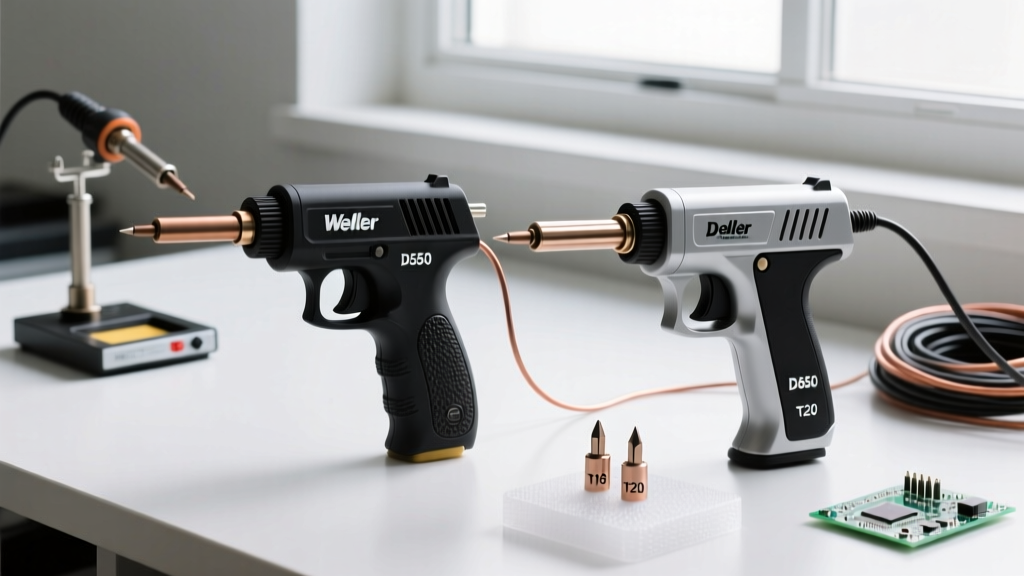
When working with massive thermal loads—such as 4/0 AWG battery cables, thick copper busbars, or heavy sheet metal roofing—standard ceramic-core soldering stations simply cannot deliver the necessary joules. A 60W or even 80W precision station will stall, resulting in cold, crystallized solder joints that fail under mechanical vibration. This is where step-down transformer guns dominate. In this comprehensive 2026 comparison, we dissect two titans of the electrical workshop: the Weller Soldering Gun D550 and its larger sibling, the Weller D650. Both tools rely on massive toroidal transformers to push high amperage through a low-resistance tip, but their application boundaries are vastly different.
Understanding the exact thermal recovery rates, tip metallurgy, and failure modes of these tools is critical for electrical contractors, automotive fabricators, and stained-glass artisans. Below, we break down the engineering realities of the Weller Soldering Gun D550 versus the D650 to help you choose the right tool for your specific high-current or high-mass soldering requirements.
Weller Soldering Gun D550: The Workshop Standard
The Weller D550 has been a staple in electrical kits for decades, and its modern 2026 production runs remain incredibly robust. It operates on a dual-stage trigger system: the primary pull engages the full 260-watt output for rapid heat-up (achieving solder-melting temperatures in roughly 6 to 8 seconds), while the secondary, softer pull drops the output to a 200-watt holding mode. This holding mode is crucial for preventing tip oxidation and extending the life of the copper-plated steel tips.
Real-World Performance and Thermal Mass
The D550 is engineered for medium-to-heavy electrical tasks. It excels at soldering 8 AWG to 2 AWG stranded copper wire, heavy-duty XT90 connectors in RC applications, and thick grounding straps. The tool utilizes the CT5 series tips, with the CT5D7 (screwdriver/chisel shape) being the most versatile for wrapping wires around terminal lugs. At a retail price hovering around $139 for the D550PK kit, it offers an unmatched cost-to-performance ratio for general heavy-duty electrical maintenance.
However, the D550 meets its thermal limit when confronted with large grounding lugs bolted to chassis steel. The surrounding metal acts as an infinite heatsink, pulling heat away from the joint faster than the 260-watt transformer can replenish it. Attempting to force a joint with the D550 on a 4/0 AWG battery terminal often results in excessive dwell time, which melts the wire insulation and degrades the flux core before the solder properly wets the copper.
Weller D650: Stepping Up to Industrial Duty
Where the D550 stalls, the Weller D650 takes over. The D650 features a physically larger transformer core and heavier secondary windings, delivering a massive 325-watt peak output on the primary trigger, and a 200-watt hold on the secondary. This extra 65 watts of peak thermal delivery translates directly into superior thermal recovery when attached to high-mass copper components.
When the Extra 65 Watts Matters
The D650 is not merely a 'hotter' D550; it is a fundamentally different class of tool designed for industrial electrical fabrication, heavy automotive battery bank assembly, and large-scale stained glass copper foiling. It utilizes the thicker CT6 series tips, such as the CT6D7, which possess greater physical mass to store and transfer heat into dense lugs without dropping below the 400°F (204°C) threshold required for standard 60/40 rosin-core solder.
Priced at approximately $215 for the kit in 2026, the D650 is an investment reserved for professionals who regularly solder wires larger than 1/0 AWG or work with thick brass and copper sheet metal. The increased thermal mass of the tip means it takes slightly longer to cool down after releasing the trigger, requiring a more deliberate workflow to avoid accidental burns or melting adjacent plastic loom tubing.
Head-to-Head Specification Matrix
| Feature | Weller D550 | Weller D650 |
|---|---|---|
| Peak Wattage (Primary Trigger) | 260W | 325W |
| Holding Wattage (Secondary Trigger) | 200W | 200W |
| Tip Series Compatibility | CT5 Series (e.g., CT5D7) | CT6 Series (e.g., CT6D7) |
| Heat-Up Time (to 600°F) | ~6.5 Seconds | ~8.0 Seconds |
| Tool Weight | 2.7 lbs (1.22 kg) | 3.4 lbs (1.54 kg) |
| Ideal Wire Gauge Range | 10 AWG to 2 AWG | 4 AWG to 4/0 AWG |
| Average 2026 Kit Price | $139 USD | $215 USD |
Common Failure Modes and Field Maintenance
Transformer guns are mechanical and electrical beasts. Unlike solid-state soldering stations, they contain moving parts and high-current contacts that degrade over time. Understanding these failure modes is essential for maintaining your equipment.
1. Dual-Stage Trigger Switch Arcing
The most common point of failure in both the D550 and D650 is the internal dual-stage trigger switch. Because the tool draws significant primary current (over 2 amps on the secondary side, translating to high primary side switching loads), the internal contacts can suffer from carbon tracking and arcing over thousands of cycles. If your gun begins to stutter or fails to engage the high-heat mode, the switch assembly (Weller part number BA600 for the D550) must be replaced. Regularly blowing out the switch housing with compressed air can extend its lifespan by removing conductive solder flux residue.
2. Thermal Expansion and Tip Loosening
The repeated cycle of heating to 700°F and cooling to room temperature causes the brass binding posts and steel tip screws to expand and contract at different rates. This inevitably loosens the tip connection, introducing electrical resistance that causes the binding post to overheat and pit.
To prevent this, you must tighten the tip screws with the included hex wrench while the tool is completely cold. If the binding posts become heavily pitted from arcing due to a loose tip, they must be filed flat or replaced to ensure a low-resistance electrical path.
3. Transformer Lamination Buzz
Both models utilize heavy silicon-steel laminations in their transformers. Over time, the varnish binding these laminations can micro-fracture due to thermal cycling, resulting in a loud 60Hz hum. While annoying, this acoustic vibration does not inherently impact the electrical output or safety of the tool, provided the internal windings remain intact and the casing is secure.
Application Safety and IPC Standards
When soldering heavy electrical connections, particularly in automotive, marine, or aerospace applications, adherence to industry standards is non-negotiable. The IPC J-STD-001 standard for soldered electrical and electronic assemblies strictly mandates proper wetting, thermal profiling, and the avoidance of cold joints or damaged insulation.
Using a Weller Soldering Gun D550 on a joint that requires the thermal capacity of a D650 will result in excessive dwell times. Prolonged heat application boils the flux, oxidizes the copper, and creates a 'grainy' or disturbed joint that violates IPC Class 2 and Class 3 requirements. Furthermore, when working on heavy chassis grounds or high-current battery banks, technicians must adhere to strict electrical safety protocols to prevent arc flashes or short circuits, as outlined by OSHA electrical safety guidelines. Always ensure circuits are de-energized and locked out before applying a high-wattage transformer gun, as the stray magnetic field from the transformer core can occasionally induce minor voltages in highly sensitive, unshielded nearby circuitry.
Ergonomics and Workflow Considerations
The physical footprint of these tools dictates how you manage your workspace. The D550, weighing 2.7 pounds, can be used comfortably for extended sessions, such as soldering the copper foil seams on a large stained-glass lamp shade. Its balance point rests naturally in the palm, reducing wrist fatigue.
The D650, at 3.4 pounds, is noticeably front-heavy due to the larger transformer core and thicker CT6 tips. It is designed for 'point-and-shoot' operations: engaging the trigger, heating a massive battery lug in 10 seconds, feeding the solder, and releasing. It is not a tool for continuous, sweeping soldering tasks. When using the D650, a sturdy bench stand with a wide base is mandatory to prevent the heavy pistol grip from tipping over and scorching your workbench.
Final Verdict: Which Gun Belongs on Your Bench?
The choice between the Weller Soldering Gun D550 and the D650 is not about which tool is 'better,' but rather which tool matches your specific thermal mass requirements. If your daily work involves automotive wiring up to 2 AWG, heavy-duty RC connectors, appliance repair, and general electrical maintenance, the D550 provides the perfect balance of rapid heat recovery, manageable weight, and tip longevity. It remains the undisputed champion of the generalist heavy-duty toolkit.
However, if you are fabricating custom battery banks, welding 4/0 AWG lugs to thick copper busbars, or working with heavy architectural sheet metal, the D650 is a mandatory upgrade. The 325-watt peak output and the massive thermal reservoir of the CT6 tips will prevent cold joints and ensure your high-current connections meet rigorous safety and conductivity standards. For more insights on maintaining heavy-duty electrical tools and selecting the right solder alloys for high-amperage joints, consult the official engineering resources available at Weller Tools.