
The Legacy of the Weller 60W Soldering Iron
For decades, the Weller 60W soldering iron has been the default entry point for electronics hobbyists, automotive wiring enthusiasts, and DIYers. Its ubiquity is undeniable, but as surface-mount device (SMD) components shrink and lead-free solder alloys demand stricter thermal profiles, the question arises: does a raw, unregulated 60-watt stick iron still belong on a modern workbench? In this comprehensive budget vs. premium analysis, we dissect the classic Weller 60W architecture against modern closed-loop soldering stations and smart irons to determine where your money is best spent in 2026.
Baseline Analysis: The Weller SP60NKUS
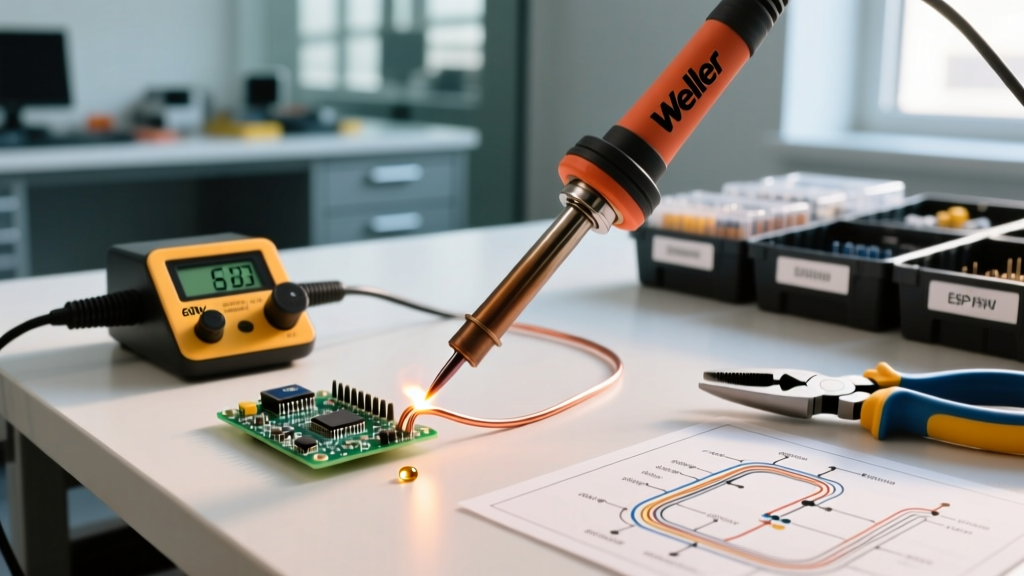
When most users search for a Weller 60W soldering iron, they are referring to the Weller SP60NKUS (or the older SP60N). Priced consistently between $35 and $45, this mains-powered stick iron utilizes a traditional mica-wound heating element and ships with a CT6F7 (1/16-inch conical) tip.
Where the SP60 Excels
- High Thermal Mass Tasks: For soldering 12AWG to 14AWG automotive wires, XT60 battery connectors, or heavy through-hole potentiometers, the raw thermal mass of the CT6 tip and continuous 60W draw can brute-force large joints.
- Zero Calibration Required: There are no PID controllers to fail, no digital screens to crack, and no firmware to update. It is a purely resistive circuit.
- Low Barrier to Entry: At under $40, it remains an accessible tool for infrequent household repairs.
Thermal Limitations and Failure Modes
The critical flaw of the SP60 is its lack of closed-loop feedback. The iron does not measure tip temperature; it simply pumps 60 watts into the heater core. When the tip contacts a multi-layer printed circuit board (PCB) with an internal ground plane, the copper acts as a massive heat sink. The tip temperature plummets—a phenomenon known as thermal droop. Because the mica element takes 45 to 60 seconds to recover, operators are forced to hold the iron on the pad longer, frequently resulting in pad delamination or thermal damage to sensitive ICs.
The Premium Shift: Closed-Loop Temperature Control
To understand the value proposition of upgrading, we must compare the baseline Weller 60W against premium temperature-controlled stations in the 65W to 80W class. The industry standards here are the Weller WE1010NA (70W) and the Hakko FX-888D (70W).
| Feature | Weller SP60NKUS (Budget) | Weller WE1010NA (Premium) | Hakko FX-888D (Premium) |
|---|---|---|---|
| Wattage | 60W (Unregulated) | 70W (PID Controlled) | 70W (PID Controlled) |
| Temperature Feedback | None | Digital Closed-Loop | Digital Closed-Loop |
| Thermal Recovery | ~45-60 seconds | < 3 seconds | < 4 seconds |
| Tip Series | CT6 (Mica Heater) | ET (Ceramic Heater) | T18 (Ceramic Heater) |
| Average Price (2026) | $38 - $45 | $115 - $130 | $115 - $125 |
Premium stations utilize ceramic heating elements with integrated thermocouples. When the tip touches a cold solder joint, the sensor detects the micro-drop in temperature and instantly commands the PID controller to surge power to the heater, maintaining a stable 350°C (662°F) profile throughout the wetting phase.
Thermal Recovery and IPC Joint Reliability
According to the soldering standards established by IPC (Association Connecting Electronics Industries), a reliable solder joint requires proper wetting and intermetallic compound (IMC) formation. This occurs optimally when the solder alloy reaches its liquidus temperature within 1.5 to 3 seconds.
Expert Insight: When using an unregulated Weller 60W iron on a 4-layer PCB, the thermal droop prevents the solder from reaching liquidus quickly. The operator compensates by applying the iron for 6+ seconds. This prolonged dwell time boils the flux core prematurely, leaving a dry, oxidized joint that fails visual inspection and is prone to micro-cracking under thermal cycling.
Furthermore, excessive dwell times with unregulated irons generate significantly more particulate matter and volatile organic compounds (VOCs). Proper ventilation and fume extraction are critical, as outlined by OSHA workplace safety guidelines, to prevent respiratory irritation from colophony-based flux smoke.
Tip Metallurgy: Why Unregulated Irons Destroy Tips
A hidden cost of the budget Weller 60W soldering iron is tip consumption. Modern lead-free solder alloys, such as SAC305 (Tin/Silver/Copper), are highly aggressive and require higher operating temperatures (typically 340°C to 380°C).
Soldering iron tips are constructed from a copper core plated with a thin layer of iron to prevent the molten tin from dissolving the copper. In a premium station like the Weller WE1010NA, the iron powers down or enters a sleep mode when placed in the stand, preserving the iron plating. The SP60NKUS, however, remains at maximum thermal output continuously. If left idle in its stand for 15 minutes, the tip temperature can runaway past 450°C. At this temperature, the iron plating oxidizes rapidly and scales off, exposing the copper core to the SAC305 solder. The tip will pit and dissolve within a few weeks of regular use, negating the initial budget savings through constant replacement costs.
The 2026 Market Disruptor: Smart Irons
Any modern budget vs. premium analysis must address the rise of USB-C PD (Power Delivery) smart irons. The Pine64 Pinecil V2 (65W) and the Sequre MHP30 have fundamentally disrupted the market. Priced around $26 to $35, these irons feature 32-bit RISC-V microcontrollers, OLED displays, and rapid thermal recovery that rivals $150 benchtop stations. For the price of the Weller SP60NKUS, a DIYer can now acquire a fully regulated, programmable 65W iron—provided they already own a 65W+ USB-C PD laptop charger or DC power supply.
Decision Matrix: Which Iron Fits Your Workbench?
Stick with the Budget Weller 60W If:
- Your primary work involves heavy-gauge automotive wiring, RC battery connectors (XT90/AS150), or stained glass/plumbing applications where SMD precision is irrelevant.
- You solder fewer than five times a year and cannot justify the bench space required for a dedicated station.
- You need a rugged, drop-proof tool for field repairs where delicate digital screens would shatter.
Upgrade to a Premium Station (Weller WE1010NA / Hakko FX-888D) If:
- You regularly solder 0805 or smaller SMD components, QFP ICs, or multi-layer PCBs.
- You are doing professional or semi-professional repair work where joint reliability and IPC compliance are mandatory.
- You want to minimize long-term consumable costs by preserving tip life through automated sleep modes.
Choose a Smart Iron (Pinecil V2) If:
- You want premium temperature control on a strict budget.
- You value portability and the ability to power your iron from a high-capacity LiPo battery or laptop charger.
Frequently Asked Questions
Can I use the Weller 60W SP60 for SMD soldering?
While technically possible for large SMD components like SOIC-8 chips, it is highly discouraged for anything smaller than 1206. The lack of fine temperature control and the bulky CT6 tip make it extremely easy to bridge fine-pitch pads or melt adjacent plastic connectors.
Why does my Weller 60W tip turn black and stop melting solder?
This is called tip oxidation. Because the SP60 lacks sleep functionality, leaving it on while not actively soldering causes the tip to overheat and oxidize. Never use sandpaper or a file to clean an oxidized tip, as this will remove the protective iron plating. Instead, use a damp brass sponge and a generous amount of flux-core solder to re-tin the tip.
Are Weller ET tips compatible with the SP60?
No. The Weller SP60 uses the CT6 series tips, which are designed for mica heating elements. The ET series tips are designed for the ceramic heating elements found in Weller's premium stations like the WES51 or WE1010NA. Attempting to force incompatible tips will result in poor thermal transfer and potential damage to the heater core.
For more detailed specifications and official warranty information on professional-grade equipment, always refer to the official Weller Tools documentation.