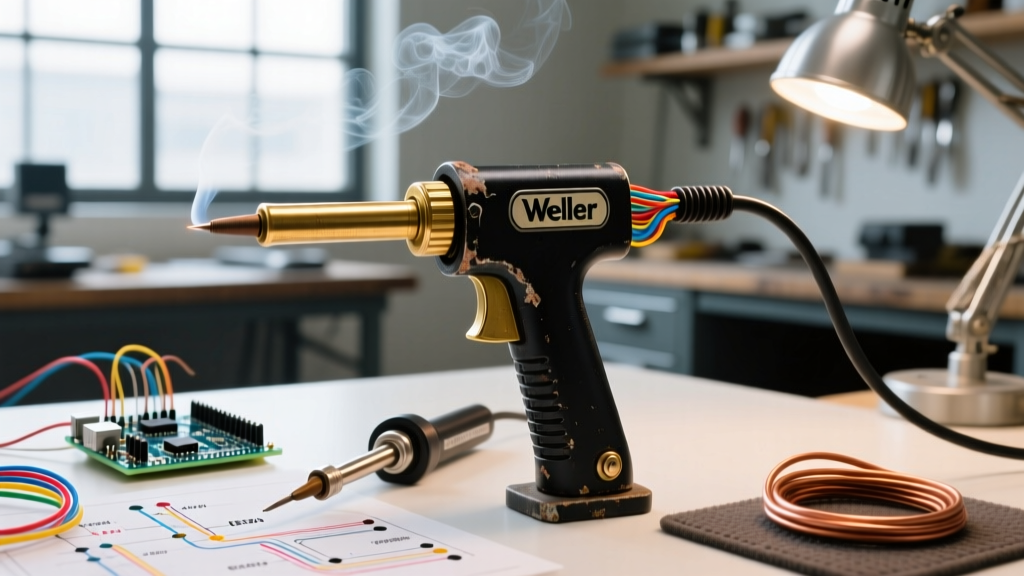

When clearing out a legacy workshop or browsing estate sales, you will inevitably encounter a heavy, pistol-grip tool: the classic transformer-based soldering gun. Models like the Weller D-550, Weller 8200, or the vintage Ungar 4050 are legendary for their instantaneous heat. However, as we navigate the advanced PCB layouts, dense ground planes, and sensitive components of 2026, many hobbyists and professionals mistakenly relegate these tools to the scrap bin. An old soldering gun is not obsolete; it is simply misunderstood. When applied to the correct tasks and properly restored, these high-thermal-mass tools outperform modern ceramic stations for heavy-duty wiring, large chassis grounds, and high-current RC battery connectors.
The Physics of the Transformer Gun
Unlike modern soldering stations that use resistive ceramic heating elements (like the Hakko FX-951 or Pinecil V2) powered by low-voltage DC, a traditional soldering gun operates on a completely different principle. It utilizes a step-down transformer. The primary coil connects directly to 120V AC mains, while the secondary coil consists of a single, massive loop of copper or aluminum that terminates at the soldering tip.
This design drops the voltage to roughly 0.2V AC but multiplies the current to hundreds of amps. The tip itself acts as a resistive heating element. Because the thermal mass of the tip is relatively low but the electrical current is massive, the tip reaches 1000°F (540°C) in under three seconds. This instantaneous thermal recovery is unmatched by standard smart stations when dealing with massive heat sinks, but it introduces unique hazards and maintenance requirements.
Diagnostic and Restoration Techniques
Before plugging in a decades-old tool, you must address the mechanical and electrical degradation inherent to vintage gear. According to OSHA guidelines for hand and power tools, inspecting cords and internal contacts is mandatory for legacy equipment.
1. Re-Forging Pitted Copper Tips
Older guns use solid oxygen-free high conductivity (OFHC) copper tips. Over time, flux corrosion and molten solder dissolve the copper, creating deep pits. Do not simply file it cold; copper work-hardens and will snap.
- Anneal the Tip: Heat the tip with a propane torch until it glows dull red, then quench it in water. This softens the copper crystalline structure.
- Re-shape: Use a flat bastard file to reshape the working face into a smooth, flat chisel or a blunt cone, depending on your application.
- Pre-tin Immediately: While the tip is still warm from the first electrical cycle, apply rosin-core solder to prevent instant oxidation.
2. Trigger Switch Carbon Burnishing
The trigger switch on a Weller D-550 carries the full 120V primary current (often 10 to 12 amps). Over decades, the internal tungsten contacts develop carbon tracking, leading to voltage drops and intermittent heating. Disassemble the grip housing and inspect the contacts. If they are pitted or blackened, apply a specialized contact cleaner like Caig DeoxIT D5. Use a strip of heavy kraft paper soaked in the cleaner to burnish the contacts—pull the paper between the closed contacts to polish them without removing the protective plating.
3. Upgrading the Power Cord
Vintage cords from the 1970s and 80s often feature degraded rubber or early PVC jackets that crack and expose mains voltage. Cut the old cord at the strain relief and solder a modern 16 AWG SJTOW (heavy-duty, oil-resistant, flexible) cord. Ensure the grounding wire is securely bonded to the transformer core laminations to prevent chassis shock.
EMI and Leakage: The Hidden Dangers
The most critical reason technicians avoid an old soldering gun on modern PCBs is Electromagnetic Interference (EMI) and capacitive leakage. The massive 60Hz magnetic field generated by the transformer secondary can induce destructive voltages in unshielded inductors, Hall effect sensors, and sensitive CMOS logic gates.
Expert Warning: Never use a transformer-based soldering gun on a live circuit or near unshielded MOSFET gates. The induced magnetic spike can instantly blow the gate oxide layer, destroying the component before the solder even melts.
Furthermore, capacitive coupling between the 120V primary winding and the secondary loop can leak a few milliamps of AC current directly into the soldering tip. To test your gun, set a digital multimeter to the AC millivolt (mV) range. Place the black probe on a known earth ground and touch the red probe to the heated tip. A reading above 50mV AC indicates degraded internal insulation between the transformer windings, meaning the tool should be relegated to non-electronic plumbing or heavy chassis work only.
Technique Matrix: When to Deploy the Gun
Understanding where the old soldering gun excels versus modern stations is vital for workflow efficiency. Reference the IPC soldering standards for joint wetting requirements on heavy thermal mass connections.
| Application Scenario | Vintage Transformer Gun (e.g., Weller D-550) | Modern Smart Station (e.g., Hakko FX-951) |
|---|---|---|
| 8 AWG to 4 AWG Silicone Wire | Excellent: Massive current melts 63/37 solder instantly without cooling the wire. | Poor: Tip temperature crashes; requires pre-heating or high-wattage specialty tips. |
| XT90 / AS150 RC Battery Connectors | Excellent: 3-second heat cycle prevents melting the plastic connector housing. | Moderate: Prolonged dwell time risks melting the nylon housing. |
| 0805 / 0603 SMD Components | Catastrophic: EMI and physical size will destroy pads and components. | Excellent: Precise thermal control and micro-tips ensure safe wetting. |
| Large Chassis Ground Lugs | Excellent: Overcomes the thermal sink of the metal chassis effortlessly. | Poor: Station will enter thermal protection mode or fail to achieve wetting. |
Step-by-Step: Soldering 8 AWG Battery Leads
To demonstrate the proper technique for an old soldering gun, here is the definitive process for terminating 8 AWG silicone wire to an XT90 connector, a common task in high-power robotics and drone builds.
- Preparation: Strip exactly 7mm of insulation from the 8 AWG wire. Twist the strands tightly to prevent fraying.
- Pre-Tinning the Wire: Apply a generous amount of high-flux rosin paste to the bare copper. Trigger the gun to its high setting (260W on the D-550). Press the flat face of the tip against the wire. Feed 63/37 leaded solder (0.062" diameter) into the wire, not the tip, until the strands wick the solder completely. Limit the trigger pull to 4 seconds to prevent burning the flux.
- Pre-Tinning the Connector: Insert the pre-tinned wire into the XT90 gold bullet connector. Hold the connector vertically using a helping-hands tool with aluminum heat-sink clips to protect the plastic housing.
- The Final Joint: Apply a drop of liquid flux to the junction. Trigger the gun and press the tip directly against the side of the gold bullet and the wire simultaneously. The massive secondary current will bridge the gap, melting the pre-tinned surfaces into a single, shiny, concave fillet in under two seconds.
- Cool Down: Release the trigger immediately. Do not move the wire until the solder transitions from liquid to solid (roughly 1.5 seconds). Moving it during the plastic phase will create a cold, disturbed joint that fails under high-current vibration.
Frequently Asked Questions
Can I use an old soldering gun for stained glass or plumbing?
Yes, but with caveats. For stained glass, the rapid heat cycle is excellent for copper foil tacking, but you must use a dedicated, wide chisel tip to distribute heat across the foil. For plumbing, standard electronic solder (63/37) and rosin flux are strictly prohibited by code. You must use silver-bearing plumbing solder and water-soluble or tinning flux. However, a 260W gun often lacks the sustained thermal output required for 1/2" or 3/4" copper pipes; a propane or MAP gas torch remains the industry standard for large-diameter plumbing joints.
Why does my vintage gun buzz loudly when triggered?
The 60Hz hum is caused by the magnetic laminations in the transformer core vibrating against each other. If the buzzing is excessively loud or accompanied by a burning smell, the shellac insulating the transformer laminations has degraded, allowing the steel sheets to vibrate freely and potentially short. This requires a complete transformer rewind or replacement of the tool.
Is it safe to leave the gun plugged in on the workbench?
Unlike modern stations that feature sleep modes and digital thermal cutoffs, an old soldering gun relies entirely on a mechanical spring-loaded switch. If the tool is dropped or the trigger is snagged by a bench mat, it will remain energized indefinitely, leading to a melted tip, a fire hazard, or transformer burnout. Always unplug the tool when not actively holding it.