
The Great Debate: When You Sponge the Soldering Iron vs. Brass Wool
For decades, the default habit taught to every electronics hobbyist and assembly line technician was the same: wipe the hot tip on a wet cellulose sponge before every joint. However, as the electronics industry transitioned heavily toward lead-free alloys like SAC305 (Sn96.5/Ag3.0/Cu0.5) and newer doped variants in 2026, operating temperatures have climbed from the traditional 315°C to upwards of 360°C. This thermal shift has reignited a critical debate in workbench ergonomics and tool maintenance: should you sponge the soldering iron, or is a dry brass tip cleaner the superior choice?
The answer is not merely a matter of preference; it directly impacts the metallurgical lifespan of your soldering tips, your thermal recovery times, and the ultimate reliability of your solder joints. In this comprehensive comparison, we break down the physics, the failure modes, and the real-world costs of both methods to help you optimize your soldering station setup.
The Anatomy of an Iron-Clad Tip
To understand why cleaning methods matter, you must first understand tip construction. Modern high-quality tips (such as those from Hakko, Weller, and JBC) are not solid copper. They feature a highly conductive copper core plated with a layer of iron, which is then coated in chromium and finally pre-tinned with solder.
- Copper Core: Provides rapid heat transfer (thermal conductivity of ~398 W/m·K).
- Iron Plating: Prevents the solder from dissolving the copper. Without it, molten SAC305 would leach the copper away in minutes, creating catastrophic tip pitting.
- Chromium Layer: Applied to the back and sides of the tip to prevent solder from creeping up the shaft, which can cause oxidation and sensor interference.
When you clean a tip, you are interacting exclusively with the iron plating and the molten solder coating. The goal is to remove oxidized solder and flux carbon residue without compromising the microscopic iron layer.
The Case for Cellulose: When You Sponge the Soldering Iron
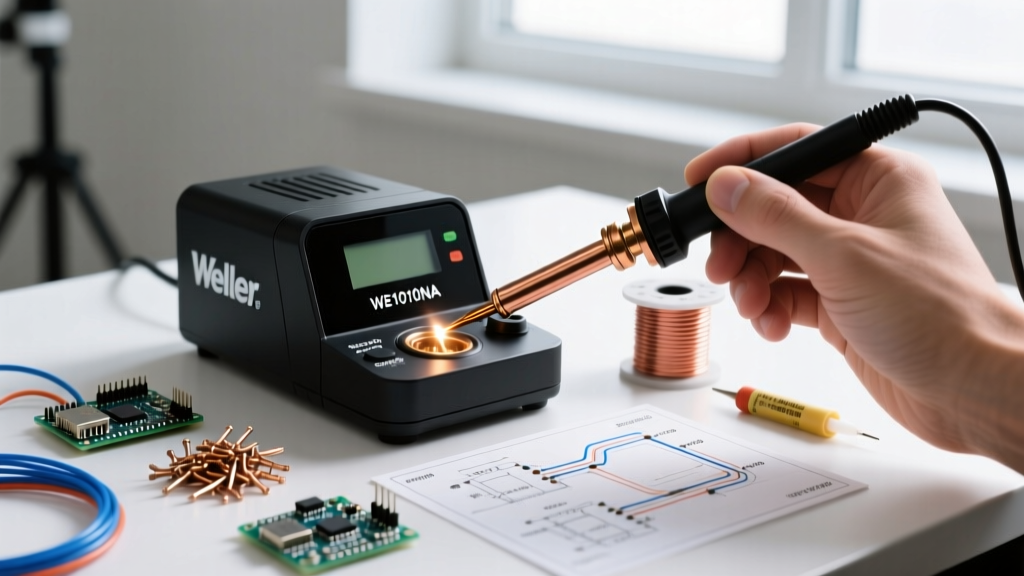
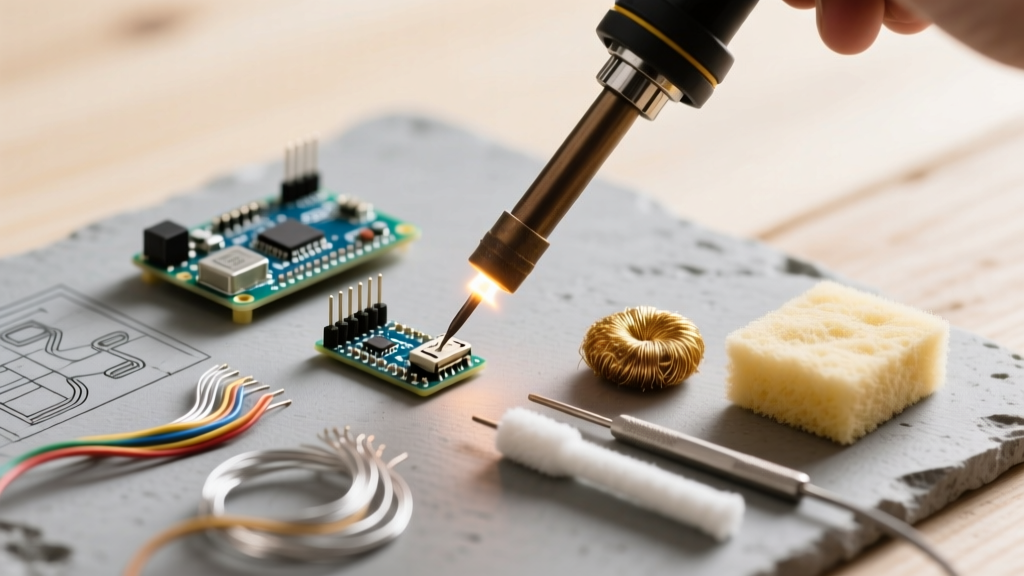
The traditional wet sponge remains the default accessory included in almost every entry-level and mid-range soldering station, from the Pinecil V2 to the Weller WE1010NA. Cellulose sponges are highly absorbent, cheap, and effective at mechanically wiping away heavy flux char.
The Physics of Thermal Shock
Water has a massive specific heat capacity. When a 360°C iron tip contacts a room-temperature wet sponge, the surface temperature of the tip can instantly plummet by 50°C to 100°C. This rapid temperature differential (Delta T) induces thermal shock. Over hundreds of cycles, this expansion and contraction causes micro-fractures in the electroplated iron layer. Once a micro-crack exposes the copper core to molten solder, the tip is effectively dead.
Best Practices for Sponge Cleaning
If you choose to sponge the soldering iron, strict adherence to maintenance protocols is required to minimize damage:
- Use Distilled Water Only: Tap water contains calcium and magnesium ions. When the water flashes to steam at 360°C, it leaves behind calcium carbonate (scale) on the tip. This scale acts as a thermal insulator, severely degrading heat transfer to your PCB pads.
- The 'Damp, Not Dripping' Rule: A waterlogged sponge causes maximum thermal shock and can send steam into the internal ceramic heating element of your handpiece, potentially causing sensor drift or corrosion on the internal contacts.
- Wipe, Don't Stab: Stabbing the tip into the sponge traps water against the chromium-plated shaft, promoting rust and galvanic corrosion.
The Case for Brass Wool: The Modern Alternative
Brass tip cleaners (often resembling a Brillo pad stuffed inside a metal or high-temp silicone bowl) have become the standard recommendation for high-reliability soldering. Popular models include the Hakko 599B (typically priced around $9–$12 in 2026) and the Weller WDC2 (around $15–$18).
Friction Without the Freeze
Brass is softer than the iron plating on your tip but harder than the oxidized solder and flux residue. When you plunge the tip into dry brass wool, the metal shavings scrape away the oxidation through mechanical friction. Because brass is a dry metal at ambient temperature, the thermal mass of the wool absorbs very little heat. The tip temperature drops by only 10°C to 20°C, virtually eliminating the risk of thermal shock and micro-cracking.
Pros and Cons of Brass Wool
- Pro: Preserves tip life by eliminating thermal shock.
- Pro: Requires zero water maintenance; no mineral scale buildup.
- Pro: Leaves a microscopic layer of solder on the tip, preventing instant re-oxidation when exposed to air.
- Con: Brass shavings can occasionally embed in soft, large solder joints if the tip is not tapped against the bowl after cleaning.
- Con: The wool eventually becomes clogged with oxidized solder and flux char, requiring periodic replacement or 'fluffing' with tweezers to expose fresh wire surfaces.
Head-to-Head Comparison Matrix
| Metric | Wet Cellulose Sponge | Dry Brass Wool (e.g., Hakko 599B) |
|---|---|---|
| Temperature Drop (Delta T) | 50°C - 100°C (High Thermal Shock) | 10°C - 20°C (Negligible Shock) |
| Tip Lifespan Impact | Accelerates micro-cracking in iron plating | Maximizes iron plating longevity |
| Oxidation Removal | Excellent for heavy flux char | Excellent for standard oxidation; struggles with heavy burnt rosin |
| Operating Cost | $2 - $5 (Generic multi-packs) | $9 - $18 (Branded replacement coils) |
| Maintenance | Requires daily distilled water topping | Requires monthly fluffing/replacement |
| Risk of Joint Contamination | Low (if using distilled water) | Moderate (brass shavings can stick to joints) |
What the Experts and IPC Standards Say
When evaluating high-reliability soldering, industry standards provide strict guidelines on tool maintenance. According to the IPC J-STD-001 requirements for soldered electrical and electronic assemblies, tip care is paramount to preventing cold joints and ensuring proper wetting. While the IPC does not explicitly ban sponges, it heavily emphasizes maintaining the thermal profile of the iron and preventing oxidation.
Furthermore, leading educators in the maker and professional space have shifted their recommendations. As noted in Adafruit's Guide to Excellent Soldering, brass tip cleaners are generally preferred for lead-free work because they do not subject the tip to the extreme thermal cycling of a wet sponge. Similarly, SparkFun's How to Solder Tutorial highlights that while sponges are acceptable if kept merely damp, brass wool is the superior choice for preserving the expensive, specialized tips required for modern micro-SMD components.
Real-World Failure Modes and Edge Cases
Understanding how these tools fail in real-world scenarios will help you troubleshoot workbench issues:
Failure Mode 1: The 'Black Tip' Syndrome
The Scenario: You use a wet sponge with tap water. Over a month, the tip turns dark grey/black and solder refuses to stick, instead balling up and rolling off.
The Cause: Calcium carbonate scale from the tap water has fused to the iron plating, combined with burnt flux carbon. The thermal shock from the water has also caused micro-pitting, trapping the carbon.
The Fix: Use a specialized tip tinner/reactivator (like Hakko FS-100) or gently polish with a fiberglass scratch pen. Never use sandpaper or a file, which will instantly destroy the iron plating.
Failure Mode 2: Brass Shavings in THT Vias
The Scenario: After cleaning with brass wool and immediately soldering a through-hole component, the joint fails visual inspection due to tiny metallic inclusions.
The Cause: The brass wool was heavily saturated with old, oxidized solder. When the tip was plunged in, microscopic brass shavings coated in brittle solder stuck to the tip and were transferred into the molten via.
The Fix: Tap the handpiece firmly against the edge of the brass bowl after cleaning to dislodge loose shavings. Replace the brass coil when it turns entirely grey and rigid.
Final Verdict: Which Should Be on Your Workbench?
For 90% of modern electronics work, especially when dealing with lead-free alloys, multi-layer PCBs, and high-density surface mount components, brass wool is the definitive winner. The preservation of your expensive iron-clad tips and the elimination of thermal shock far outweigh the minor inconvenience of occasionally tapping off loose brass shavings.
However, the wet cellulose sponge is not entirely obsolete. If you are doing heavy plumbing, soldering massive ground planes that require aggressive flux, or working in a dusty environment where the brass wool quickly becomes contaminated with environmental debris, a damp sponge (strictly using distilled water) remains a highly effective mechanical wiper. Ultimately, many veteran technicians in 2026 keep both on their bench: brass for routine micro-soldering and joint prep, and a barely-damp distilled sponge for heavy-duty flux removal at the end of a long session.