
The Legacy of the WESD51 and the Modern Shift
For over a decade, the Weller WESD51 soldering station was the undisputed king of the mid-tier digital electronics workbench. Replacing the analog dial of the legendary WES51 with a digital display and push-button temperature controls, it offered precision and lockout features that made it a favorite among both hobbyists and professional repair technicians. However, as we navigate the electronics landscape in 2026, the WESD51 has officially transitioned into legacy status. Weller discontinued the platform in favor of the modern WE1010, leaving buyers with a distinct choice: hunt for a well-maintained WESD51 on the secondary market, or invest in the current-generation WE1010?
This comprehensive tool comparison breaks down the thermal dynamics, tip ecosystems, known hardware failure modes, and real-world pricing of both stations to help you make an informed decision for your workbench.
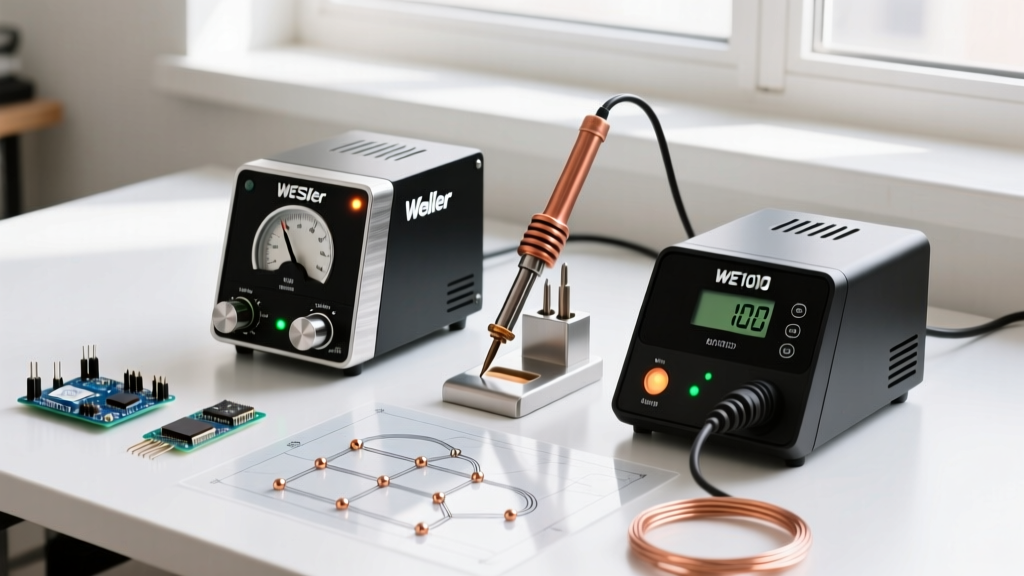
Quick Comparison Matrix: WESD51 vs WE1010
| Feature | Weller WESD51 (Legacy) | Weller WE1010 (Current) |
|---|---|---|
| Max Power Output | 50 Watts | 70 Watts |
| Iron Model | PES51 | WEP70 |
| Tip Series | ET Series (ETA, ETB, ETC) | XTL Series (XT-A, XT-B, XT-C) |
| Temperature Range | 350°F - 850°F (177°C - 454°C) | 122°F - 850°F (50°C - 450°C) |
| Display | Red LED Segment Display | High-Contrast LCD Screen |
| Calibration Method | Internal Trimpot (Hardware) | Digital Menu (Software) |
| Typical 2026 Price | $120 - $180 (Used/Surplus) | $135 - $160 (Brand New) |
Deep Dive: Thermal Recovery and Power Output
The most critical difference between these two stations lies in their thermal recovery capabilities. The WESD51 is capped at 50 watts. While 50 watts is more than sufficient for standard 0805 SMD components and light through-hole work, it struggles significantly when soldering to heavy ground planes or large multi-layer PCBs.
According to the thermal profiling guidelines outlined in the IPC J-STD-001 standards for soldered electrical assemblies, maintaining a stable tip temperature during the dwell time is crucial to prevent cold solder joints and pad delamination. When the WESD51's 50W PES51 iron hits a large copper pour, the temperature drops rapidly. The station's PID controller maxes out the 50W output, but the recovery time forces the technician to hold the iron on the pad longer, increasing the risk of thermal damage to surrounding components.
The WE1010 solves this with a 70-watt output and the WEP70 iron. The additional 20 watts, combined with a more aggressive heating algorithm, allows the WE1010 to maintain thermal stability on high-mass joints without requiring the operator to increase the base temperature setting. This means you can safely run the WE1010 at a lower baseline temperature (e.g., 320°C instead of 360°C), extending tip life and reducing flux burn-off.
Tip Ecosystem: ET Series vs XTL Series
Weller's tip architecture changed drastically between these generations. The WESD51 utilizes the classic ET series tips. These tips slide over a ceramic heating element and rely on a small set-screw for retention. The thermal mass of the ET series is relatively low, which is great for delicate work but poor for heavy joints.
The WE1010 uses the newer XTL series tips. As noted by Weller's official engineering documentation, the XTL tips feature a much larger internal cavity that wraps further around the heating element. This increased surface contact area drastically improves thermal transfer efficiency. Furthermore, the XTL tips use a knurled screw-on cap for retention, eliminating the infamous issue of ET set-screws stripping or seizing when exposed to years of oxidized flux.
Expert Warning on Tip Compatibility: You cannot use XTL tips on a PES51 iron, nor can you use ET tips on a WEP70 iron. If you have a massive inventory of expensive ET series tips (like the specialized ET-O or ET-V), you are locked into the WESD51 ecosystem or the older analog WES51.
Known Failure Modes and Maintenance
Buying legacy gear requires an understanding of its specific failure points. The WESD51 and its PES51 iron have a few well-documented weaknesses that you must inspect before purchasing a used unit in 2026.
1. PES51 Sensor Burnout and Tip Seizure
The PES51 iron integrates the thermocouple sensor directly into the ceramic heater assembly. Over time, flux creep and oxidation can cause the ET tip to fuse to the heater. If a technician uses pliers to forcefully twist and pull a seized tip, they will almost certainly snap the fragile thermocouple wires inside the wand. This results in a flashing 'Sensor Open' error on the WESD51 display. Replacing the PES51 heating element costs around $60, which severely cuts into the savings of buying a used station.
2. Handle Ribbon Cable Fatigue
The silicone jacket on the PES51 cord is stiff. Years of bending at the strain relief point near the handle cause the internal micro-wires to fracture. This leads to intermittent power loss or erratic temperature readings. Fixing this requires cutting open the silicone jacket, micro-soldering the broken wires, and applying heat shrink—a tedious repair for a beginner.
3. WE1010 Improvements
The WE1010's WEP70 iron features a vastly superior strain relief design and a modular heater/sensor architecture that is much more forgiving during tip changes. Furthermore, the WESD51 requires opening the chassis and turning a physical trimpot with a ceramic screwdriver to calibrate the temperature offset. The WE1010 handles calibration digitally via a hidden button-press menu, saving you from voiding warranties or risking static damage to internal potentiometers.
Pricing and Availability in 2026
The economics of choosing between these stations have shifted. A brand new Weller WE1010NA (the North American 120V variant) retails consistently between $135 and $160 from authorized industrial suppliers. It comes with a fresh warranty, a WEP70 iron, an XTL-B tip, and a modern safety rest.
Conversely, the WESD51 is only available on the secondary market (eBay, surplus liquidators, or local classifieds). Prices for a fully functional, tested WESD51 typically range from $120 to $180. Given that the WE1010 offers 40% more power, a better tip ecosystem, and digital calibration for roughly the same price, the WESD51 only makes financial sense if you can snag one locally for under $90 in pristine condition.
Frequently Asked Questions (FAQ)
Can I upgrade my WESD51 by plugging in the newer WEP70 iron?
No. The WESD51 uses a 5-pin DIN connector with a specific pinout designed for the PES51's resistance and thermocouple characteristics. The WEP70 iron uses a completely different connection standard and requires the 70W transformer and logic board found inside the WE1010. Attempting to cross-wire these will result in immediate component failure.
Is the WESD51 still safe to use for lead-free soldering?
Yes, but with limitations. Lead-free SAC305 solder requires higher tip temperatures (typically 350°C - 380°C). The WESD51 can reach these temperatures, but its 50W limit means thermal recovery on lead-free joints will be sluggish. You will need to use larger tip geometries, like the ET-C (chisel) or ET-K (knife), to maximize the thermal mass in contact with the pad.
Which station is better for micro-soldering and 0402 components?
For ultra-fine pitch work, neither station is ideal out-of-the-box compared to specialized micro-soldering rigs like the JBC CD-2BQE or Weller's own WXMP microsoldering handle. However, between the two, the WE1010 paired with an XT-A (micro conical) tip offers slightly better low-end temperature stability (capable of dropping to 122°F/50°C for cooling cycles) and faster response times than the WESD51.
Final Verdict
The Weller WESD51 soldering station is a masterpiece of 2010s bench equipment, built like a tank and capable of handling 90% of daily repair tasks. However, its 50W ceiling and aging PES51 failure points make it a tough recommendation in 2026 when the WE1010 exists. Unless you are inheriting a WESD51, already own a stockpile of ET tips, or find an unbeatable surplus deal, the WE1010 is the superior investment for modern electronics diagnostics and repair.