
When transitioning from through-hole to surface-mount technology (SMT), mastering the technique of soldering with hot air becomes non-negotiable. Whether you are reworking a QFN-64 IC, replacing a blown 0402 decoupling capacitor, or tackling BGA reflow, the convective heat transfer dynamics dictate your success. But does a $55 budget station compromise your PCB, or is a $650 premium Hakko strictly for high-volume manufacturing? In this 2026 analysis, we dissect the thermal, mechanical, and ESD realities of budget versus premium hot air rework stations to help you make an informed workbench investment.
The Physics of Convection: Why PID Control Matters
Unlike a soldering iron that relies on direct thermal conduction, soldering with hot air relies on forced convection. The efficiency of this heat transfer is governed by the air's velocity, volume, and the thermal mass of the component. Budget stations typically utilize basic hysteresis-based thermostats. This means the heating element cycles fully on and fully off, resulting in temperature swings of ±15°C to ±20°C at the nozzle tip.
Premium stations, conversely, employ advanced PID (Proportional-Integral-Derivative) controllers. A PID algorithm continuously calculates the error value as the difference between the desired setpoint and the actual measured temperature, applying a correction that minimizes overshoot. When working with lead-free SAC305 solder (which requires a peak reflow temperature of 235°C–245°C), a 20°C overshoot can easily push the localized PCB temperature past the glass transition temperature (Tg) of FR-4 substrates, causing delamination or pad lifting. Adhering to thermal profiling limits outlined in IPC J-STD-001 is virtually impossible with severe thermal hysteresis.
Budget Contenders: The $60 Reality Check
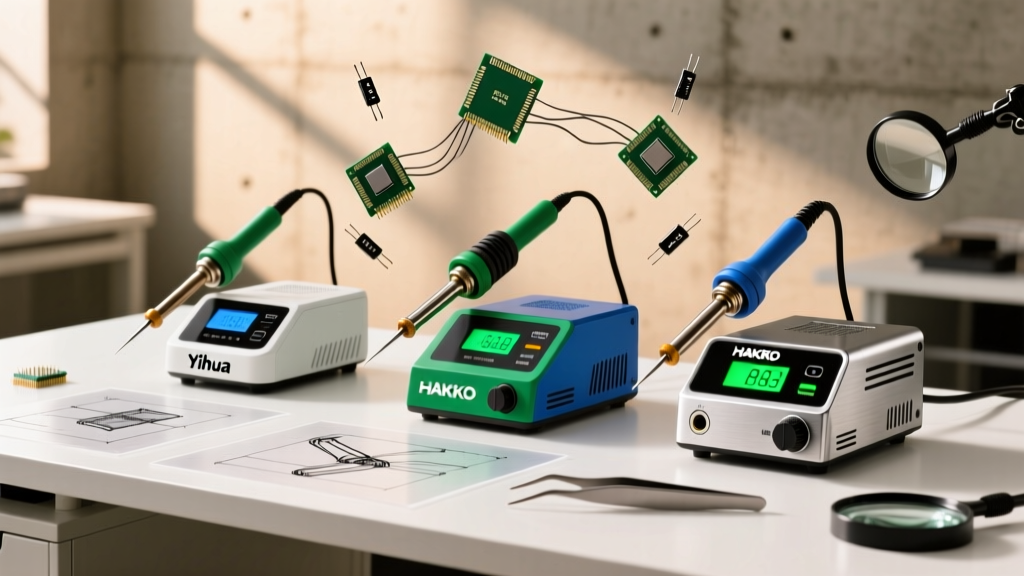
The undisputed king of the entry-level market remains the Yihua 858D (and its various clones), typically priced around $55 to $65 in 2026. It features a 700W ceramic heater and a diaphragm pump located in the base unit.
The Airflow Pulsation Problem
Diaphragm pumps generate airflow through a rapid mechanical pulsing action. While this is sufficient for desoldering large SOIC-8 chips, the micro-pulsations become a liability when soldering with hot air on micro-components. When reflowing 0201 or 0402 resistors, the uneven airflow vector can easily cause "tombstoning"—where the surface tension of the molten solder pulls the component upright on one end.
The ESD and Motor Risk
Budget handpieces house brushed DC motors to drive the cooling fan. Brushed motors generate carbon dust and electromagnetic interference (EMI). More critically, without a dedicated earth-ground connection running through the handpiece cable to the station chassis, static charge can accumulate on the nozzle. According to ESD Association Standards, sensitive CMOS components can be destroyed by electrostatic discharge events as low as 20 volts. If you are repairing bare-die RF modules or unshielded MOSFETs, a budget brushed motor poses a genuine risk.
Premium Powerhouses: Quick 861DW and Hakko FR-810B
Stepping into the premium tier ($250–$650), the engineering focus shifts from simply "blowing hot air" to precision thermal management and operator ergonomics.
Quick 861DW: The Prosumer Benchmark
Priced at approximately $260, the Quick 861DW is widely considered the gold standard for independent repair shops. It boasts a 1000W heater and a brushless turbine motor located in the base, pushing air through a static-dissipative hose to the handpiece. Because the motor is brushless and the hose is lined with conductive materials, the ESD risk is effectively neutralized. Furthermore, the 861DW features a magnetic auto-sleep sensor; placing the handpiece in the cradle instantly drops the temperature to 150°C and reduces airflow, drastically extending the lifespan of the heating element and preventing accidental bench fires.
Hakko FR-810B: Industrial Pre-Programmed Profiles
At the $650 mark, the Hakko FR-810B caters to high-reliability environments like aerospace and medical device manufacturing. Its standout feature is digital airflow control and programmable thermal profiles. Instead of manually adjusting dials mid-rework, the operator can program a multi-stage ramp-up and cool-down sequence. This ensures that heavy ground planes are saturated with heat evenly before the delicate component leads reach their melting point, preventing the dreaded "cold solder joint" on hidden thermal pads.
Head-to-Head Specification Matrix
| Feature | Yihua 858D (Budget) | Quick 857DW (Mid-Tier) | Quick 861DW (Premium) | Hakko FR-810B (Industrial) |
|---|---|---|---|---|
| 2026 Street Price | $55 - $65 | $140 - $160 | $250 - $280 | $620 - $680 |
| Heater Wattage | 700W | 600W | 1000W | 650W (High Efficiency) |
| Motor Type | Brushed (Handle) | Brushless (Handle) | Brushless (Base/Turbine) | Brushless (Base/Turbine) |
| Temp Stability | ± 15°C (Hysteresis) | ± 5°C | ± 2°C (PID) | ± 1°C (Advanced PID) |
| Airflow Mechanism | Diaphragm Pump | Diaphragm/Turbine Hybrid | High-Pressure Turbine | Digital Mass Flow Controller |
| ESD Safe Handle | No | Yes | Yes | Yes |
Hidden Costs: Nozzles, Maintenance, and Air Leaks
When evaluating the total cost of ownership for soldering with hot air, the initial hardware price is only half the equation. The nozzle ecosystem represents a significant hidden cost.
- Thread Tolerances: Quick and Hakko utilize different thread pitches and nozzle seating depths. Purchasing $5 clone nozzles from third-party marketplaces often results in a 0.5mm variance in thread depth. This microscopic gap causes air leakage before the air reaches the component.
- The Pressure Drop Effect: A 15% air leak at the nozzle base forces the station's pump to work harder, altering the calibrated L/min output. To compensate for the perceived lack of heat, operators inevitably turn up the temperature dial, leading to localized scorching of the PCB solder mask.
- Hose Replacement: Budget stations use rigid, cheap silicone hoses that crack and lose flexibility within 18 months of daily use. Premium stations use multi-layered, static-dissipative polyurethane hoses that remain supple for years but cost $40+ to replace.
Actionable Advice: The Perfect Lead-Free QFN Rework Profile
Regardless of whether you are using a budget or premium station, following a strict thermal profile is critical for modern lead-free assemblies. Here is a proven 4-step profile for reworking a QFN-48 IC using SAC305 solder paste:
- Preheat (120°C - 150°C): Use a wide-flow nozzle (e.g., 10mm diameter). Set the station to 180°C with low airflow (20 L/min). Keep the nozzle 15mm above the PCB and move in slow, concentric circles for 60 seconds. This activates the flux and prevents thermal shock.
- Soak / Ramp (180°C - 210°C): Increase station temperature to 250°C. Move the nozzle closer (8mm standoff). Dwell for 45 seconds. This allows the heavy ground pads beneath the QFN to absorb heat via conduction from the traces.
- Peak Reflow (245°C): Switch to a square nozzle that closely matches the IC footprint. Set the station to 320°C with medium airflow (35 L/min). Hold at a 5mm standoff. The actual air hitting the chip will measure ~245°C. Watch for the solder paste to transition from a dull grey to a shiny, liquid metallic state (usually 20-30 seconds).
- Natural Cool-Down: Remove the heat and let the board sit undisturbed. Never use compressed air or a desk fan to force-cool the joint. Rapid cooling induces micro-cracking in the crystalline structure of lead-free solder, a direct violation of aerospace and IPC reliability standards.
Frequently Asked Questions
Can I use a heat gun instead of a dedicated hot air station?
While a hardware store heat gun can technically melt solder, it is highly discouraged for precision electronics. Heat guns lack PID temperature control, often exceeding 400°C at the core, which will instantly delaminate multi-layer PCBs and melt plastic connectors. Furthermore, they lack the focused, low-velocity airflow required to keep tiny SMD components anchored to their pads.
How often should I calibrate my hot air station?
For hobbyists, an annual visual inspection and basic thermometer verification is sufficient. For professional repair shops adhering to ISO 9001 or IPC standards, stations should be calibrated every 6 months using a certified digital thermal profiler and a surface-mount thermocouple attached directly to a dummy PCB.
Why does my budget station blow 0402 capacitors off the board?
This is caused by the high-velocity air spikes inherent to diaphragm pumps found in budget models. To mitigate this, increase your standoff distance (move the nozzle further away), use a wider nozzle to disperse the air pressure, and rely on lower temperatures with longer dwell times rather than brute-force heat and high airflow.
The Verdict: Matching the Station to Your Workbench
If your workbench primarily sees through-hole repairs, occasional large SMD connector replacements, and hobbyist Arduino projects, the Yihua 858D remains an unbeatable value at $60. However, if your daily workflow involves smartphone logic board micro-soldering, automotive ECU repair, or reworking dense BGA chips, the investment in a Quick 861DW ($260) is mandatory. The brushless motor, ESD safety, and PID thermal stability will pay for themselves by preventing catastrophic damage to expensive donor boards and irreplaceable customer hardware.