
The Terminology Trap: Tips vs. Nozzles in Soldering Stations
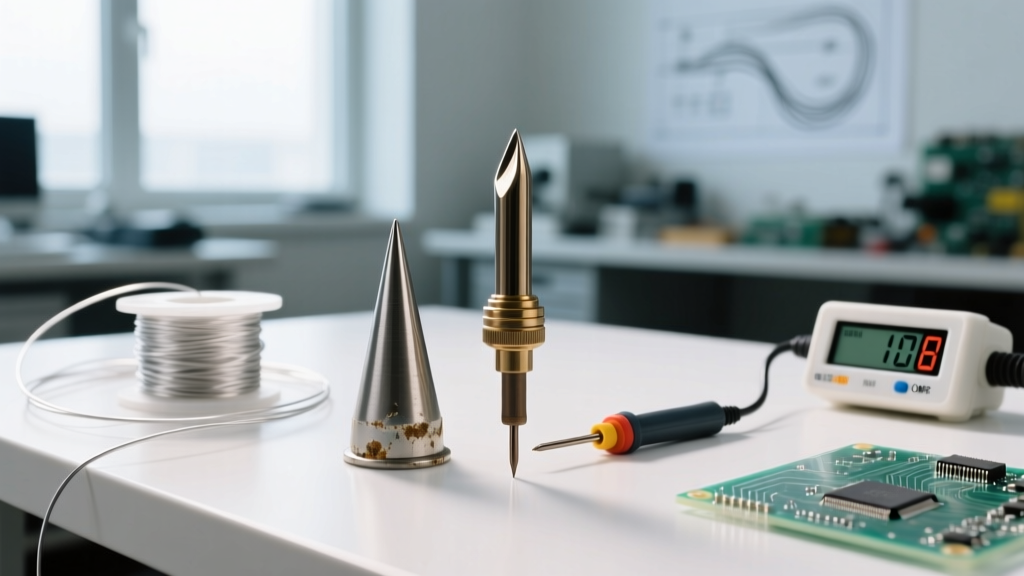
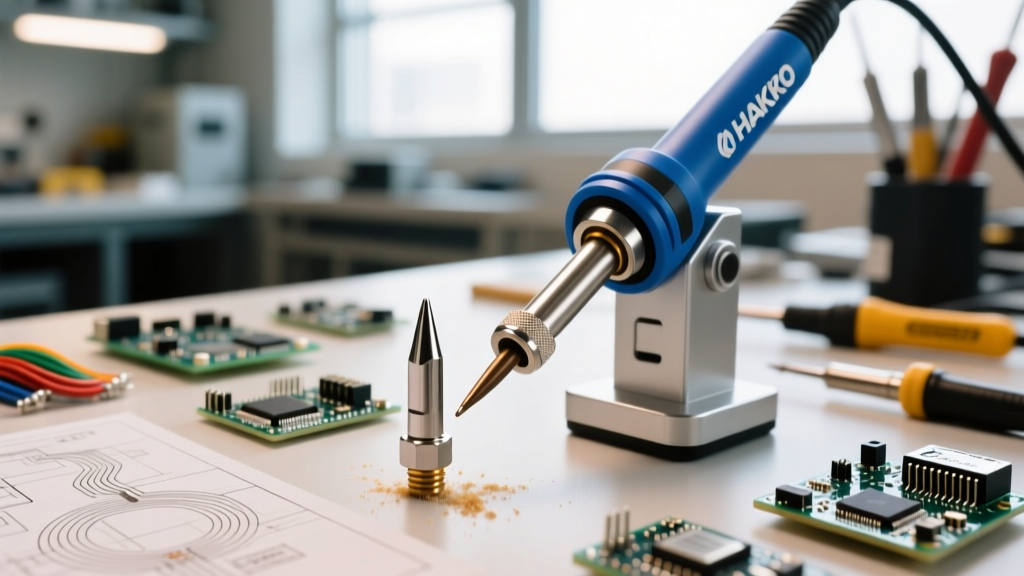
When hobbyists and professionals search for a nozzle for soldering station setups, they are usually encountering a critical terminology overlap. In the electronics rework industry, a 'tip' refers to the solid copper/iron alloy attachment on a conductive soldering iron (like the Hakko FX-888D). A 'nozzle,' however, almost exclusively refers to the hollow, airflow-directing attachments used on hot air rework stations or vacuum desoldering stations.
As we navigate the manufacturing and repair landscape in 2026, the shift toward lead-free SAC305 and SAC405 alloys requires highly precise thermal profiles. Using the wrong hot air nozzle can result in tombstoning, pad lifting, or thermal damage to adjacent sensitive ICs. This feature deep dive explores the physics, brand ecosystems, and practical selection criteria for hot air and desoldering nozzles.
Core Anatomy and Material Science
A high-quality hot air nozzle is not just a bent piece of metal. OEM nozzles from top-tier brands are typically manufactured from high-grade stainless steel or brass, often with specialized internal plating to resist oxidation and flux carbon buildup.
- Inner Diameter (ID): Dictates the spread of the thermal column.
- Wall Thickness: Thinner walls allow for tighter clearance in dense PCB layouts but are more prone to warping if dropped.
- Mounting Collar: The interface with the handpiece. This varies wildly between screw-on, slip-on, and magnetic quick-change systems.
Matching Nozzle Geometry to SMD Footprints
Selecting the correct shape and size is the most critical step in SMD (Surface Mount Device) rework. According to guidelines referenced by the Surface Mount Technology Association (SMTA), the nozzle should encompass the component body without directly blasting adjacent, smaller components.
| Component Type | Typical Footprint | Recommended Nozzle Shape | Optimal Dimensions (Approx) |
|---|---|---|---|
| 0402 / 0603 Passives | 1.0 x 0.5 mm | Round (Small ID) | 2.0mm - 3.0mm |
| SOIC-8 / SOP-8 | 5.0 x 4.0 mm | Rectangular / Oval | 6.0 x 5.0 mm |
| QFP-44 / QFP-64 | 10.0 x 10.0 mm | Square | 12.0 x 12.0 mm |
| BGA / QFN | Variable | Custom Square / Round | Component Size + 2mm |
Airflow Dynamics: The Bernoulli Effect in Rework
One of the most common failures in DIY and entry-level professional rework is blowing tiny components off the board. This is a fluid dynamics issue, not just a temperature issue.
Expert Insight: Your station's pump generates a specific volume of air (measured in Liters/Minute or CFM). When you force that fixed volume through a smaller nozzle ID, the velocity of the air increases dramatically. A 4.0mm nozzle at 30L/min will hit a 0402 capacitor with significantly more kinetic force than a 10.0mm nozzle at the same pump setting.
Therefore, when stepping down to a micro-nozzle for precision work, you must proportionally reduce the airflow dial on your station to prevent the 'wind tunnel' effect.
Brand Ecosystems: Compatibility and Pricing (2026 Market)
The market is heavily segmented by proprietary mounting mechanisms. Buying third-party clones is common, but understanding the OEM baselines is essential for thermal consistency.
1. Quick Ecosystem (858D, 861DW, TR-1100)
Quick dominates the mid-tier and professional repair market. The Quick 861DW, a staple on repair benches globally, uses a threaded screw-on collar.
- Round Series (e.g., Quick 801045): Ranges from 2.0mm to 12.0mm. OEM price: ~$14 USD.
- Square Series (e.g., Quick 801055): Essential for QFP and QFN chips. OEM price: ~$16 USD.
- Failure Mode: Cheap $3 generic clones often have poorly machined threads that strip the aluminum collar on the handpiece over time. Always use OEM or verified high-tier clones (like those from AiXun or Sugon).
2. Hakko Ecosystem (FR-811, FM-206)
Hakko's approach leans heavily into automated alignment and high-volume manufacturing standards, aligning with the rigorous IPC-7711/7721 standard for rework.
- FR-811 Hot Air Preheater/Rework: Uses the B5184 series nozzles. These are expensive, often ranging from $60 to $120+ USD per nozzle, but feature built-in vacuum pickup mechanisms for automated component removal.
- FM-206 / FM-2024 Handpiece: Uses slip-on or set-screw nozzles depending on the exact wand model. Less standardized than Quick, requiring careful cross-referencing of the handpiece model number.
3. JBC Ecosystem (JTSE, HDE)
JBC revolutionized the market with magnetic quick-change cartridges. Their hot air nozzles follow a similar philosophy. The JBC JTSE station utilizes specialized nozzles that snap magnetically or via quick-release collars, allowing swaps in under 2 seconds without burning your fingers. JBC nozzles command a premium (often $50+ USD) but offer unparalleled concentricity and heat retention.
The 'Other' Nozzle: Vacuum Desoldering Stations
If your work involves through-hole components or removing multi-layer ground plane vias, the 'nozzle' you need belongs to a desoldering gun (e.g., Hakko FR-4104 or FR-301). These nozzles are fundamentally different:
- Hollow Core: They act as a vacuum chamber to suck up molten solder.
- Ceramic Heating Elements: Many modern desoldering nozzles house the ceramic heater directly inside the nozzle body for instant thermal recovery.
- Maintenance Intensive: The internal bore must be cleared with a specialized cleaning pin after every single use. If solder solidifies inside the bore, the nozzle becomes a $15 paperweight.
Maintenance, Cleaning, and Failure Matrix
Flux residue, particularly from modern no-clean and Rosin Mildly Activated (RMA) fluxes, bakes onto the exterior and interior of hot air nozzles. This carbon buildup acts as a thermal insulator and alters the airflow dynamics.
According to reliability data from the NASA Electronic Parts and Packaging (NEPP) Program, maintaining tool geometry is vital for preventing localized thermal shock to aerospace and high-reliability components.
Expert Troubleshooting Matrix
| Symptom | Root Cause | Actionable Fix |
|---|---|---|
| Component blows away before solder melts | Airflow velocity too high for nozzle ID; using round nozzle on rectangular part. | Drop pump speed by 15-20%; switch to a shaped (square/rectangular) nozzle to distribute air. |
| Uneven melting on QFP pins | Nozzle is warped or bent, causing asymmetric airflow. | Inspect nozzle rim on a flat glass surface. Replace if warped; do not attempt to bend back. |
| Solder takes too long to reflow | Heavy flux carbon buildup on inner walls; thermal insulation effect. | Soak in 99% IPA or use an ultrasonic cleaner. Scrub exterior with brass wool (never steel). |
| Threads stripping on handpiece | Cross-threading or using out-of-spec clone nozzles. | Replace handpiece collar if damaged. Switch to OEM nozzles with machined brass collars. |
Final Verdict: Building Your Nozzle Arsenal
Do not attempt to build a complete collection on day one. For 90% of SMD rework tasks in 2026, a technician only needs three hot air nozzles: a 3.0mm round for 0402/0603 passives and SOT-23 transistors, an 8.0mm x 8.0mm square for QFP and QFN ICs, and a 12.0mm round for broad preheating and large BGA soaking. Invest in OEM nozzles for these three sizes to ensure perfect thread tolerances and consistent thermal delivery, and rely on your station's temperature and airflow dials to bridge the gaps for edge-case components.