
The Hidden Engineering of the Soldering Iron Stand
When building a workbench, most hobbyists and professionals obsess over the soldering iron itself—focusing on wattage, thermal recovery, and microcontroller precision. However, the soldering iron with stand combination is the true unsung hero of electronics assembly. The stand dictates your workflow ergonomics, bench safety, and, most critically, the lifespan of your soldering tips. In 2026, the market is sharply divided between ultra-budget portable setups and premium cartridge-based stations. But does a $250 premium setup actually offer a better return on investment than a $35 portable kit?
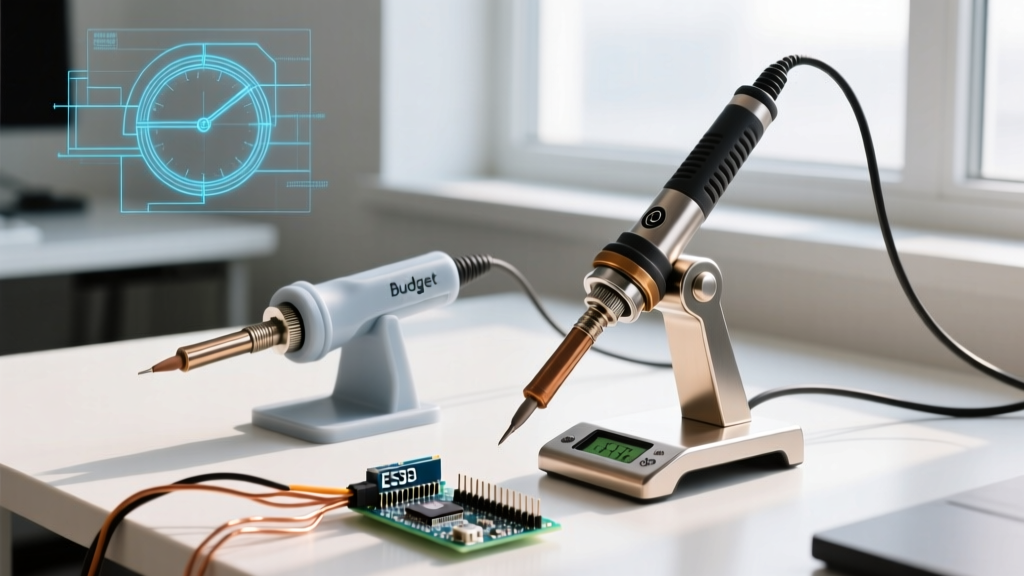
In this deep-dive analysis, we compare the modern budget king—the Pine64 Pinecil V2 paired with a generic wire stand—against the industry-standard premium setup: the JBC AL-2A intelligent stand paired with a T245 cartridge handle. We will break down the thermal dynamics, oxidation mathematics, and total cost of ownership to help you decide which tier belongs on your desk.
Budget Contender: Pine64 Pinecil V2 + Generic Wire Rest
The Pine64 Pinecil V2 has completely disrupted the budget soldering market. Powered by a Bouffalo Lab RISC-V MCU, it supports USB-C Power Delivery 3.0 up to 65W and heats a standard TS100-compatible tip to 350°C in under 8 seconds. However, because it is a portable stick iron, it does not come with a standalone base. Users typically pair it with a $5 stamped steel wire rest or a 3D-printed PETG cradle.
Real-World Performance and Ergonomics
The generic wire stand is purely functional. It features a coiled steel spring designed to catch the cylindrical body of the Pinecil. While it prevents the hot tip from touching your workbench, it introduces several engineering compromises:
- Center of Gravity Issues: The Pinecil is incredibly lightweight (30g), but the thick, braided USB-C silicone cable creates a rearward weight bias. On a lightweight wire stand, the iron frequently tips backward, pulling the tip out of the cradle and exposing it to the air.
- Zero Thermal Management: The stand lacks any magnetic or reed-switch sensors. When placed in the wire rest, the Pinecil remains at its target temperature (e.g., 360°C) indefinitely unless the user manually enables the software-based sleep mode via the onboard OLED screen.
- Wrist Extension: Wire stands force the handle into a shallow 15-to-20-degree upward tilt. Over a 4-hour soldering session, this forces the user's wrist into extension, leading to fatigue compared to a drop-in cradle design.
Premium Contender: JBC AL-2A Stand + T245 Cartridge Handle
At the opposite end of the spectrum is the JBC AL-2A Stand, designed exclusively for JBC's C245 cartridge handles. This setup is not just a place to rest your iron; it is an active thermal management system. The stand communicates directly with the JBC control station (like the CD-2BQF) to manage power delivery based on the handle's physical location.
Intelligent Sleep Modes and Ergonomic Design
The AL-2A justifies its premium price tag through several highly specific design choices that directly impact soldering quality and tip longevity:
- Reed Switch Proximity Sensor: A magnetic reed switch is embedded exactly 18mm from the base of the cradle. The moment the T245 handle is seated, the station drops the tip temperature to 150°C within 2 seconds. After 120 minutes of inactivity, the station cuts power entirely.
- 15-Degree Angled Brass Wool: Unlike cheap stands that use a flat brass sponge (which forces you to lift the iron to wipe it), the AL-2A integrates a brass wool cartridge angled at 15 degrees. You simply drag the tip downward through the wool, allowing for one-handed tip cleaning without breaking your visual focus on the microscope or workpiece.
- Silicone Cord Guide: A flexible silicone tube extends from the rear of the stand, elevating the heavy JBC cable above the workbench. This eliminates cable drag, a crucial factor when soldering 0402 surface-mount components where a millimeter of resistance can ruin pad alignment.
Head-to-Head Comparison Matrix
| Feature | Pinecil V2 + Wire Stand (Budget) | JBC AL-2A + T245 (Premium) |
|---|---|---|
| Total Setup Cost (Approx.) | $35 - $45 | $230 - $260 |
| Heating Element Type | Ceramic Core (Separate from tip) | Integrated Cartridge (Heater inside tip) |
| Heat-Up Time (to 350°C) | 8 - 11 seconds | 2.0 - 2.5 seconds |
| Auto-Sleep Sensor | No (Software/Manual only) | Yes (Hardware Reed Switch) |
| Tip Cleaning Medium | None included (Sponge bought separately) | Integrated 15° Brass Wool |
| Footprint on Bench | 45mm x 35mm (High tip-over risk) | 110mm x 95mm (Weighted, stable) |
| Replacement Tip Cost | $4 - $8 (Generic TS100 clones) | $40 - $45 (OEM C245 Cartridges) |
The True Cost of Ownership: The Oxidation Problem
According to DigiKey's technical guides on soldering station basics, the primary cause of soldering tip failure is oxidation, which destroys the iron plating and prevents heat transfer to the solder joint. The rate of oxidation roughly doubles for every 10°C increase in temperature above 350°C.
The Idle Penalty: When a budget iron sits in a 'dumb' wire stand at 360°C for 30 minutes while you troubleshoot a schematic, the tip undergoes severe thermal stress. The flux residue carbonizes, and the iron plating micro-fractures. A $5 generic TS100 tip used in a stand without auto-sleep will typically suffer catastrophic de-wetting (where solder refuses to stick to the tip) within 3 to 4 months of regular hobbyist use.
Conversely, the JBC AL-2A's reed switch drops the temperature to 150°C the second you let go of the handle. At 150°C, oxidation effectively halts. Furthermore, because the heating element is inside the C245 cartridge itself, the system can recover from 150°C to 350°C in under two seconds when you pick it back up. This means you never have to leave the iron at a high temperature 'just in case' you need it in five minutes.
Calculating the 3-Year TCO (Total Cost of Ownership)
Let's assume a professional or serious hobbyist solders for 10 hours a week. Over 3 years, the tip replacement costs tell a fascinating story:
- Budget Setup: Replacing a degraded generic tip every 3 months at $6 each equals $72 in tips over 3 years. Add the initial $40 setup cost, and the 3-year TCO is $112.
- Premium Setup: A genuine JBC C245 cartridge costs $42. Because it is protected by the AL-2A's sleep mode and cleaned via brass wool (which doesn't induce thermal shock like wet sponges do), a single cartridge easily lasts 18 to 24 months. Over 3 years, you will buy 2 cartridges ($84). Add the initial $250 setup cost, and the 3-year TCO is $334.
While the premium setup remains significantly more expensive in absolute terms, the delta in ongoing maintenance costs is surprisingly narrow. You are paying a premium for the hardware, not for replacement consumables.
Final Verdict: Which Tier Do You Actually Need?
The decision between a budget and premium soldering iron with stand ultimately comes down to your workflow cadence and the scale of your components.
Choose the Budget Pinecil + Wire Stand If:
You are a hobbyist working primarily on through-hole components, thick gauge wiring, or occasional repairs. If your soldering sessions involve picking up the iron, making a joint, and immediately turning it off, the lack of an auto-sleep stand won't hurt you. The Pinecil's 65W PD capability and RISC-V precision offer unmatched value for intermittent use. Just be sure to manually toggle the sleep mode in the firmware settings when you set it down.
Choose the Premium JBC AL-2A + T245 If:
You are doing high-density SMD rework, soldering 0402 or 0201 components under a microscope, or running a professional repair shop. The AL-2A stand is not just a holder; it is an integrated part of the thermal loop. The weighted base prevents bench disasters, the silicone cord guide eliminates micro-movements during delicate SMD tack-soldering, and the reed-switch sleep mode guarantees your $42 cartridges will last for years. In a professional environment where a single lifted pad on a $500 logic board costs more than the entire JBC stand, the premium setup pays for itself on the very first complex repair.