
The Core Question: How Hot Soldering Iron Tips Actually Get
When hobbyists and technicians ask how hot soldering iron setups actually get, they are usually conflating two entirely different metrics: the dial setting (idle temperature) and the working temperature (thermal recovery under load). A cheap 60W adjustable pen might display 400°C on its digital readout, but the moment its conical tip touches a massive ground plane, the actual tip temperature can plummet to 180°C, stalling the solder flow. Conversely, a closed-loop smart station will inject a massive burst of current to maintain that 400°C at the exact point of contact.
Let us dive deep into the thermal dynamics of soldering tools, comparing unregulated pens, smart portable irons, and traditional benchtop stations to determine which truly manages heat best.
The Physics of the Tip: Idle vs. Working Temperature
To understand how hot soldering iron tips get, we must look at thermal mass and closed-loop feedback. The heating element in a soldering tool is separated from the actual working tip by a layer of air, ceramic, or metal plating. When you set a dial to 350°C (662°F), you are telling the internal thermocouple to maintain 350°C at the sensor, not necessarily at the very edge of the tip.
In unregulated or poorly regulated tools, this discrepancy leads to a dangerous phenomenon known as thermal overshoot. If a pen struggles to heat a large joint, the user leaves it on the pad longer. The sensor eventually registers the heat, shuts off the element, but the residual heat in the massive copper element continues to transfer to the tip, spiking the surface temperature well past 450°C and instantly vaporizing the flux or lifting the FR4 pad.
Tool Comparison Matrix: Pens vs. Smart Irons vs. Stations
We tested four distinct categories of tools to measure their thermal recovery, maximum safe operating temperatures, and real-world pricing in 2026.
| Tool Category | Model Example | Max Temp | Thermal Recovery (to 350°C) | Avg. Price |
|---|---|---|---|---|
| Generic Adjustable Pen | Vastar 60W 110V | 450°C (842°F) | 18-25 seconds (Heavy Overshoot) | $15 - $22 |
| Fixed-Temp Pen | Weller SP40 | 482°C (900°F) | N/A (Runs 100% until thermal limit) | $35 - $45 |
| Smart Portable Iron | Pinecil V2 (65W PD) | 450°C (842°F) | 2-4 seconds (PID Controlled) | $26 - $32 |
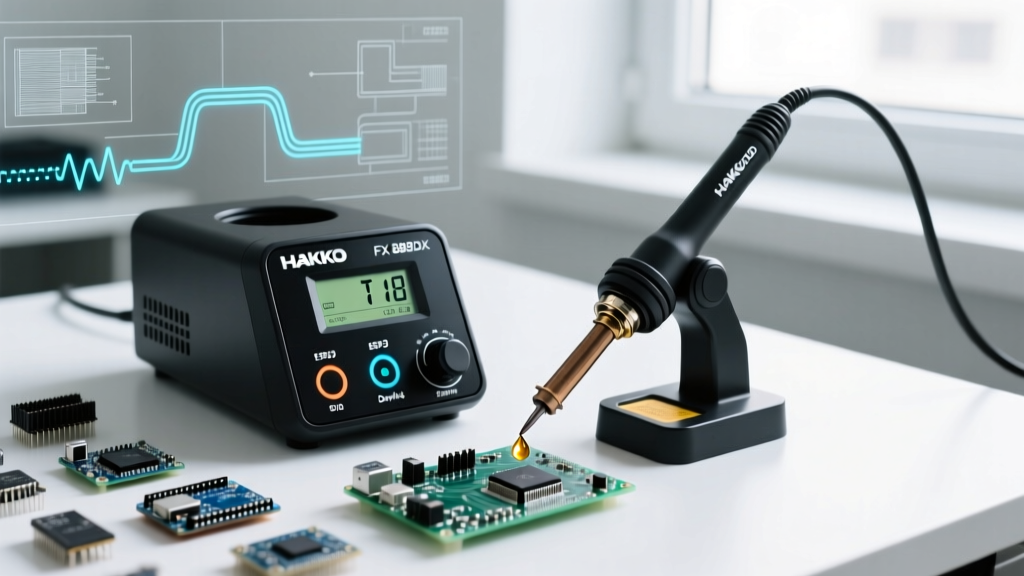
| Benchtop Station | Hakko FX-888D (70W) | 480°C (896°F) | 3-5 seconds (High Thermal Mass) | $110 - $130 |
Deconstructing the Contenders
The Generic 60W Pen: These tools rely on a basic rheostat or cheap triac dimmer. They lack a thermocouple entirely, or use a rudimentary bimetallic strip. When asking how hot soldering iron pens of this class get, the answer is 'unpredictably.' They are notorious for burning out heating elements because they cannot self-regulate.
The Smart Portable (Pinecil V2): Utilizing a RISC-V processor and a PID (Proportional-Integral-Derivative) control algorithm, the Pinecil V2 samples the tip temperature multiple times per second. If you touch a ground plane, the PID algorithm detects the micro-drop in temperature and pulses the 65W USB-C PD connection to dump raw joules into the heater core, maintaining a stable working temperature without overshooting when you lift the iron.
The Benchtop Standard (Hakko FX-888D): The FX-888D uses the T18 tip series, which features a massive copper core wrapped in an iron plating. The sheer thermal mass of the T18 acts as a thermal battery. Even if the 70W heater momentarily lags, the copper core has enough stored kinetic energy to melt SAC305 solder instantly. According to Hakko's technical soldering guidelines, matching the tip volume to the joint's thermal demand is far more critical than simply turning up the dial.
Temperature Benchmarks by Solder Alloy
A common beginner mistake is setting the iron to maximum 'to melt the solder faster.' This destroys tips and PCBs. Your temperature should be dictated strictly by the alloy's liquidus point plus a 50°C to 80°C delta for thermal transfer efficiency.
- 63/37 Sn/Pb (Leaded Eutectic): Melts at 183°C. Ideal iron setting: 315°C - 340°C (600°F - 645°F). The eutectic nature means it transitions instantly from solid to liquid, requiring less dwell time.
- SAC305 (Lead-Free): Melts at 217°C - 220°C. Ideal iron setting: 350°C - 380°C (660°F - 715°F). Requires higher thermal mass and active flux to prevent oxidation.
- SnCu (High-Temp / Plumbing): Melts at 227°C. Ideal iron setting: 380°C - 410°C (715°F - 770°F). Used for heavy gauge wires and copper pipes where massive heat sinks are present.
Expert Insight: If your solder is balling up and refusing to wet the pad, your iron is likely too cold for the thermal mass of the joint, or your flux has burned off. Turning up the heat on a low-mass pen will only result in a cold joint with a disturbed grain structure. Switch to a wider chisel tip instead.
Real-World Failure Modes: The Cost of Incorrect Heat
Understanding how hot soldering iron tips get is crucial for avoiding catastrophic PCB failures. The IPC-A-610 standard outlines strict criteria for solder joint reliability, heavily penalizing heat-induced damage.
1. Intermetallic Compound (IMC) Overgrowth
When solder wets a copper pad, it forms an intermetallic layer (typically Cu6Sn5). This layer is necessary for a mechanical and electrical bond. However, IMC growth is a function of both time and temperature. If you use an underpowered pen that takes 8 seconds to flow solder, the prolonged heat exposure causes the IMC layer to grow too thick. Thick IMC is brittle and will crack under thermal cycling or mechanical vibration.
2. Copper Dissolution and Pad Lifting
Conversely, if a user compensates for a slow iron by cranking a generic pen to 450°C, the extreme heat accelerates copper dissolution into the tin bath. Furthermore, the epoxy resin in the FR4 fiberglass substrate begins to degrade and outgas around 260°C. Prolonged contact with a 450°C tip will cause the adhesive bonding the copper trace to the board to fail, resulting in a lifted pad—a usually fatal error for multilayer boards.
For a visual breakdown of proper wetting and heat management, SparkFun's comprehensive soldering tutorial provides excellent macro-photography of good vs. heat-damaged joints.
Tip Geometry: The Hidden Temperature Multiplier
The physical shape of your tip dictates how efficiently heat transfers from the heater core to the solder joint. A conical tip (often included free with cheap pens) has a microscopic surface area at its apex. Even if the iron is set to 400°C, the tiny point cannot transfer enough joules per second to overcome the heat dissipation of a large ground plane.
| Tip Shape | Best Use Case | Thermal Transfer Efficiency |
|---|---|---|
| Conical (B-Type) | 0402 SMD, fine-pitch ICs | Low (Poor for through-hole) |
| Chisel (D-Type) | General through-hole, wires | High (Broad surface contact) |
| Bevel / Hoof (C-Type) | Drag soldering, large pads | Very High (Holds solder pool) |
| Knife (K-Type) | THT cleaning, SMD rework | Medium-High (Versatile edge) |
As detailed in the Pinecil V2 official documentation, swapping from a conical TS-B2 tip to a chisel TS-D25 tip on a smart iron effectively increases your working thermal mass without requiring you to raise the temperature dial, saving your PCB from thermal stress.
Final Verdict: Which Tool Should You Buy?
If your primary concern is managing exactly how hot soldering iron tips get to protect sensitive components, unregulated pens must be avoided entirely. The $15 savings will cost you far more in ruined boards and frustration.
- For the Field Tech / Minimalist: The Pinecil V2 is the undisputed king of thermal regulation on a budget. Its PID tuning rivals $150 benchtop stations, provided you have a reliable 65W USB-C GaN charger.
- For the Production Bench / Heavy Duty: The Hakko FX-888D remains the industry workhorse. The sheer mass of the T18 tips and the robust, grounded 70W transformer make it ideal for continuous, heavy thermal load work like soldering 10 AWG silicone wires or large XT90 connectors.
Ultimately, temperature control is not just about reaching a high number; it is about the tool's ability to sustain that number precisely when the thermal demand spikes. Invest in closed-loop feedback and high-mass tips, and let the solder chemistry do the rest.