
The 'Soldering Gun' vs. 'Cordless Iron' Distinction
When veteran technicians hear the term "soldering gun," they immediately picture the heavy, pistol-grip, transformer-based tools like the classic Weller D550. Those traditional guns use a step-down transformer in the handle to push massive current (often over 150 amps) through a thick copper wire loop tip, generating instant, localized heat for heavy-gauge wires and metal chassis grounds.
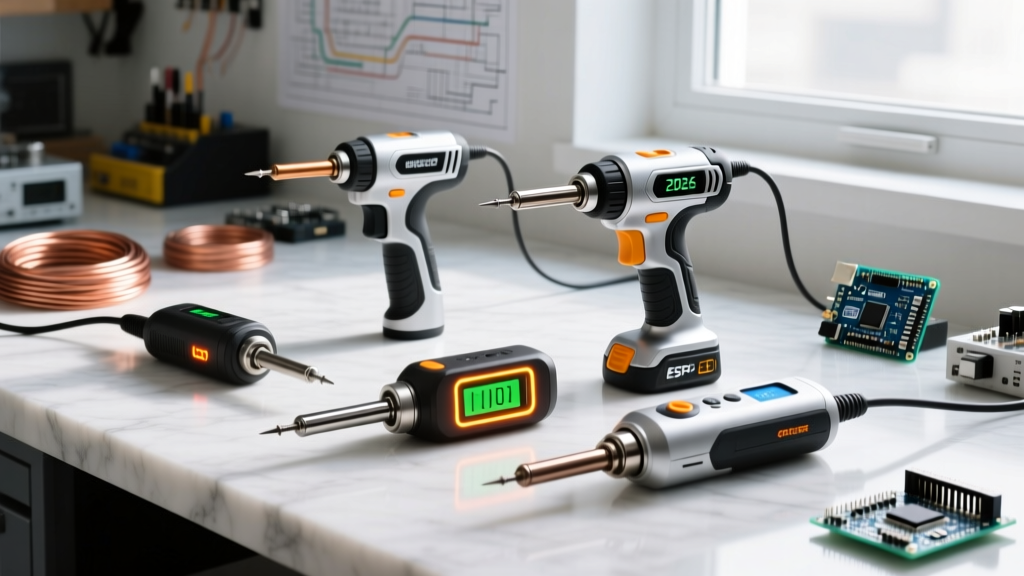
However, physics dictates that a handheld battery cannot safely or efficiently deliver the continuous 150+ amps required by a traditional transformer gun without extreme voltage sag, rapid cell degradation, and dangerous heat generation. Therefore, the 2026 market for a battery soldering gun has fundamentally shifted. Modern cordless tools emulate the heavy-duty thermal performance of a gun using high-wattage (65W to 120W) lithium-ion resistive and inductive heating elements paired with high-thermal-mass chisel tips.
These modern cordless setups are engineered specifically for high-thermal-load applications: soldering 8 AWG to 4 AWG silicone battery cables, XT90 RC connectors, solar panel busbars, and automotive wiring harnesses in the field. If you are looking for a true battery-powered soldering gun to replace your corded transformer model, you are actually looking for a high-performance cordless soldering station. Here is our expert breakdown of the top contenders on the market today.
Top Battery-Powered Soldering Tools Reviewed for 2026
1. Milwaukee M12 Soldering Iron (Model 2468-20)
Best For: Automotive technicians, field repair, and 12V system integration.
The Milwaukee 2468-20 is widely considered the benchmark for heavy-duty cordless soldering. Powered by the M12 REDLITHIUM battery ecosystem, it delivers the thermal punch of a 90W corded iron. It reaches its operating temperature of 800°F (426°C) in under 30 seconds. For technicians working on vehicle wiring harnesses or marine electronics where running an extension cord is impossible, this tool is indispensable.
- Pros: Rapid heat-up time; leverages existing M12 battery ecosystem; rugged overmold grip survives drops onto concrete shop floors.
- Limitations: The pencil-grip form factor (with battery attached) can feel front-heavy during extended overhead soldering sessions. Replacement proprietary tips are more expensive than standard Hakko 900M clones.
- 2026 Pricing: ~$119 (Bare tool, battery sold separately).
2. Ryobi 18V ONE+ HP Soldering Iron (Model P310)
Best For: RC hobbyists, solar installers, and heavy-gauge (4 AWG - 8 AWG) wire soldering.
Ryobi’s entry into the 18V soldering space utilizes their High Performance (HP) brushless-equivalent power delivery to manage a massive 100W equivalent heating element. The P310 is a beast when it comes to thermal recovery. When you press a 6mm chisel tip into a thick 6 AWG battery cable, the internal PWM controller dumps current into the ceramic heater to maintain tip temperature, preventing the dreaded "cold joint" that plagues lesser cordless irons.
- Pros: Exceptional thermal recovery on massive joints; compatible with the vast Ryobi 18V ONE+ battery lineup; includes a heavy-duty chisel tip optimized for XT60/XT90 connectors.
- Limitations: Bulky. The 18V battery attached to the base of the handle makes it unsuitable for precision PCB work. This is strictly a "heavy iron" replacement.
- 2026 Pricing: ~$99 (Bare tool).
3. Pine64 Pinecil V2 + 140W USB-C PD Power Bank
Best For: Precision field repairs, drone technicians, and backpack-portable setups.
While technically a pencil iron, the Pinecil V2 paired with a high-output USB-C Power Delivery (PD) battery bank functions as the ultimate modern "cordless gun" for precision work. The RISC-V powered Pinecil can negotiate up to 24V/4A from a compatible PD 3.1 power bank, delivering a staggering 88W of pure heating power. It bridges the gap between heavy-duty field repair and micro-soldering.
- Pros: Weighs almost nothing; open-source firmware (IronOS) allows custom temperature curves; USB-C PD means you can use the same power bank to charge your laptop and run your iron.
- Limitations: Requires a high-quality, 100W+ PD power bank (which can cost $60-$100) to achieve peak wattage. The lightweight tip lacks the raw thermal mass of the Ryobi for 4 AWG wires.
- 2026 Pricing: ~$26 (Iron) + ~$70 (Quality 140W PD Bank).
Specification & Performance Matrix
| Model | Power Source | Peak Wattage Equiv. | Heat-Up Time (to 350°C) | Best Application |
|---|---|---|---|---|
| Milwaukee 2468-20 | 12V Li-ion (M12) | ~90W | ~28 Seconds | Automotive / Marine Harness |
| Ryobi P310 | 18V Li-ion (ONE+) | ~100W | ~35 Seconds | RC Batteries / Solar Busbars |
| Pinecil V2 + PD Bank | 20V-24V USB-C PD | 88W (at 24V) | ~14 Seconds | Drones / Precision PCB Field Fix |
Critical Buying Factors for Cordless Soldering
Battery Chemistry and Voltage Sag
The single biggest point of failure in cordless soldering is voltage sag under heavy thermal load. According to Adafruit's comprehensive guide to Li-ion discharge rates, drawing high continuous current from a battery with high internal resistance causes a temporary drop in voltage. If you attempt to solder a massive ground plane with a compact 1.5Ah battery pack, the voltage will sag below the tool's Battery Management System (BMS) cutoff threshold, causing the tool to abruptly shut off mid-solder. The Fix: Always use high-capacity, high C-rating batteries (e.g., 4.0Ah to 6.0Ah packs) for heavy thermal loads to ensure stable voltage delivery.
Thermal Mass vs. Active Heating
When emulating a soldering gun, you need thermal mass. A thin, conical PCB tip will instantly lose its heat when it touches a thick copper wire. For battery-powered heavy soldering, you must swap to wide, bevel, or heavy chisel tips (typically 4mm to 6.5mm). The physical mass of the copper and iron plating stores the thermal energy, acting as a buffer while the battery-powered heater works to replenish it.
Expert Insight: Never use a conical tip for heavy-gauge wire soldering, regardless of your iron's wattage. The surface area contact is too small, resulting in extended dwell times that violate IPC J-STD-001 standards for proper wetting and thermal profiles, ultimately degrading the wire insulation and oxidizing the tip.
Real-World Failure Modes & Troubleshooting
Working with a battery soldering gun in the field introduces edge cases you won't face at a grounded ESD bench. Be prepared for the following failure modes:
- BMS Thermal Cutoff: As mentioned, drawing 100W continuously can overheat the battery's internal BMS. If your tool shuts down after 3 minutes of heavy use, allow the battery to cool. Consider using a battery with built-in active cooling or heat sinks.
- Wind-Induced Thermal Loss: In outdoor environments (e.g., repairing a solar array on a roof), even a 10 MPH breeze will strip heat from your soldering tip faster than the battery can replenish it. Always use a physical wind block or your body to shield the joint.
- Tip Oxidation from Improper Storage: Cordless irons are often tossed into tool bags while still warm. If the tip is not heavily tinned before powering down, the residual heat will burn off the flux and oxidize the iron plating, rendering the tip useless by the next job.
- Cold Joints from Premature Removal: Because battery life is a psychological stressor in the field, technicians tend to rush. Removing the iron before the solder has fully flowed through the stranded wire results in a dull, grainy cold joint that will fail under vibration.
Field Soldering Best Practices & Safety
Safety is paramount when combining high-heat tools with high-density lithium-ion energy storage. The OSHA guidelines on lithium-ion battery safety emphasize the risks of thermal runaway if batteries are subjected to external heat or physical damage. Never rest your hot soldering iron against the battery pack or the plastic battery housing. Furthermore, always use a high-quality, no-clean or rosin-core flux when working outdoors. Field conditions introduce dust and moisture to exposed copper; a generous application of liquid flux will displace contaminants and drastically reduce the time the iron needs to dwell on the joint, preserving both your battery life and your tip.
Final Verdict
The era of the heavy, wall-tethered transformer soldering gun is slowly giving way to intelligent, battery-powered thermal management systems. If your work involves heavy automotive or marine wiring, the Milwaukee M12 (2468-20) remains the undisputed champion of rugged, cordless field repairs. For RC enthusiasts and solar techs pushing 4 AWG silicone cables, the Ryobi P310 offers the raw thermal mass required to get the job done. Finally, for the modern drone technician who values precision and portability, the Pinecil V2 paired with a PD power bank represents the cutting edge of 2026 cordless soldering technology. Choose the ecosystem that matches your existing batteries, invest in high-capacity cells to prevent voltage sag, and always respect the thermal limits of your tips.