
The Physics of Micro-Soldering: Why Tip Geometry Matters
As surface-mount technology (SMT) continues to shrink in 2026, with 01005 (0.4mm x 0.2mm) and 008004 components becoming standard in high-density wearables and IoT devices, the physics of heat transfer at the micro-level have never been more critical. When working with soldering iron fine tips, the primary challenge is not reaching the target temperature, but maintaining thermal equilibrium at the joint without damaging the substrate or the component's internal die.
A common misconception among hobbyists is that a 0.1mm conical tip is the best choice for 0.4mm fine-pitch ICs. In reality, conical tips suffer from a severe lack of thermal mass at the apex. According to the principles of thermal dynamics and IPC workmanship standards, a micro-chisel or bent-knife geometry provides a vastly superior contact area, allowing capillary action to draw the molten solder alloy (such as SAC305 or Sn63/Pb37) across the pad uniformly.
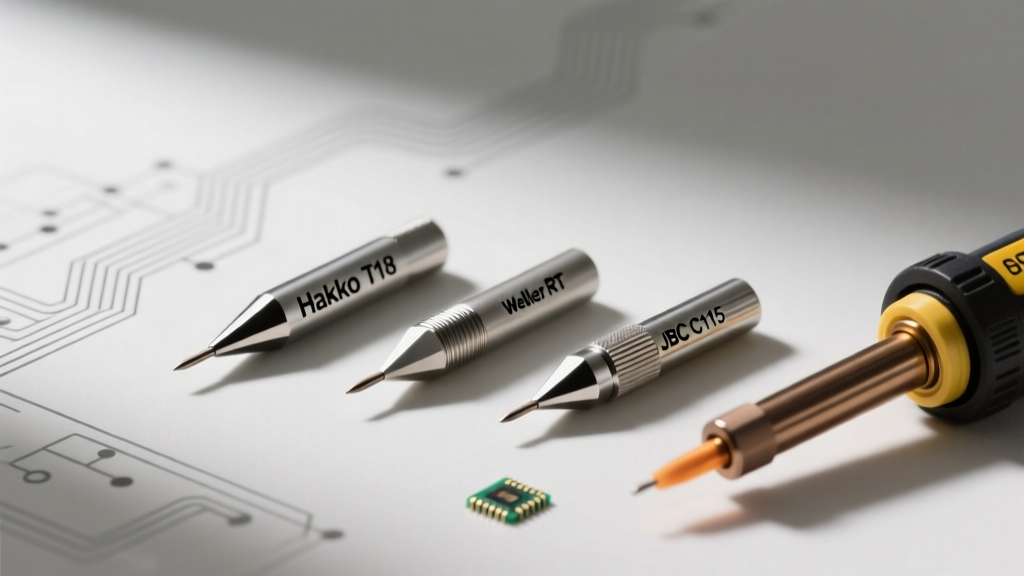
Head-to-Head Matrix: Hakko T18 vs. Weller RT vs. JBC C115
To determine which fine tip ecosystem dominates the workbench, we evaluated the three industry-standard cartridge and composite systems. Below is our 2026 benchmark matrix focusing on micro-soldering performance.
| Brand & Series | Model Tested | Geometry & Size | Avg. Tip Cost (2026) | Thermal Recovery (0.5s touch) | Best Application |
|---|---|---|---|---|---|
| Hakko T18 | T18-IL | Bent Conical, 0.4mm | $8.50 - $11.00 | Slow (Composite heater) | General 0603/0402 SMD |
| Weller RT | RT2 | Conical, 0.4mm | $42.00 - $48.00 | Fast (Integrated heater) | 0402 passives, SOIC-8 |
| JBC C115 | C115-112 | Bent Conical, 0.1mm | $38.00 - $45.00 | Ultra-Fast (Cartridge) | 0201, 01005, micro-BGA |
| JBC C115 | C115-108 | Micro Knife, 1.3mm | $40.00 - $46.00 | Ultra-Fast (Cartridge) | 0.4mm pitch QFN/QFP drag |
Deep Dive: Hakko T18 Series (The Budget Workhorse)
The Hakko T18 series, designed primarily for the ubiquitous FX-888D station, utilizes a composite tip design where the heater and sensor are housed in the station's handpiece, not the tip itself. This creates a physical air gap and a mechanical coupling that inherently slows thermal transfer.
T18-I vs. T18-IL: Conical vs. Bent Conical
The T18-I (0.2mm straight conical) is frequently purchased for fine work, but it requires excessive dwell time to heat a ground plane pad, increasing the risk of delamination on FR-4 boards. The T18-IL (0.4mm bent conical) is vastly superior; the 30-degree bend allows the user to rest the shaft of the tip against the component body for stability while using the very edge of the bevel to wick solder. However, because the T18 relies on the FX-888D's 65W ceramic heater, thermal recovery drops noticeably when transitioning from a signal trace to a multi-via ground pad.
Critical Edge Case: When using Hakko T18 fine tips with lead-free SAC305 solder, the iron plating dissolves up to 3x faster than with leaded alloys. If you are doing high-volume micro-rework, budget for a new T18 tip every 40-50 hours of active wet-soldering time.
Deep Dive: Weller RT Series (The Active Heating Standard)
Weller's RT series (compatible with WT1H and WR2002 stations) revolutionized the mid-tier market by integrating the heating element and thermocouple directly into the tip cartridge. The RT2 (0.4mm conical) and RT3 (0.8mm chisel) are exceptional for 0402 components.
Because the sensor is located less than 2mm from the tip's apex, the Weller microprocessor detects a temperature drop within milliseconds of touching a cold copper pad. This allows the operator to use a lower baseline temperature (e.g., 320°C instead of 360°C), which drastically reduces flux burnout and extends the life of the fine tip's iron plating. According to NASA's Electronic Parts and Packaging (NEPP) program guidelines on soldering reliability, minimizing peak thermal exposure is key to preventing intermetallic compound (IMC) overgrowth, which leads to brittle solder joints.
Deep Dive: JBC C115 (The Ultra-Fine Specialist)
When the task involves 0.4mm pitch QFNs, 0201 resistors, or micro-soldering under a microscope, the JBC C115 cartridge system is the undisputed industry leader. The C115-112 (0.1mm bent conical) offers unprecedented precision. Because the JBC T245 station delivers 65W directly to the microscopic heating element inside the C115 tip, it achieves a 350°C operating temperature from a cold start in under 2 seconds.
For drag soldering fine-pitch ICs, the C115-108 micro-knife is the ultimate weapon. The 1.3mm blade width holds just enough solder volume to bridge 10-15 pins in a single, fluid motion, while the sharp outer corner can be used to wick away excess solder with a brass tip cleaner.
Selection Framework: Matching Tip to Component Pitch
Do not default to the smallest tip available. Use this decision matrix to select the correct soldering iron fine tip for your specific PCB rework scenario:
- 0805 & 0603 Passives: Use a 1.0mm to 1.6mm micro-chisel (e.g., Hakko T18-D16 or Weller RT4). The larger thermal mass ensures both pads reach liquidus simultaneously.
- 0402 Passives & SOT-23: Use a 0.4mm bent conical (e.g., Hakko T18-IL or Weller RT2). The bend provides physical clearance for the tweezers holding the component.
- 0201 & 01005 Passives: Use a 0.1mm to 0.2mm bent conical (e.g., JBC C115-112). Requires microscope assistance and ultra-low mass solder paste or 0.3mm solder wire.
- 0.5mm to 0.4mm Pitch ICs (QFP/QFN): Use a micro-knife or mini-hoof tip (e.g., JBC C115-108). Avoid conical tips entirely, as they cannot hold the flux-core volume required for drag soldering.
Maintenance Protocols to Prevent Iron Plating Dissolution
Fine tips have exceptionally thin iron plating (often less than 100 microns). Once the underlying copper is exposed to molten solder, the tip will pit and fail within minutes. To maximize the lifespan of your micro-tips, adhere to this strict maintenance protocol:
- Never use abrasive cleaners: Steel wool and coarse brass sponges will strip the iron plating from a 0.2mm tip instantly. Use only high-density, fine-gauge brass wire balls or a damp (not wet) cellulose sponge.
- Retin immediately: The moment you lift the iron from the joint, apply a generous amount of rosin-core solder to the apex. This sacrificial layer prevents high-temperature oxidation.
- Lower idle temperatures: If your station supports sleep mode, set the standby temperature to 180°C. Continuous exposure to 350°C+ while idle causes the flux residues on the tip to carbonize, creating a thermal barrier that tempts the user to turn up the heat, accelerating plating erosion.
- Use specialized tip tinner: Once a week, dip the cooled tip into a commercial tip tinner (a mixture of tin powder and aggressive activators) to rebuild minor surface oxidation and restore wetting properties.
Final Verdict for 2026
If your budget is constrained and you primarily work with 0603/0402 components, the Hakko T18-IL remains a highly capable, cost-effective entry point. However, for professional rework involving 0201 components, fine-pitch BGAs, or high-reliability aerospace/medical boards where IPC Class 3 compliance is mandatory, investing in the JBC C115 cartridge ecosystem or the Weller RT series is non-negotiable. The integrated heating technology eliminates the thermal lag that causes cold joints and pad lift-off, ultimately paying for itself in saved PCBs and reduced tip replacement costs.