
The Benchmark Showdown: Weller WESD51 vs. The Competition
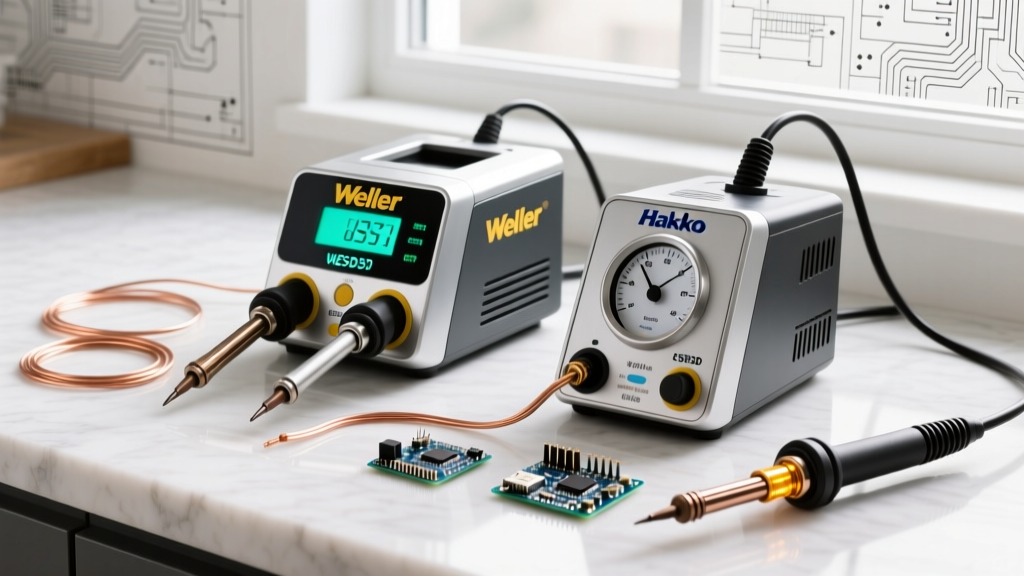
The Weller WESD51 digital soldering station has long been a staple in both professional repair labs and advanced DIY workbenches. In 2026, with surface-mount components shrinking to 0201 and 01005 imperial sizes, precise thermal management is no longer optional—it is a strict requirement. While the analog WES51 paved the way, the digital WESD51 introduced push-button precision and lockout features that made it a favorite for production environments. But how does it stack up against its most formidable rival, the Hakko FX-888D, in today's market?
This comprehensive tool comparison dives deep into the thermal architecture, real-world failure modes, and total cost of ownership for the WESD51, giving you the actionable data needed to make an informed benchtop investment.
Core Specifications: Weller WESD51 at a Glance
Before dissecting the nuances of thermal recovery, we must establish the baseline hardware specifications. The WESD51 operates on a closed-loop feedback system, but its physical implementation differs vastly from modern ceramic heater stations.
| Specification | Weller WESD51 (Digital) | Hakko FX-888D (Competitor) |
|---|---|---|
| Power Output | 50 Watts | 70 Watts |
| Temperature Range | 350°F to 850°F (177°C to 454°C) | 390°F to 890°F (200°C to 480°C) |
| Heater Technology | Integrated Coil & Sensor (ETA Tips) | Ceramic Core (T18 Tips) |
| Display | Digital LED (Dual Push-Button) | Digital LCD (Dual Push-Button) |
| ESD Safe / Grounded | Yes (< 2 Ohms to ground) | Yes (< 2 Ohms to ground) |
| 2026 Average Street Price | $135 - $155 USD | $115 - $130 USD |
Thermal Architecture: Integrated vs. Ceramic Heater
The most critical distinction between the Weller WESD51 and almost every other station in its class—including the Hakko FX-888D—is the tip and heater architecture. Understanding this physics difference is vital for anyone soldering heavy ground planes or multi-layer PCBs.
The Weller ETA Advantage: Direct Thermal Coupling
The WESD51 uses Weller's ETA series tips. In this design, the heating element and the thermocouple sensor are physically embedded inside the copper tip itself. There is zero air gap between the heat source and the working surface. When the sensor detects a temperature drop (e.g., when touching a large copper pour), the closed-loop circuit drives the 50W heater instantly. Because the thermal mass of the heater is directly coupled to the tip, the WESD51 punches far above its 50W weight class in thermal recovery.
The Ceramic Trade-off
Conversely, stations like the Hakko FX-888D use a ceramic heater core over which the T18 tip slides. While 70W sounds superior on paper, the physical air gap and mechanical interface between the ceramic core and the hollow tip introduce thermal resistance. In high-demand scenarios governed by IPC J-STD-001 standards, the WESD51's integrated tip often maintains a more stable thermal profile, preventing the cold-solder joints that occur when ceramic heaters lag during heat absorption.
User Interface and Production Lockout Features
In a professional or educational lab, unauthorized temperature adjustments are a primary cause of damaged PCBs and oxidized tips. The WESD51 digital soldering station shines in this operational context.
- Digital Precision: The dual push-button interface allows exact temperature dialing, eliminating the guesswork of the analog WES51 dial.
- Temperature Lockout: The WESD51 features a built-in lockout function. By entering a specific button sequence, supervisors can lock the temperature to a strict profile (e.g., 350°C for lead-free SAC305 solder). This ensures compliance with NASA Electronic Parts and Packaging Program workmanship standards, which dictate strict thermal limits to prevent delamination on high-reliability aerospace boards.
- Sleep Mode: While the WESD51 lacks the automatic motion-sensing sleep mode of higher-end Weller WX series, its digital display provides immediate visual feedback on heating states, flashing when the setpoint is reached.
Real-World Failure Modes and Maintenance Edge Cases
No tool is immune to bench wear-and-tear. Based on long-term teardowns and repair data, here are the specific failure modes you must watch for with the WESD51:
- Membrane Switch Degradation: The push-buttons on the WESD51 front panel rely on a tactile membrane. In environments with heavy flux splatter or isopropyl alcohol (IPA) cleaning, the solvent can seep into the membrane layers, causing the buttons to become unresponsive. Fix: Always use a microfiber cloth when cleaning the base unit; never spray IPA directly onto the fascia.
- Heater Coil Burnout: Because the heater is in the tip, dropping the iron or applying excessive mechanical leverage (e.g., using the iron as a pry tool) can snap the internal heater coil. This means a 'burnt out heater' requires buying a whole new tip, not just a $15 replacement wand.
- Grounding Prong Wear: The 3-prong power cord is the ESD ground path. Over years of use, the ground pin can wear, increasing resistance above the 2-ohm safety threshold. Annual multimeter testing from the tip barrel to the ground pin is mandatory for ESD-sensitive environments.
Expert Tip on Oxidation: Never use the WESD51 above 400°C (750°F) for standard 63/37 or SAC305 work. Exceeding this threshold causes the iron plating on the ETA tips to micro-fracture, allowing the internal copper core to dissolve into the solder pool, permanently destroying the tip in a matter of hours.
Cost of Ownership: Tip Ecosystem and 2026 Pricing
When evaluating the Weller WESD51 digital soldering station, the initial hardware cost is only half the equation. The integrated tip design inherently shifts the cost burden to the consumables.
Tip Pricing Breakdown
- Weller ETA Series: Because the heater and sensor are built-in, genuine Weller ETA tips cost between $7.50 and $11.00 each in 2026, depending on the geometry (e.g., the ETA-008SMT for fine-pitch work is at the higher end).
- Hakko T18 Series: Because the T18 is just a hollow copper/iron shell, replacement tips cost between $3.50 and $5.00 each.
The 5-Year Projection: If you replace 10 tips a year, the Weller ecosystem will cost you roughly $40 to $50 more annually than the Hakko ecosystem. However, for production facilities, the reduced scrap rate and higher first-pass yield from the WESD51's superior thermal stability easily offset this marginal consumable cost.
Final Verdict: Who Should Buy the WESD51?
The Weller WESD51 remains a highly relevant, robust tool in 2026, provided it is deployed in the right environment.
Choose the Weller WESD51 if:
- You are running a production bench or educational lab and require the digital lockout feature to enforce IPC-compliant thermal profiles.
- You frequently solder heavy multi-layer boards with large ground planes where direct-thermal-coupling (ETA tips) prevents cold joints.
- You prefer the rugged, heavy-duty build quality of Weller's legacy metal-and-hard-plastic chassis over lighter competitors.
Look elsewhere (e.g., Hakko FX-888D or Weller WE1010) if:
- You are a casual hobbyist where a lower consumable cost is more important than absolute thermal stability.
- You require auto-sleep functionality to preserve tip life during long debugging sessions.
Frequently Asked Questions
Is the Weller WESD51 ESD safe for sensitive microcontrollers?
Yes. The WESD51 is fully ESD safe. The grounding wire runs directly from the soldering iron tip, through the cord, to the earth ground on your wall outlet. Always verify your outlet is properly grounded and test the tip-to-ground resistance (it should be under 2 ohms) before handling bare CMOS or MOSFET components.
Can I use WES51 analog tips on the WESD51?
Yes. The WESD51 uses the exact same ETA series tips as the analog WES51. The only difference between the two stations is the control interface (digital push-buttons vs. analog dial) and the lockout capabilities. Your existing tip inventory is fully cross-compatible.
What is the best tip for 0402 SMD components?
For 0402 and 0603 imperial surface-mount components, the Weller ETA-005 (conical) or the ETA-010SMT (chisel) are optimal. The SMT-specific tips feature a localized heating zone that prevents thermal bridging to adjacent fine-pitch pads.