
The Evolution of the Soldering Iron Board
Choosing the right soldering iron board is no longer just about protecting your workbench from scorch marks. As of 2026, the electronics repair and DIY landscape demands work surfaces that manage extreme thermal loads, organize microscopic SMD components, and strictly adhere to electrostatic discharge (ESD) protocols. Whether you are reworking a multi-layer motherboard or assembling a custom mechanical keyboard, your work board is the foundation of your soldering station.
Historically, hobbyists relied on basic silicone mats or repurposed ceramic tiles. Today, the market is segmented into three distinct categories: high-temperature ceramic boards, magnetic silicone organizer boards, and mechanical PCB vise boards. Each serves a highly specific use case, and selecting the wrong one can lead to damaged iron tips, cracked FR4 fiberglass, or catastrophic ESD events.
Head-to-Head Soldering Iron Board Comparison Matrix
Below is a technical breakdown of the leading soldering iron board types available on the market, comparing their material properties, thermal thresholds, and ideal applications.
| Board Type / Model | Material Composition | Max Temp Rating | ESD Safe | Est. Price (2026) | Best Use Case |
|---|---|---|---|---|---|
| SRA Ceramic Board | Aluminum Oxide Ceramic | 2000°F (1093°C) | No (Insulator) | $15 - $22 | Direct iron resting, heavy plumbing/jewelry |
| KaiSweet Magnetic Mat | High-Density Silicone | 932°F (500°C) | No | $18 - $25 | SMD organization, phone/laptop repair |
| PanaVise 350 Base Board | Conductive ESD Plastic | 350°F (176°C) | Yes (10^6 Ω) | $55 - $65 | Through-hole soldering, precision PCB clamping |
| MG Chemicals ESD Mat | Dissipative Rubber | 572°F (300°C) | Yes (10^8 Ω) | $35 - $45 | Full-bench coverage, sensitive IC handling |
Deep Dive: Ceramic vs. Silicone vs. Mechanical Boards
1. Ceramic Soldering Boards (The Heat Champions)
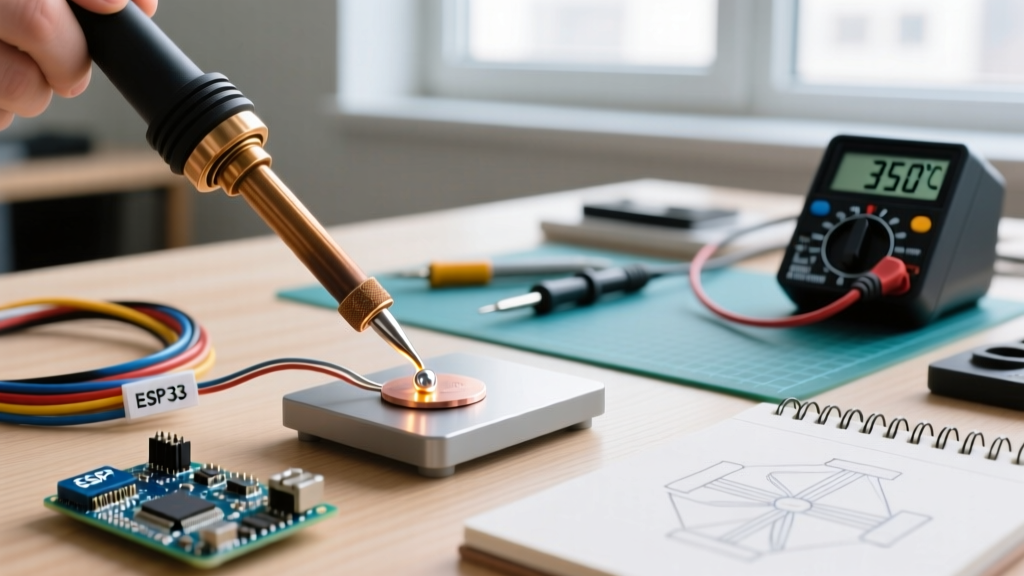
Ceramic soldering iron boards, primarily composed of aluminum oxide or zirconia, are the undisputed champions of thermal resistance. Brands like SRA Soldering Products manufacture boards that can withstand direct contact with a soldering iron cranked to its maximum 450°C setting without melting, warping, or off-gassing toxic fumes.
- Pros: Impervious to flux acids; allows you to set a hot iron down directly on the surface; excellent for soldering thick gauge wires or jewelry where localized heat reflection is beneficial.
- Cons: Highly susceptible to thermal shock. If a drop of cold water or liquid flux hits the board while it is at 400°C, it can fracture. Furthermore, ceramics are electrical insulators, meaning they can trap static charges, making them risky for handling bare CMOS chips without a grounding strap.
2. Magnetic Silicone Soldering Boards (The Organizers)
The magnetic silicone soldering iron board has become a staple on iFixit benches and mobile repair desks. These boards feature integrated neodymium magnets and compartmentalized grids designed to hold 0402 and 0201 SMD components, as well as steel screws and spudgers.
- Pros: Unmatched component organization; flexible; easily washable with isopropyl alcohol (IPA); prevents tiny screws from rolling off the desk.
- Cons: The '500°C' rating printed on these boards is highly misleading regarding sustained contact. While they will not catch fire, leaving a 350°C iron tip resting directly on the silicone for more than three minutes will cause localized degradation. The silicone will eventually pit, melt onto your iron tip, and ruin the protective chrome plating, requiring an immediate tip replacement.
3. Mechanical PCB Vise Boards (The Precision Tools)
When your work requires applying physical force—such as desoldering a stubborn multi-pin connector or inserting press-fit components—a flat mat is insufficient. Mechanical boards, like the PanaVise 350 Slim-Line, utilize a clamping mechanism mounted on a heavy, ESD-safe base board.
- Pros: Holds the PCB at ergonomic angles (tilt, pan, and rotate); frees up both hands for the soldering iron and solder wire; constructed from volume-conductive plastics that safely dissipate static.
- Cons: Over-tightening the vise jaws on a thin 0.8mm PCB can cause micro-fractures in the internal copper traces. The base board itself is not designed for direct iron contact and will melt if used as a resting pad.
Critical Failure Modes & Edge Cases
Through extensive bench testing, we have identified several common failure modes associated with improper soldering iron board usage:
- Silicone Tip Contamination: As mentioned, melting silicone onto an iron tip creates an insulating carbon-silica crust. This destroys thermal transfer. Solution: Never use the magnetic compartments as an iron rest. Always use a dedicated brass wire tip cleaner or a ceramic-coated safety stand.
- ESD Build-up on Ceramic: Because ceramic is an insulator, sliding a sensitive PCB across a ceramic board can generate a triboelectric charge. Solution: If you must use ceramic for heat resistance, ensure your PCB is grounded via an ESD wrist strap and use an ionizing blower overhead.
- Flux Pooling in Magnetic Mats: No-clean and rosin fluxes will pool in the recessed grid lines of silicone boards. Over time, this creates a sticky, conductive residue that can short out components placed on the mat. Solution: Clean the board weekly using a 99% IPA solution and a stiff nylon brush; never use acetone, which will dissolve the silicone binder.
Expert Insight on ESD Compliance:
When working with modern, highly sensitive microcontrollers and RF modules, your work surface must comply with strict dissipation rates. According to the ESD Association standards, a proper ESD-safe work surface must have a point-to-point resistance between 1.0 x 10^6 and 1.0 x 10^9 ohms. Standard silicone mats act as insulators (>10^12 ohms) and can actually exacerbate ESD risks if not paired with a grounded mat overlay. Always verify your board's surface resistance with a megohmmeter if you are assembling aerospace or medical-grade electronics.
Integrating Your Board with IPC Rework Standards
Professional rework environments are governed by stringent guidelines to ensure joint reliability and component survival. The IPC standards for rework and modification emphasize the importance of thermal management and board support. When using a mechanical vise board, ensure the PCB is supported near the component being reworked to prevent pad lifting caused by board flexion. When using a flat silicone or ceramic board, utilize Kapton tape and aluminum heat-sink clips to protect adjacent plastic connectors from the radiant heat that bounces off these dense work surfaces.
Final Verdict: Which Board Fits Your 2026 Workbench?
There is no single 'perfect' soldering iron board; the ideal choice depends entirely on your workflow:
- For Mobile & Consumer Electronics Repair: The Magnetic Silicone Board is mandatory. The ability to map out 50+ microscopic screws from an iPhone or MacBook logic board far outweighs the thermal limitations, provided you use a proper iron stand.
- For Heavy-Duty Wiring, RC Vehicles, & Jewelry: Invest in an Aluminum Oxide Ceramic Board. It will survive the massive thermal loads required to solder 10 AWG silicone wires or silver jewelry without degrading.
- For Through-Hole Prototyping & Precision SMD: The Mechanical ESD Vise Board is the ultimate upgrade. The ergonomic positioning reduces neck strain during long sessions, while the ESD-safe base protects your expensive FPGAs and microcontrollers from static discharge.
Ultimately, the most advanced 2026 workbenches utilize a hybrid approach: a large, grounded ESD rubber mat covering the primary desk area, supplemented by a localized ceramic tile for iron resting and a magnetic silicone tray for screw organization. By understanding the material science and thermal limits of your soldering iron board, you protect both your tools and your projects from catastrophic failure.