
The Torch vs. Iron Debate: Can You Solder Jewelry with Soldering Iron Tools?
When most jewelers think of soldering, they immediately picture a butane or oxy-acetylene torch melting hard silver solder at 1,300°F. However, a growing community of craft jewelers, chainmaille artists, and repair technicians are asking: can you successfully solder jewelry with soldering iron setups?
The short answer is yes, but with strict metallurgical limitations. Standard electronics soldering irons max out around 850°F (454°C). This means you cannot use an iron for sizing gold rings, soldering platinum, or working with traditional hard solders. However, for base metals (copper, brass, nickel silver), costume jewelry, and low-temperature silver-bearing soft solders, a high-quality soldering station is not just viable—it offers superior precision and safety compared to an open flame.
In this 2026 buying guide, we break down the exact stations, tip geometries, and alloy chemistries required to successfully solder jewelry with a soldering iron.
The Metallurgy: Why Jewelry Soldering is Different
To understand tool selection, you must understand the filler metal. According to industry suppliers like Rio Grande, traditional jewelry hard solder is an alloy of silver, copper, and zinc that requires flux and high heat to flow via capillary action. An electronics iron will simply melt the flux and oxidize the tip.
Instead, iron-based jewelry soldering relies on silver-bearing soft solders (often branded as Stay-Brite). These alloys typically consist of 95% tin and 5% silver, melting at a highly manageable 430°F (221°C). While the joint strength is lower than hard-soldered precious metals, the tensile strength of a properly fluxed 95/5 Sn/Ag joint is more than sufficient for jump rings, clasps, and copper art jewelry.
2026 Buying Guide: Top Soldering Stations for Metalwork
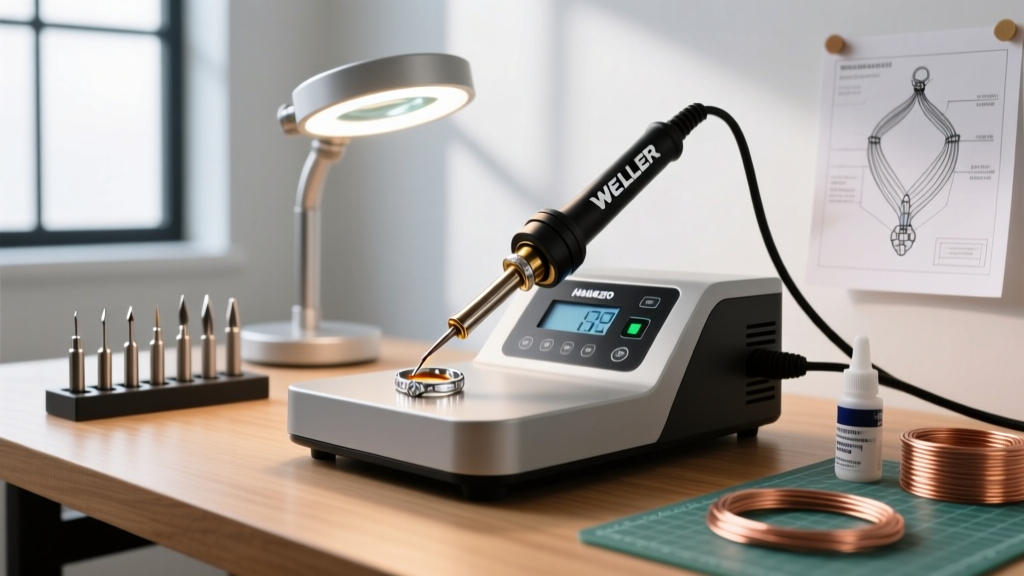
Not all irons can handle the thermal drain of a heavy brass jump ring. You need a station with high thermal recovery and a robust heating element. Here are the top three stations for jewelry applications in 2026.
1. Hakko FX-951-66 (Best Overall for Heavy Gauge)
Price: ~$285 | Wattage: 70W | Temp Range: 120°F - 890°F
The Hakko FX-951 remains the gold standard for high-thermal-mass applications. Its composite tip design houses the heater and sensor in the same cartridge, eliminating the thermal lag found in older ceramic heater models. For jewelry, we recommend pairing it with the T18-D24 (2.4mm Chisel) tip. The flat surface area maximizes heat transfer into thick copper or brass wire, preventing the 'cold joint' failure mode common when using pointed tips.
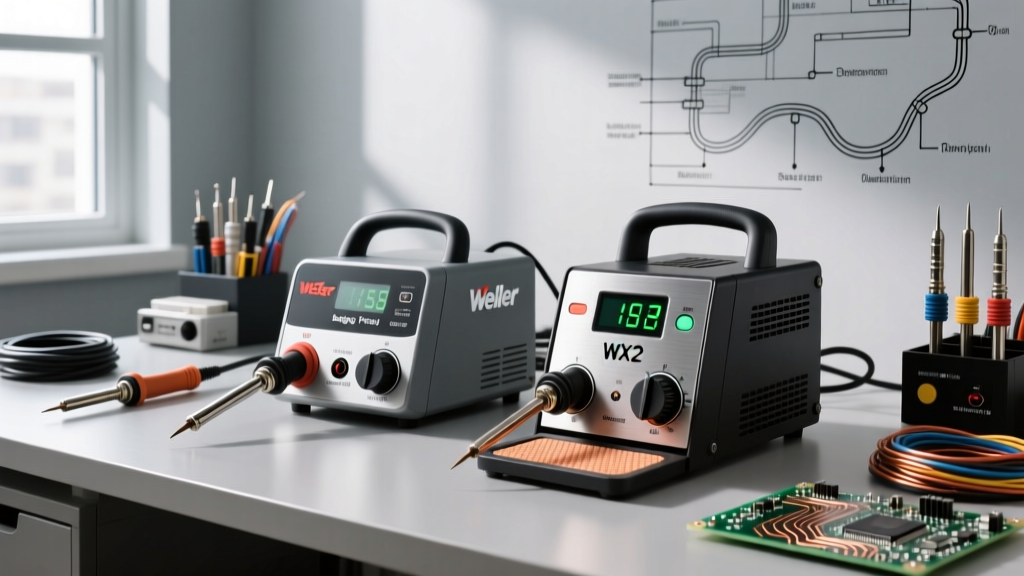
2. Weller WE1010NA (Best Budget Station for Crafters)
Price: ~$135 | Wattage: 70W | Temp Range: 200°F - 850°F
For hobbyists making chainmaille or lightweight brass findings, the Weller WE1010NA offers incredible value. It features a digital interface and rapid heat-up times. The ETA series tips are cost-effective, though they lack the extreme thermal recovery of the Hakko. Set the station to 650°F (343°C) and use a ETA DL (screwdriver/chisel) tip for optimal results on 18-gauge jump rings.
3. Pine64 Pinecil V2 (Best Portable / Mobile Repair)
Price: ~$26 (plus USB-C PD power supply) | Wattage: Up to 65W
If you repair jewelry at craft fairs or lack bench space, the RISC-V powered Pinecil V2 is a marvel of 2026 portable tech. Powered by a 65W USB-C laptop charger, it reaches 430°F in under 8 seconds. While it lacks the sheer thermal mass of a benchtop station, it is exceptionally precise for delicate micro-soldering on thin copper foils or fine silver-plated wire.
Tool Comparison Matrix
| Station Model | Price (2026) | Thermal Recovery | Best Jewelry Use Case | Recommended Tip |
|---|---|---|---|---|
| Hakko FX-951 | $285 | Excellent | Heavy brass/copper, thick jump rings | T18-D24 (Chisel) |
| Weller WE1010NA | $135 | Good | Chainmaille, base metal findings | ETA DL (Screwdriver) |
| Pine64 Pinecil V2 | $26+ | Moderate | Micro-soldering, mobile repairs | TS-D24 (Chisel) |
The Chemistry: Selecting Flux and Filler
You cannot use standard electronics rosin flux (RMA) for jewelry. Rosin leaves a sticky, amber residue that is nearly impossible to remove from textured metal without ultrasonic cleaning. Instead, you must use a phosphoric acid-based liquid flux (such as Harris Stay-Clean).
Expert Warning: Acid fluxes are highly corrosive. While they are necessary to strip the heavy oxidation found on brass and copper, you must neutralize the joint immediately after soldering using a baking soda and water solution, followed by a thorough rinse. Failure to do so will result in 'green rot' (copper chloride formation) destroying the joint within weeks.
Step-by-Step: Soldering a 16-Gauge Brass Jump Ring
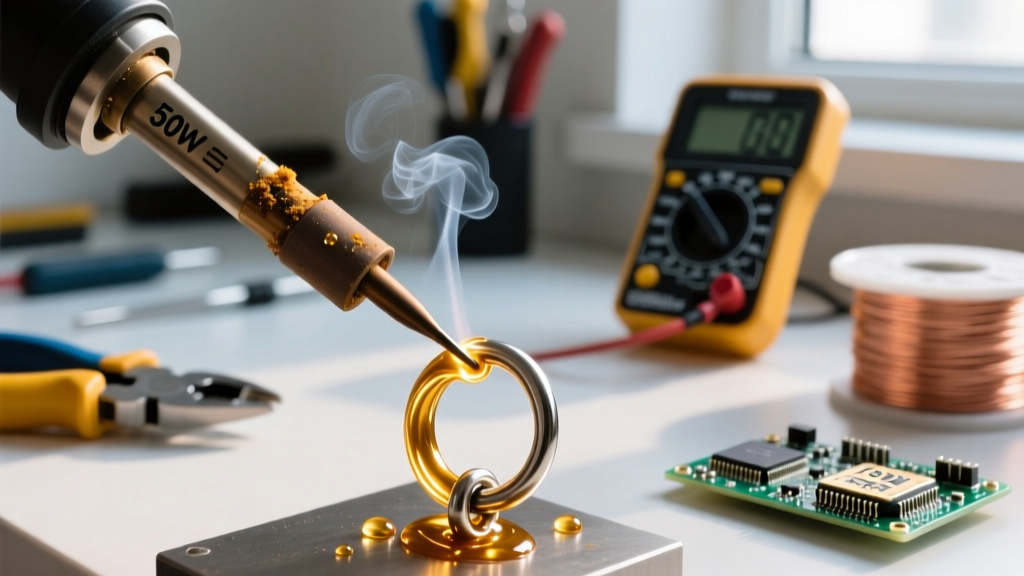
- Preparation: File the ends of the jump ring perfectly flat. Ensure a tight, flush seam. Clean the brass with acetone to remove skin oils.
- Flux Application: Apply a micro-drop of phosphoric acid flux directly to the seam using a wooden toothpick.
- Pre-Tinning: Set your Hakko FX-951 to 680°F (360°C). Melt a tiny amount of 95/5 Sn/Ag solder onto the chisel tip, then immediately touch it to the fluxed seam. Capillary action will draw the silver-bearing solder into the joint.
- Heat Management: Hold the iron on the joint for exactly 2-3 seconds. Do not 'paint' the metal. Prolonged heat will burn the flux, leaving a black, unsolderable scale.
- Quench & Neutralize: Drop the piece into a water bath, then transfer to a baking soda bath to halt the acid etching.
Common Failure Modes and Edge Cases
The 'Thermal Sink' Effect
When attempting to solder a heavy cast brass pendant to a thin wire loop, the iron's heat will instantly dissipate into the heavy pendant, leaving the solder slushy and unmelted. Solution: Use a station with at least 70W of power, pre-heat the heavy component with a secondary heat source (like a hot plate set to 200°F), or redesign the piece to use mechanical cold-connections (rivets or tabs) instead of solder.
Tip Degradation
Acid fluxes will eat through standard iron plating on soldering tips much faster than rosin flux. To extend tip life in jewelry applications, never leave the iron at 700°F while idle. Use the station's sleep function, and always leave a thick blob of standard 63/37 leaded solder on the tip when turning the station off to act as a sacrificial oxidation barrier.
Frequently Asked Questions
Can I solder sterling silver with a soldering iron?
No. Sterling silver conducts heat too rapidly and requires hard silver solder (melting above 1,200°F) to maintain structural integrity and color matching. An iron will only discolor the silver with fire-scale without melting the appropriate filler.
Is 95/5 Sn/Ag solder safe for skin contact?
Yes. Unlike traditional electronics solder which contains lead (Sn/Pb), silver-bearing tin alloys are lead-free, non-toxic, and hypoallergenic, making them perfectly safe for wearable costume jewelry and earrings.
Where can I find authoritative standards on soft soldering?
For deep dives into the metallurgy and joint reliability of tin-silver alloys, the Hakko technical documentation and IPC-A-610 standards provide extensive data on wetting angles and thermal profiles, which translate directly to jewelry making.