
Beyond the Dial: The 2026 Adjustable Soldering Iron Landscape
The days of relying on a fixed 40W wall-wart are over. In 2026, the adjustable soldering iron market is strictly divided into two camps: legacy digital bench stations and next-generation smart irons powered by USB-C Power Delivery (PD). But does a $120 bench station still hold an advantage over a $27 smart iron? We put the most popular adjustable models on the test bench to measure real-world thermal rebound, tip ecosystem viability, and firmware edge cases.
Head-to-Head Matrix: Top Adjustable Soldering Irons
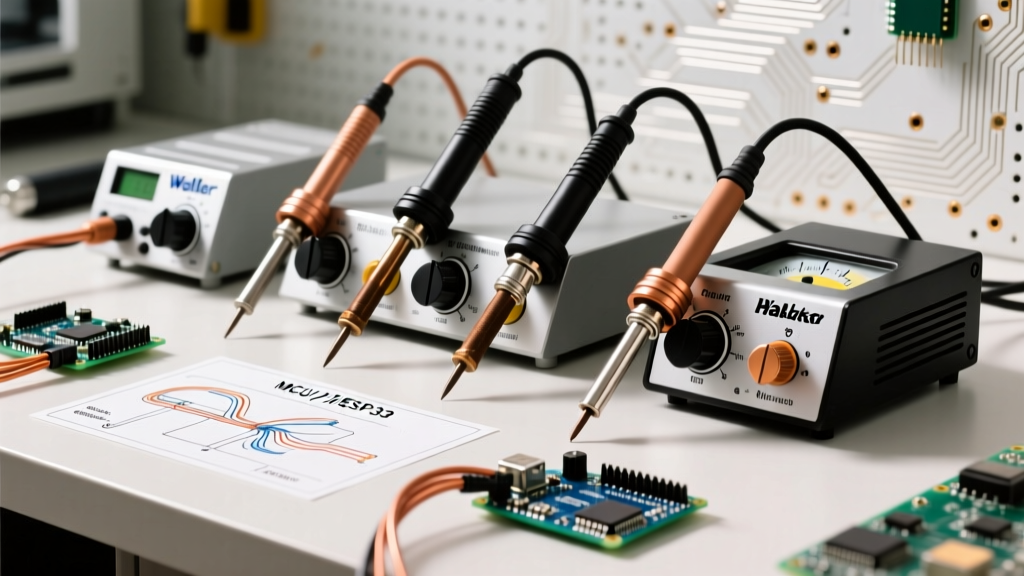
When selecting an adjustable soldering iron, raw wattage is a misleading metric. The true bottleneck is the thermal mass of the tip and the PID controller's polling rate. Below is our 2026 comparison matrix of the top contenders.
| Model | Architecture | Max Power | Tip Ecosystem | Avg Price (2026) | Boot Time |
|---|---|---|---|---|---|
| Pinecil V2 | RISC-V (IronOS) | 65W (PD) | TS100 / MiniWare | $26.99 | 2.1 seconds |
| Hakko FX-888D | Analog/Digital PID | 70W | T12 Cartridge | $109.95 | 8.5 seconds |
| Weller WE1010NA | Microcontroller PID | 70W | ET Series | $124.50 | 12.0 seconds |
| Sequre S60 | ARM (Custom FW) | 65W (PD) | T12 / N65 | $34.99 | 3.0 seconds |
Deep Dive: Contender Analysis & Edge Cases
Pinecil V2: The Disruptor
The Pinecil V2 utilizes a BL706 RISC-V microcontroller running the open-source IronOS firmware. Its adjustable temperature interface is navigated via two physical buttons and a crisp OLED screen. The Edge Case: The V2 requires a high-quality 100W GaN charger with an E-marker chip to negotiate 20V/3.25A. If you use a standard 65W phone charger, the iron will cap at 45W, causing severe thermal droop when soldering to multi-layer ground planes. Furthermore, the TS100-compatible tips lack the integrated thermocouple found in T12 cartridges, resulting in a slight temperature offset at the very edge of the tip.
Hakko FX-888D: The Bench Standard
According to the official Hakko specifications, the FX-888D delivers 70W to the T12 cartridge series. The T12-BC2 (bevel) and T12-D24 (chisel) tips feature a co-located heater and thermocouple, enabling closed-loop PID adjustments every 20 milliseconds. The Edge Case: The FX-888D lacks a sleep mode by default. If left at 350°C, the tip will oxidize and blacken within 45 minutes, permanently ruining the iron plating. You must manually enter the settings menu (holding the UP arrow on boot) to enable the 5-minute auto-sleep feature—a notoriously hidden setting that catches many beginners off guard.
Weller WE1010NA: Heavy Thermal Mass
Weller’s adjustable WE1010NA station uses the older ET screw-on tip series. While this design is mechanically bulkier than Hakko’s cartridges, the ET-RL (round tip) and ET-B (chisel) possess massive thermal inertia. This makes the Weller superior for heavy-gauge wire tinning and large through-hole components, but sluggish for fine-pitch SMD rework.
Pro-Tip for Adjustable Irons: Never use temperature as a crutch for insufficient tip mass. If your 350°C adjustable iron isn't melting solder on a ground plane, stepping up to 400°C will oxidize the tip and risk delaminating the PCB. Instead, swap to a bevel (T12-C4) or chisel tip to increase the thermal transfer surface area.
Thermal Physics and IPC Dwell Time Limits
Why does rapid adjustable temperature recovery matter? The IPC-J-STD-001 standard outlines strict requirements for soldered electrical assemblies, specifically warning against prolonged thermal excursion. When an iron with poor thermal recovery touches a cold copper pour, the tip temperature plummets. The user then applies excessive pressure and holds the iron for 8-10 seconds, waiting for the solder to flow. This exceeds the IPC recommended dwell time, leading to pad delamination, lifted traces, and degraded component lifespans. A high-quality adjustable iron with a fast PID loop will inject maximum wattage to recover to 350°C within 1.5 seconds, allowing for a clean, 3-second solder joint.
Real-World Failure Modes in Adjustable Irons
- USB-C PD Negotiation Timeout: On smart adjustable irons like the Pinecil and Sequre S60, using a cable with only 2-wire power delivery (instead of 4-wire E-marker chips) causes the iron to default to 5V/3A (15W). The screen will read 350°C, but the tip will barely melt rosin flux.
- Thermocouple Drift: In bench stations like the Hakko and Weller, after roughly 400 hours of use at temperatures exceeding 380°C, the internal thermocouple degrades. The station display will read 350°C, but the actual tip temperature may be 370°C. This requires a manual offset calibration using a digital tip thermometer.
- Cartridge Seating Oxidation: T12 adjustable cartridges rely on a friction-fit metal socket. Flux vapor buildup over time causes intermittent heating or "HEATER ERROR" codes. Fix: Remove the cartridge and clean the station's internal contacts with a fiberglass scratch pen and 99% isopropyl alcohol.
Crucial Maintenance for Adjustable Temperature Profiles
Because an adjustable soldering iron allows you to dial in exact temperatures, it is tempting to leave the station at 380°C to handle both leaded and lead-free solder. This is a critical mistake. Leaded 60/40 solder flows optimally at 310°C to 330°C. Running your adjustable iron at 380°C with leaded solder causes the rosin flux to carbonize instantly, creating a black crust that acts as a thermal insulator. This forces you to turn the temperature up even higher, creating a death spiral that destroys the tip's iron plating. Always utilize the adjustable dial to drop to 320°C for leaded work, and use brass tip wool—not a wet sponge—to clean the oxidized residue. A wet sponge causes rapid thermal shock, micro-fracturing the ceramic heating element inside T12 cartridges over time.
Final Verdict: Which Adjustable Iron Fits Your Bench?
If your work involves 80% SMD components, 0402 resistors, and STM32 microcontrollers, the Pinecil V2 paired with a 100W PD charger is the undisputed king of the adjustable soldering iron market in 2026. Its rapid boot time and precise IronOS PID tuning cannot be beaten at the $27 price point. However, if your daily workflow includes tinning 12 AWG silicone wires, repairing automotive harnesses, or soldering large copper ground planes, the Weller WE1010NA provides the necessary thermal mass that lightweight smart irons simply cannot deliver.