
The Cordless Field Soldering Dilemma
For HVAC technicians, automotive wire harness specialists, and field service engineers, soldering in the wild has historically been a frustrating compromise. Butane-powered irons like the Weller Portasol offer excellent thermal mass but are increasingly banned on commercial job sites due to open-flame and fume hazards. On the other end of the spectrum, USB-C PD irons like the Pinecil V2 are brilliant for the bench, but tethering them to a heavy 65W power bank in a crawlspace or on a lift is entirely impractical.
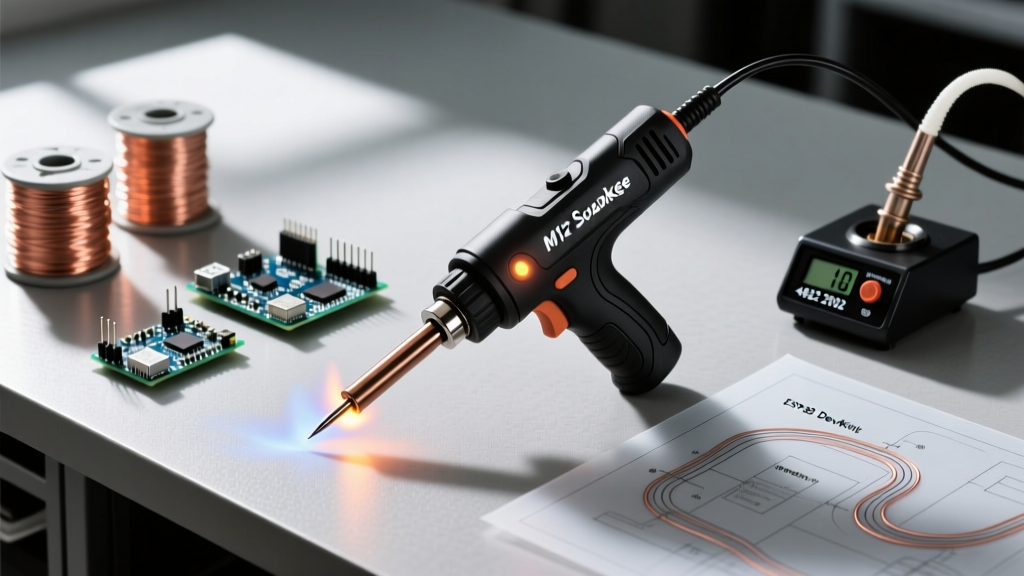
Enter the Milwaukee M12 Soldering Iron (Model 4822-2002). By leveraging the massive M12 lithium-ion ecosystem, Milwaukee aimed to deliver a truly cordless, job-site-compliant soldering solution. But does a battery-powered resistive heater actually hold up when touching a heavy ground plane? In this comprehensive 2026 review and buying guide, we dissect the thermal physics, battery sag realities, and real-world edge cases of the M12 soldering iron.
Milwaukee 4822-2002 Deep-Dive: Thermal Performance
The core appeal of the M12 Soldering Iron is its rapid heat-up time and dual-temperature switch. Unlike variable digital dials found on bench stations, Milwaukee utilizes a rugged, slide-switch interface designed for gloved hands.
Temperature Tiers and Heat-Up Metrics
- Low Setting (~400°F / 204°C): Ideal for delicate electronics, thin-gauge signal wires (22-28 AWG), and lead-free solder paste reflow where component protection is paramount.
- High Setting (~750°F / 400°C): Designed for heavier gauge wires (12-16 AWG), ring terminals, and quick thermal recovery. Reaches max temperature in approximately 30 seconds from a cold start.
The internal ceramic heating element provides decent thermal transfer, but it is fundamentally limited by the wattage the M12 battery can safely discharge. Under optimal conditions, the iron behaves similarly to a 40W to 50W mains-powered station. However, as we will explore, optimal conditions depend entirely on your battery selection.
Comparative Matrix: M12 vs. The Alternatives
How does the Milwaukee M12 stack up against other portable soldering solutions in 2026? Below is a structural comparison of field-ready options.
| Feature | Milwaukee M12 (4822-2002) | Weller Portasol (Butane) | Pinecil V2 (USB-C PD) |
|---|---|---|---|
| Power Source | M12 Li-ion Battery | Refined Butane Gas | 65W+ PD Brick / Power Bank |
| Max Temp | 750°F (400°C) | 850°F+ (454°C+) | 842°F (450°C) |
| Site Compliance | High (No open flame/fumes) | Low (Often banned indoors) | High (Requires tethering) |
| Thermal Mass | Moderate (Subject to voltage sag) | Very High (Continuous combustion) | High (If PD source holds 65W) |
| 2026 Street Price | ~$139 (Bare Tool) | ~$95 | ~$27 (Iron only) |
The Physics of Battery Sag: Why Your Battery Choice Matters
The most common complaint in negative reviews of cordless soldering irons stems from a misunderstanding of lithium-ion discharge curves. A standard M12 battery is a 3S (3-cell series) Li-ion pack with a nominal voltage of 10.8V (12V max).
A soldering iron is a purely resistive load. According to Joule's first law, Power equals Voltage squared divided by Resistance (P = V² / R). Because the resistance of the ceramic heater is fixed, any voltage sag directly crushes your heating power.
CP2.0 vs. XC4.0 vs. XC6.0
When you touch a cold 10 AWG wire, the iron demands maximum current. A compact CP2.0Ah battery (Model 48-11-2420) has a higher internal resistance. Under a 4-amp draw, its voltage can sag below 9.5V, triggering the battery's BMS (Battery Management System) to throttle output or causing the iron's heating element to starve, resulting in cold solder joints.
Expert Field Tip: Never use the M12 CP2.0Ah battery for heavy-gauge automotive or HVAC splicing. The voltage sag will cause the iron to stall. Always pair the 4822-2002 with an XC4.0Ah (48-11-2440) or XC6.0Ah HIGH OUTPUT battery. The larger cell format reduces internal resistance, maintaining voltage above 10.5V under load and ensuring continuous thermal recovery.
For deeper insights into how cell chemistry affects high-draw tools, refer to Battery University's guide on lithium-ion discharge characteristics, which details why smaller form-factor cells struggle with sustained resistive loads.
Real-World Edge Cases and Failure Modes
While the M12 iron excels at splicing 18 AWG thermostat wires and repairing 12V lighting harnesses, it has distinct limitations that field techs must respect.
1. The Ground Plane Heatsink Effect
Attempting to solder a heavy ground strap to a vehicle chassis or a thick copper ground plane on an industrial control board will overwhelm the M12. The thermal mass of the chassis pulls heat away faster than the ~45W equivalent output can replenish it. Solution: Use a localized pre-heater or a high-wattage butane torch for chassis grounding. The M12 is for wire-to-wire and wire-to-terminal joints, not structural grounding.
2. Tip Oxidation and Auto-Sleep Limitations
The M12 iron features an auto-shutoff that engages after 10 minutes of inactivity, detected via an internal accelerometer. However, if you are working on a complex harness and frequently setting the iron down for 8-minute intervals, the tip remains at 750°F without touching solder. This accelerates tip oxidation (burnout). Always manually slide the switch to 'Off' or tin the tip heavily with rosin-core solder before setting it in the holster.
3. IPC Compliance in the Field
When performing field repairs on certified aerospace or medical electronics, thermal dwell time is strictly regulated to prevent insulation melt-back or pad delamination. According to the IPC J-STD-001 soldering standards, operators must avoid prolonged heating that degrades the wire's dielectric properties. The M12's Low setting (400°F) is highly recommended for these sensitive applications to ensure compliance and prevent thermal damage to adjacent components.
2026 Buying Guide: Which SKU Should You Choose?
Milwaukee offers the M12 Soldering Iron in a few distinct configurations. Here is how to allocate your budget based on your existing tool inventory.
- 4822-2002 (Bare Tool): Street Price: ~$139. The no-brainer for technicians already invested in the Milwaukee M12 ecosystem. Includes the iron, a protective holster, and a sample of 60/40 rosin-core solder. Batteries and charger sold separately.
- 4822-2102 (Kit): Street Price: ~$199. Includes the bare tool, one CP2.0Ah battery, and an M12 lithium-ion charger. Warning: As noted above, the included CP2.0 battery is only suitable for light electronics. You will likely need to purchase an XC4.0 battery separately for heavy field work.
- 48-40-2002 (Replacement Chisel Tip): Street Price: ~$18. Always keep a spare OEM tip in your bag. The M12 uses proprietary threading, and third-party clones often suffer from poor thermal coupling to the ceramic core.
If you are evaluating the broader M12 ecosystem for your service van, you can review the full compatibility matrix on Milwaukee's official M12 cordless system lineup to ensure your current chargers support the HIGH OUTPUT batteries recommended for this tool.
Maintenance and Longevity Protocols
To maximize the lifespan of your M12 Soldering Iron and its tips, adhere to the following maintenance protocol:
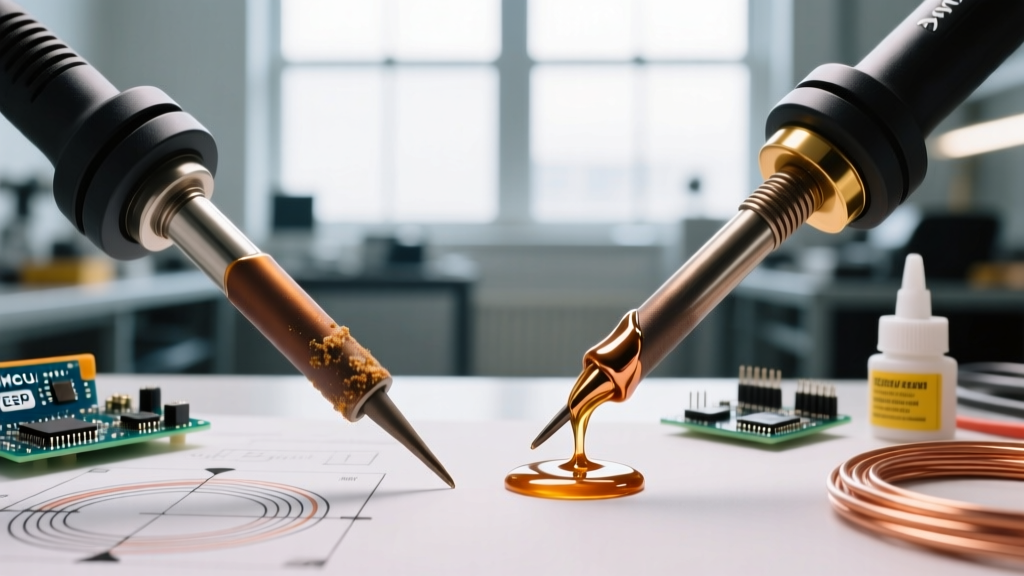
- Never wipe a hot tip on a wet sponge. The thermal shock will micro-fracture the iron plating. Use a dry brass wire sponge exclusively.
- Store with a solder cap. Before powering down, melt a generous blob of 63/37 (eutectic) or 60/40 leaded solder over the entire working surface of the tip. This sacrificial layer oxidizes instead of the tip's iron plating.
- Clean the battery contacts. Field environments are dirty. Wipe the M12 battery terminals and the iron's receiver contacts with isopropyl alcohol monthly to prevent voltage drop across dirty connections.
Final Verdict
The Milwaukee M12 Soldering Iron (4822-2002) is a highly specialized tool that solves a very specific problem: safe, cordless, flame-free soldering in commercial and industrial environments. While it will not replace a 100W bench station for heavy plumbing or massive ground planes, it is an absolute game-changer for HVAC control wiring, automotive 12V harness repair, and field sensor splicing. By pairing it with the correct HIGH OUTPUT battery and respecting its thermal limits, it easily earns its place in the 2026 professional service kit.