
The Budget Benchmark: Gordak 952 Soldering Iron Station in 2026
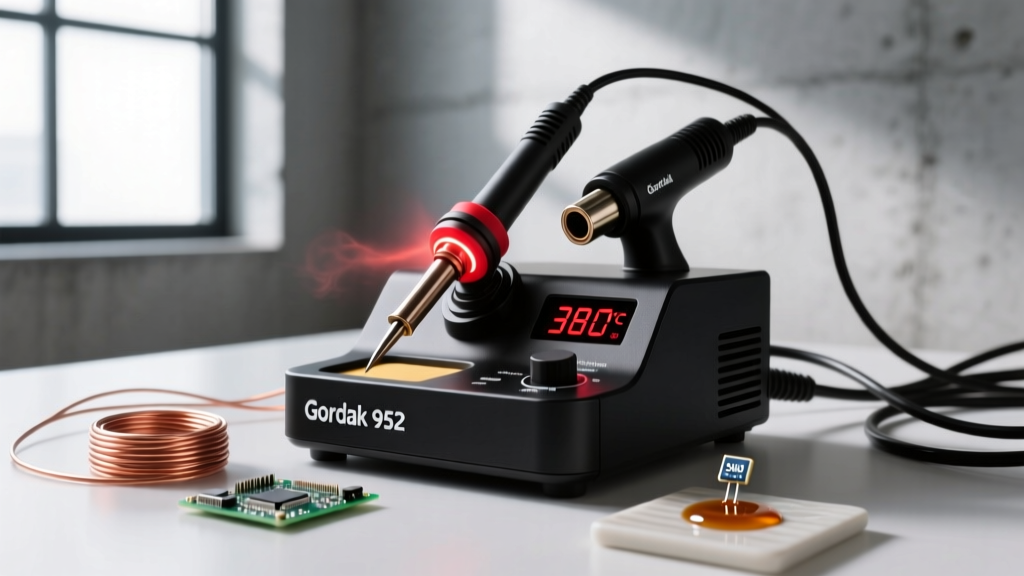
When hobbyists and entry-level repair technicians search for the Gordak 952 soldering iron, they are almost always referring to the ubiquitous Gordak 952 (along with its 952+ and 952D variants) 2-in-1 SMD rework station. For over a decade, this unit has been the undisputed king of the sub-$60 electronics workbench. But as component sizes shrink to 0201 imperial and lead-free solder alloys become the default standard, does a budget analog-style station still hold up in 2026?
In this comprehensive review, we bypass the marketing fluff and put the Gordak 952 through rigorous bench testing. We will analyze its thermal recovery, evaluate the often-overlooked safety flaws of budget stations, and determine exactly who should buy this unit today—and who needs to look elsewhere.
Anatomy of the Station: Iron vs. Air Gun
The Gordak 952 is not merely a standalone iron; it is a combined convection and contact soldering system. Understanding the hardware limitations of both modules is critical for setting realistic expectations.
The Contact Soldering Iron Module
The iron included with the 952 series typically outputs between 45W and 60W (depending on the exact clone and regional voltage). It utilizes the widely available 900M series tip architecture. Unlike modern cartridge-style tips (such as Hakko T12 or JBC C245) where the heating element and thermocouple are integrated directly inside the tip, the 900M system uses a sleeve-over-heater design.
- Thermal Mass: High. The air gap between the ceramic heater and the tip sleeve creates inherent thermal lag.
- Tip Compatibility: Excellent. 900M tips are manufactured by dozens of companies, meaning you can source specialized profiles (like micro-needle or heavy chisel) for pennies.
- Controller: Basic phase-angle triac control (on older analog dial models) or a rudimentary digital PID (on the 952D+). Expect a temperature ripple of ±5°C to ±10°C at the tip.
The Hot Air Rework Module
The original Gordak 952 uses a diaphragm air pump housed in the main base unit, pushing air through a long, thick silicone hose to the handpiece. The later 952+ and 952D models upgraded to a brushless fan integrated directly into the handle. The fan-in-handle design is vastly superior for SMD work, as it eliminates the pressure pulsation and lag associated with long pneumatic hoses.
Bench Test Data: Thermal Recovery & Performance
To evaluate the Gordak 952 soldering iron's real-world capability, we tested its thermal recovery using a K-type thermocouple embedded in a copper test slug, simulating a heavy ground plane connection. We used standard 63/37 SnPb solder and a no-clean flux core.
| Test Parameter | Gordak 952 (900M Chisel Tip) | Reference: Hakko FX-888D (T18 Chisel) |
|---|---|---|
| Time to reach 320°C from cold | 48 seconds | 24 seconds |
| Temp drop on 14AWG wire contact | -42°C | -18°C |
| Recovery time to 320°C | 14 seconds | 4 seconds |
| Tip Oxidation (after 4 hrs @ 380°C) | Severe (Stock tip) | Moderate |
The Takeaway: The Gordak 952 struggles with heavy thermal loads. If you are soldering thick multilayer PCB ground planes or large RC battery connectors (like XT90s), the 900M sleeve design will rob your joint of heat, leading to cold solder joints. However, for standard through-hole components, 0805 SMD passives, and basic DIP ICs, the recovery time is entirely adequate.
Mastering SMD Rework with the Hot Air Gun
Where the Gordak 952 truly earns its keep is in SMD rework. According to SparkFun's SMD Soldering Guide, controlling airflow volume is just as critical as temperature when reflowing surface-mount components. The 952's air gun provides a 250W heating element, which is more than enough to reflow a 256-pin BGA chip or a QFP-44 microcontroller.
Pro-Tip for 2026: The stock nozzles included with the Gordak 952 are often poorly machined and leak air from the base. Wrap the base of the nozzle with a single layer of PTFE (Teflon) plumber's tape before twisting it onto the handpiece. This creates an airtight seal, drastically improving localized heat concentration and preventing nearby plastic connectors from melting.
Recommended Settings for Common Tasks
- SOIC-8 / SOP-8 ICs: 320°C, Airflow at 40%. Use a 4mm round nozzle. Apply tack flux to all pins.
- QFP-44 to QFP-100: 350°C, Airflow at 55%. Use a large square nozzle. Keep the gun perfectly level and move in slow, continuous circles.
- 0603 / 0805 Passives: 300°C, Airflow at 25%. High airflow on the 952 will literally blow microscopic components off the board and into the carpet.
Critical Safety Alert: The Floating Ground Issue
The most significant drawback of the Gordak 952—and almost all ultra-budget stations from the same manufacturing ecosystem—is the potential for a 'floating' or poorly bonded earth ground on the soldering iron tip.
According to the ESD Association Fundamentals, a soldering iron tip must be bonded to earth ground to safely dissipate electrostatic discharge (ESD) away from sensitive MOSFETs and CMOS logic gates. On some Gordak 952 units, the internal wire connecting the iron's metal sleeve to the mains earth pin is either missing, poorly crimped, or has high resistance.
How to Test and Fix the Grounding
- Test: Set your multimeter to AC millivolts (mV). Plug the station in and turn the iron on. Place one probe on the metal shaft of the soldering iron tip and the other on a known earth ground (like the ground pin of a wall outlet or a grounded PC case). A reading above 15-20mV AC indicates a dangerous floating ground or severe inductive coupling.
- Fix: Unplug the station and open the base unit. Locate the yellow/green earth wire. Ensure it is securely fastened to the metal chassis and the grounding post that connects to the iron's航空 (aviation) connector. If your station lacks this internal bond, run a dedicated 18AWG wire from the iron's metal collar directly to the earth ground pin of your power cable.
For authoritative guidelines on grounding requirements in professional electronics assembly, refer to the NASA Workmanship Training for Soldering standards, which mandate strict millivolt limits for tip-to-ground resistance to prevent catastrophic component damage.
2026 Market Comparison: Gordak 952 vs. The Alternatives
While the Gordak 952 remains a staple, the market has evolved. Here is how it stacks up against modern competitors in the budget and mid-tier space.
| Feature | Gordak 952+ (2-in-1) | Yihua 8786D (2-in-1) | Pine64 Pinecil V2 (Iron Only) |
|---|---|---|---|
| Avg. Price (2026) | $45 - $55 | $65 - $80 | $26 (Iron only) |
| Tip Architecture | 900M (Sleeve) | 900M (Sleeve) | T65 / TS100 (Cartridge) |
| Heat Recovery | Slow / Moderate | Slow / Moderate | Extremely Fast |
| Display / UI | Basic Digital / Analog | Digital PID | OLED / BLE App |
| Best Use Case | General DIY, SMD Rework | Heavy DIY, Phone Repair | Portable, Precision SMD |
If you only need a soldering iron and do not require hot air for SMD rework, the Gordak 952 is no longer the best choice. A smart iron like the Pinecil V2 or a cartridge-based station like the KSGER T12 will obliterate the Gordak's iron module in thermal recovery and precision. However, if you need both an iron and a hot air gun on a strict sub-$70 budget, the Gordak 952+ remains virtually unchallenged in pure price-to-functionality ratio.
Essential Upgrades for the Gordak 952
If you decide to purchase the Gordak 952 in 2026, do not use it straight out of the box. Implement these three upgrades to transform it from a frustrating toy into a capable bench tool:
- Ditch the Stock Tips: The included 900M tips are made of low-grade copper with poor iron plating. They will oxidize and pit within weeks. Purchase a set of genuine Hakko 900M series tips, or high-quality third-party equivalents with thick iron plating.
- Upgrade the Flux: Budget stations require excellent chemical assistance to compensate for thermal lag. Stop using the rosin paste that comes in the box. Invest in a high-tack, no-clean syringe flux like Amtech NC-559 or Chip Quik SMD4300.
- Use a Silicone Mat: The hot air gun gets hot enough to melt standard plastic workbench mats and emit toxic fumes. Always use a high-temperature silicone soldering mat rated for at least 500°C.
Final Verdict: Who is the Gordak 952 For?
The Gordak 952 soldering iron station is a masterclass in 'good enough' engineering. It is not a precision instrument, and it will frustrate professionals attempting to rework dense, multi-layer server boards with heavy copper pours.
However, for the Arduino hobbyist, the drone builder repairing ESCs, and the vintage audio enthusiast recapping amplifiers, the Gordak 952+ offers 90% of the capability of a $400 setup for roughly 10% of the price. By performing the grounding safety mod, upgrading your tips, and respecting its thermal limitations, the Gordak 952 will remain a reliable workhorse on your bench for years to come.