
The Big-Box Reality: What You Get in the Soldering Aisle
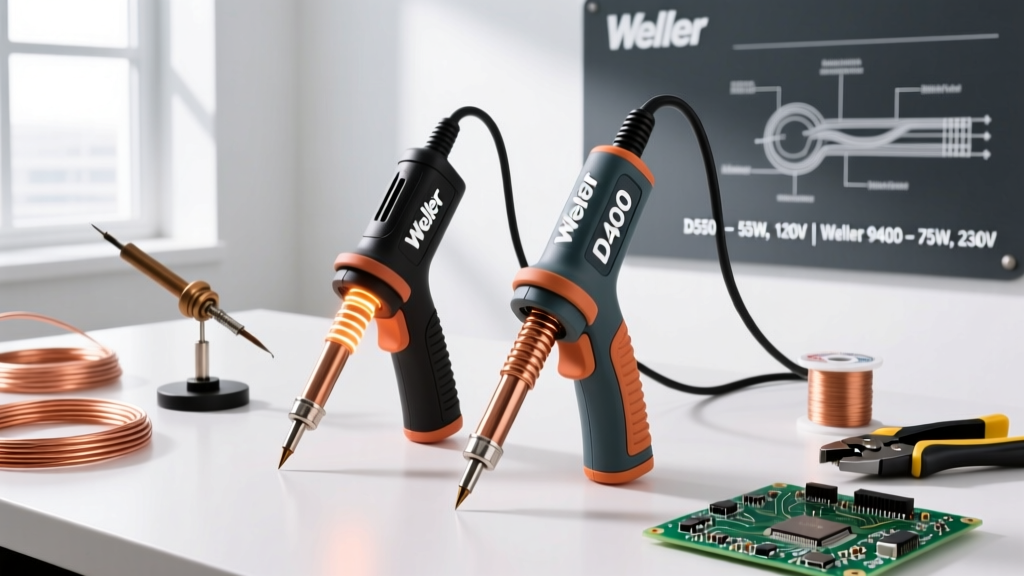
When tackling heavy-duty electrical projects, automotive wiring, or stained glass work, a standard 40W pencil iron simply will not cut it. You need massive thermal recovery and high amperage. This inevitably leads DIYers and professionals to the big-box hardware store. If you are searching for a Lowe's soldering gun, you are primarily looking at the legacy transformer-based models manufactured by Weller. In 2026, Lowe's continues to stock the quintessential heavy-hitters of the soldering world: the Weller D550PK and the Weller 9400 series.
Unlike modern ceramic-core pencil irons that rely on PID temperature controllers, these soldering guns utilize a raw, step-down transformer design. They are heavy, they hum, and they feature a trigger-switch mechanism. But are they the right tool for your specific application? This feature deep dive dissects the engineering, practical applications, and critical failure modes of the transformer soldering guns available at Lowe's.
Transformer Physics: How the Weller Guns Actually Work
To understand why a Lowe's soldering gun behaves the way it does, you must understand the internal topology. These tools do not use a resistive heating element. Instead, they house a toroidal step-down transformer.
- Primary Coil: Connected to your 120V AC mains, featuring thousands of turns of thin wire.
- Secondary Coil: Consists of a single, massive turn of thick copper tubing or braid.
- The Tip: The copper loop tip you attach to the front is actually the final segment of the secondary circuit.
When you pull the trigger, the transformer steps down the 120V AC to approximately 0.5V AC, while simultaneously stepping up the current to a staggering 150 to 200 Amps. This massive current passing through the high-resistance copper tip generates intense, instantaneous heat via Joule heating. This is why a Weller gun can reach 1000°F (538°C) in roughly six seconds, whereas a standard iron takes two minutes.
Expert Insight: Because the tip is part of an active AC electrical circuit, a very small voltage potential exists across the tip itself. While harmless to bare copper wire, this potential can be catastrophic to sensitive, ungrounded semiconductor junctions.
Head-to-Head: Weller D550PK vs. Weller 9400 Series
When browsing the aisles or the Lowe's online inventory, you will typically encounter two main tiers of transformer guns. Below is a technical comparison based on 2026 retail specifications and pricing.
| Feature | Weller D550PK (Kit) | Weller 9400 |
|---|---|---|
| Wattage Output | 260W / 200W (Dual Trigger) | 140W / 100W (Dual Trigger) |
| Approx. Lowe's Price | $74.98 | $54.98 |
| Tip Style | Heavy Copper Loop | Standard Copper Loop |
| Heat-Up Time | ~6 Seconds | ~6 Seconds |
| Ideal Wire Gauge | 8 AWG to 14 AWG | 12 AWG to 18 AWG |
| Weight | 2.4 lbs | 1.8 lbs |
The D550PK is the undisputed heavyweight champion. Its 260W high setting provides the thermal mass necessary to solder thick 8 AWG battery cables or heavy copper lugs without the joint acting as a massive heat sink. The 9400, while lighter and more ergonomic, struggles with anything thicker than 12 AWG wire, as the thermal energy dissipates into the copper mass faster than the 140W transformer can replenish it.
Practical Applications: Where the Lowe's Soldering Gun Shines
Transformer guns are highly specialized tools. According to guidelines referenced by electronics educators at SparkFun, you must match the thermal mass of the tool to the thermal mass of the joint. Here is where your Lowe's purchase will pay dividends:
1. RC Hobby and Drone Wiring (XT60 / XT90 Connectors)
Soldering 12 AWG or 10 AWG silicone wire to the massive brass pins of an XT90 connector requires immense, sustained heat. A 60W pencil iron will result in a 'cold joint' as the brass pin wicks the heat away. The Weller D550 on the 260W setting, paired with 0.062-inch diameter 60/40 Sn/Pb solder and a generous application of Kester 186 RMA (Rosin Mildly Activated) flux, will flow a perfect, shiny fillet in under four seconds.
2. Automotive and Marine Harnesses
When repairing trailer wiring harnesses or marine battery lugs in damp environments, you need to quickly heat the wire, flow the solder, and apply heat-shrink tubing before the ambient environment cools the joint. The instant-on nature of the trigger switch allows you to work in tight engine bays without a hot iron resting dangerously on a plastic intake manifold.
3. Stained Glass (Copper Foil Method)
Artisans using the copper foil method for stained glass rely heavily on the Weller 9400. The broad, flat profile of the copper loop tip is ideal for 'beading' 60/40 solder over copper tape. The trigger allows the artist to modulate the heat precisely, backing off the trigger as the solder begins to flow to prevent burning the adhesive on the copper foil.
The Danger Zone: When to NEVER Use a Transformer Gun
It is equally important to understand the limitations of these tools. If your project involves Printed Circuit Boards (PCBs), surface-mount devices (SMD), or microcontrollers like Arduino or ESP32 modules, leave the soldering gun in the toolbox.
- Magnetic Induction: The single-turn secondary coil generates a highly concentrated, alternating magnetic field at the tip. If brought near unshielded inductors, transformers, or sensitive ICs, this field can induce destructive voltage spikes.
- Thermal Shock: The 1000°F tip will instantly delaminate the copper pads from a standard FR4 fiberglass PCB.
- Physical Clumsiness: The pistol-grip form factor and heavy transformer make it impossible to achieve the sub-millimeter precision required for 0.1-inch header pins or SOIC chips.
For PCB work, adhere to IPC standard methodologies and invest in a proper PID-controlled station (like a Hakko FX-888D or Weller WE1010) rather than relying on a big-box transformer gun.
Failure Modes, Edge Cases, and Maintenance
Transformer guns are remarkably durable, often lasting decades. However, they do have specific failure modes that users must actively manage to protect their investment.
- Transformer Burnout (The 60-Second Rule): The most common way users destroy a Weller gun is by leaving the trigger engaged continuously. The secondary winding is not designed for a 100% duty cycle. Pulling the trigger for more than 60 seconds at a time will overheat the internal bobbin, melting the insulation and shorting the transformer. Solution: Pulse the trigger. Release it for 5 seconds every minute to allow air cooling.
- Terminal Nut Loosening: The copper tips are secured by two #10-32 brass nuts. The extreme thermal expansion and contraction cycles cause these nuts to back out over time. A loose nut introduces electrical resistance, which causes arcing, pitting, and localized melting of the terminal block. Solution: Check and tighten the nuts with a 5/16-inch nut driver before every major project. Never use pliers, which will strip the soft brass.
- Tip Pitting and Oxidation: Copper tips oxidize rapidly at 1000°F, forming a black, non-conductive scale that prevents solder from wetting. Furthermore, wiping a glowing hot copper tip on a wet cellulose sponge causes severe thermal shock, leading to microscopic pitting and eventual tip fracture. Solution: Clean the tip using a dry brass wire sponge, and always leave a generous blob of solder on the tip before releasing the trigger and storing the tool.
Final Verdict: Should You Pull the Trigger at Lowe's?
If your 2026 project list includes heavy-gauge wiring, automotive repairs, RC battery harnesses, or stained glass, buying a Lowe's soldering gun is a highly practical, cost-effective decision. The Weller D550PK remains the gold standard for heavy thermal mass joints, offering raw power that modern ceramic irons simply cannot match at this price point. However, if your primary focus is electronics prototyping, PCB repair, or microcontroller wiring, bypass the soldering gun aisle entirely and look toward dedicated, temperature-controlled soldering stations.