
The Thermal Mass Problem: Why You Need a Large Soldering Iron
When transitioning from delicate PCB work to heavy-duty electrical wiring, many technicians hit a frustrating wall. Attempting to solder 4 AWG battery cables, thick ground straps, or heavy copper lugs with a standard 60W or 80W station almost always results in cold, dull joints, excessive flux burn, and melted wire insulation. The culprit is not your technique; it is thermal mass.
Thick copper acts as a massive heat sink. When a low-wattage iron touches a large copper lug, the iron's tip temperature plummets instantly. The heater core struggles to recover, forcing the operator to hold the iron in place for 30+ seconds. This prolonged heat exposure wicks up the wire, melting the PVC or silicone insulation and violating core safety standards. To achieve a shiny, concave, and structurally sound joint in under five seconds, you need a large soldering iron with high thermal capacity and rapid recovery times.
In this 2026 buying guide, we evaluate the top heavy-duty soldering irons on the market, breaking down their heating elements, tip geometries, and ideal use cases for industrial and automotive applications.
2026 Heavy-Duty Iron Comparison Matrix
| Model | Max Wattage | Temp Range | Best Application | Est. Price (2026) |
|---|---|---|---|---|
| Hakko FX-601-02/P | 130W (equiv.) | 200°C - 540°C | AWG 10 to AWG 4 lugs, RC batteries | $145 - $160 |
| Weller W200PG | 200W | Fixed (via CT6 tips) | AWG 2 to AWG 4/0 battery cables | $180 - $210 |
| American Beauty 3154 | 200W | Fixed / High-Heat | Industrial busbars, heavy plumbing | $250 - $280 |
Top Contenders Reviewed
Hakko FX-601-02/P: The Adjustable Powerhouse
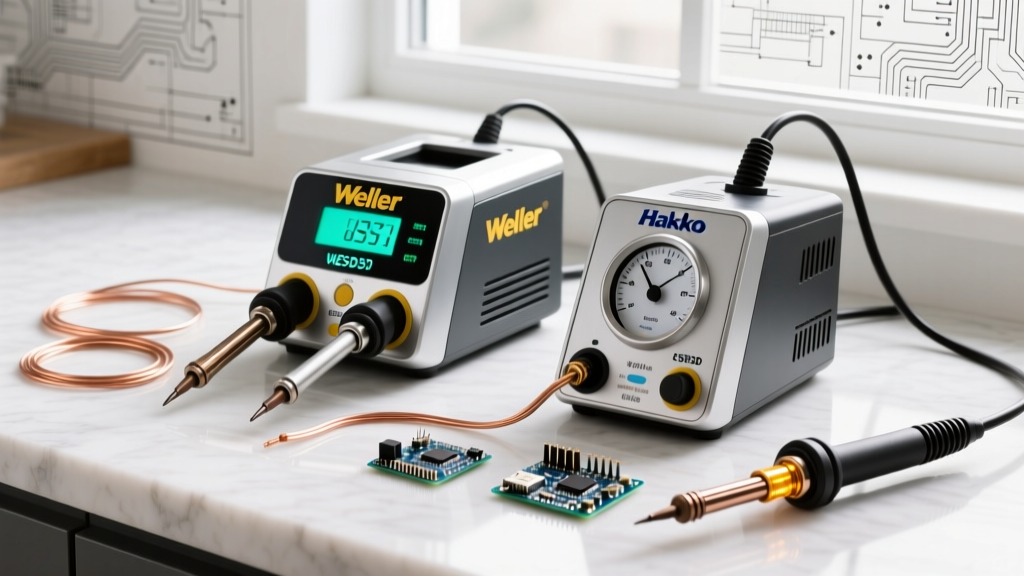
The Hakko FX-601 is a unique beast in the heavy-duty category. While officially rated at 67W, its advanced ceramic heating element and proprietary thermal sensor deliver the equivalent heat capacity of a traditional 130W nichrome iron. It is the only heavy-duty iron in this roundup with a digital-style dial for precise temperature control, ranging from 200°C to a blistering 540°C (1004°F).
Pros:
- Lightweight (only 230g) despite its power, reducing wrist fatigue during long harness builds.
- Uses the widely available 900M series tips, making it easy to source large chisel and bevel tips.
- Dial adjustment allows you to drop the temp for 12 AWG wires and crank it to 450°C for 4 AWG lugs without changing tools.
Cons:
- The included 900M-B (conical) tip is virtually useless for heavy wire. You must purchase a 900M-D52 (5.2mm chisel) or 900M-K (knife) separately.
- Not quite powerful enough for 2/0 AWG or 4/0 AWG welding cables.
Weller W200PG: Industrial Grade for Massive Lugs
If you are building custom battery banks, solar inverter runs, or automotive starter cables, the Weller W200PG is the gold standard. This is a pure, unadulterated 200W heavy-duty iron. It relies on Weller's CT6 series tips, which are massive, solid-copper, iron-plated behemoths that hold an incredible amount of thermal energy.
The CT6 Tip System: Unlike adjustable stations, the W200PG uses temperature-coded tips. The CT6E7 (700°F / 371°C) and CT6F8 (800°F / 426°C) are the go-to choices for heavy electrical work. The sheer mass of the CT6 tip ensures that when you press it against a 1/0 AWG copper ring terminal, the temperature barely drops, melting 63/37 rosin-core solder instantly.
Failure Mode Warning: Because this iron operates at high fixed temperatures, leaving it in a holder without using the Weller W200PG's optional heat-reducing stand can cause rapid tip oxidation. Always tin heavily with Kester 186 flux paste before racking it.
American Beauty 3154: The 200W Battery Cable Specialist
American Beauty is a brand synonymous with heavy industrial soldering. The Model 3154 is a 200W iron designed specifically for high-volume, high-thermal-mass applications. It features an ergonomic, heat-resistant molded handle and a heavy-duty stainless steel shaft that prevents heat from migrating to the user's hand.
Where the American Beauty shines is in continuous duty cycles. If you are soldering 50+ heavy grounding straps in a manufacturing environment, the nichrome heating element and heavy copper core provide relentless, unwavering heat. It pairs exceptionally well with their proprietary paste fluxes and large-diameter solid wire solder. However, at nearly $280 and weighing significantly more than the Hakko, it is overkill for the weekend DIYer or occasional RC hobbyist.
Mastering the Joint: Tip Geometry and Flux Dynamics
Owning a large soldering iron is only half the battle. Heavy-gauge wire requires specific consumables and techniques to prevent joint failure.
1. Ditch the Conical Tip
Conical (pointed) tips are designed for precision PCB work. On a large soldering iron, a conical tip will result in a microscopic contact area with a copper lug, drastically reducing thermal transfer. Always use a heavy chisel, screwdriver, or bevel tip. A flat chisel tip maximizes the surface area touching the round barrel of a wire lug, wrapping the heat around the copper.
2. The Necessity of External Flux
While you should use rosin-core solder (like Kester 44), the core flux is rarely sufficient for heavy, oxidized copper lugs. You must apply an external flux to the wire and terminal before applying heat. For electrical work, use a high-quality RMA (Rosin Mildly Activated) liquid or paste flux. Avoid plumbing acid flux at all costs, as it will cause severe galvanic corrosion and eventual open-circuit failure.
3. The 'Heat the Lug, Not the Solder' Rule
Expert Technique: Apply the tinned flat of your large iron tip directly to the copper lug barrel. Hold for 2-3 seconds until the flux sizzles and smokes. Then, touch your solder wire to the opposite side of the lug, not the iron tip. If the lug is hot enough, it will draw the solder in via capillary action, ensuring the solder penetrates deep into the wire strands.
IPC Standards and Fume Safety
When soldering heavy-gauge wires, you are vaporizing significantly more flux than you would on a standard circuit board. According to the guidelines outlined in IPC J-STD-001 (Requirements for Soldered Electrical and Electronic Assemblies), excessive heat application can cause insulation damage and conductor separation. A high-wattage iron prevents this by completing the joint in seconds rather than minutes, keeping the heat localized to the terminal.
However, the rapid vaporization of rosin flux generates dense colophony fumes. Prolonged exposure to these fumes is a known respiratory sensitizer and can lead to occupational asthma. The Occupational Safety and Health Administration (OSHA) strongly mandates the use of local exhaust ventilation (LEV) when soldering. For heavy-duty bench work, a standard desktop fan is insufficient. Invest in a HEPA and activated carbon fume extractor (such as the Hakko FA-400 or Weller WX Fume Extraction systems) positioned within 6 inches of the solder joint to capture particulates before they reach your breathing zone.
Final Verdict: Which Large Iron Fits Your Bench?
Choosing the right large soldering iron depends entirely on your typical wire gauge and duty cycle:
- For RC Hobbyists, Automotive DIYers, and Solar Techs (AWG 16 to AWG 4): The Hakko FX-601 is the undisputed champion. Its adjustable temperature dial offers unmatched versatility, allowing you to use one tool for both delicate XT60 connectors and heavy 4 AWG inverter cables.
- For Custom Battery Banks and Starter Cables (AWG 2 to AWG 4/0): The Weller W200PG with a CT6F8 tip is mandatory. The raw thermal mass is the only way to properly flow solder into 4/0 AWG welding cable without scorching the insulation.
- For Industrial Manufacturing: The American Beauty 3154 offers the ruggedness and continuous-duty reliability required for production-line environments.
Investing in a proper heavy-duty iron will immediately eliminate cold joints, reduce wire prep time, and elevate the mechanical strength of your high-current electrical assemblies.