
The Evolution of Hot Air Soldering in 2026
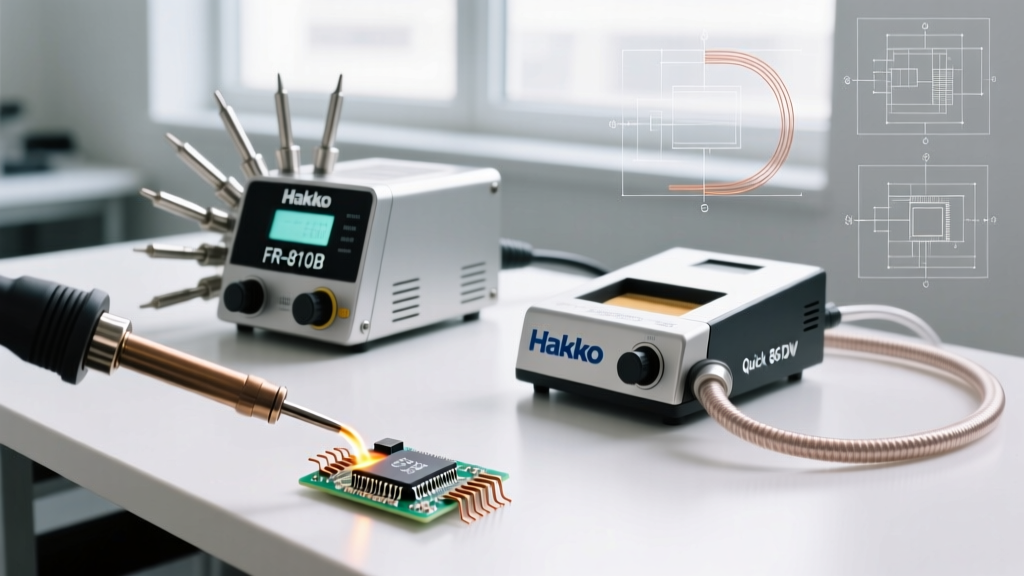
As surface-mount technology continues to shrink, with 0201 and 01005 imperial components becoming standard in consumer electronics and IoT devices, precision thermal management is no longer optional. Hot air soldering has evolved from a blunt desoldering tool into a surgical instrument required for BGA rework, QFN installation, and delicate heat-shrink applications. In the professional and high-end enthusiast space, two stations dominate the conversation: the premium Hakko FR-810B and the mid-tier benchmark Quick 861DW.
This comprehensive tool comparison dissects the real-world performance, thermal recovery, ergonomics, and total cost of ownership for both units. Whether you are running a high-volume repair depot or building a serious home lab, understanding the nuanced differences between these two hot air soldering stations will dictate your rework success rate.
Contender Profiles: By the Numbers
Before diving into the qualitative rework experience, we must establish the baseline hardware specifications. Note that pricing reflects average market rates as of early 2026.
| Specification | Hakko FR-810B | Quick 861DW |
|---|---|---|
| Market Position | Professional / Industrial | Prosumer / Mid-Tier |
| Average Price (2026) | $950 - $1,050 | $270 - $310 |
| Heater Power | 600W | 1000W |
| Temperature Range | 100°C - 500°C | 100°C - 500°C |
| Max Airflow | 20 L/min (High Pressure) | 120 L/min (High Volume) |
| Handpiece Weight | ~130g (Ultra-light) | ~180g (Standard) |
| PID Control | Advanced Digital PID | Standard Digital PID |
Thermal Recovery and Airflow Dynamics
The most critical failure mode in hot air soldering is 'pad lifting' or 'tombstoning,' which occurs when thermal equilibrium is lost during the reflow phase. The Quick 861DW approaches this with brute force: a massive 1000W ceramic heater paired with a high-volume brushless fan pushing up to 120 L/min. This high-volume airflow is excellent for rapidly heating large ground planes on 4-layer PCBs, but it requires careful dialing to avoid blowing away 0402 components.
Conversely, the Hakko FR-810B utilizes a 600W heater but compensates with superior thermal coupling and a high-pressure, low-volume airflow design (capped at 20 L/min). According to Hakko FR-810B official documentation, this pressurized approach allows for pinpoint accuracy. The air exits the nozzle with higher velocity but lower overall displacement, meaning you can target a specific 3x3mm QFN chip without inadvertently reflowing the adjacent 0603 decoupling capacitors.
Expert Insight: When removing large BGA chips on multi-layer boards, the Quick 861DW's 1000W heater recovers from the thermal sink of the copper planes faster. However, for precision micro-soldering and localized SMD work, the Hakko's focused airflow prevents collateral thermal damage to surrounding plastics and connectors.
Ergonomics and Handpiece Fatigue
In a professional rework environment, the physical toll of the handpiece is a major factor. The Quick 861DW handpiece weighs approximately 180g. While not excessively heavy, the silicone hose exhibits significant 'memory' and stiffness, especially in cooler ambient room temperatures. This stiffness creates a dragging resistance that can cause hand fatigue during 45-minute rework sessions.
Hakko completely redesigned the ergonomics for the FR-810B. The handpiece weighs a mere 130g, and the hose is constructed from a highly supple, heat-resistant polymer that offers almost zero resistance. Furthermore, the FR-810B features an auto-sleep function that triggers the moment the wand is placed in the cradle, dropping the temperature to 200°C to preserve the heating element and reduce ambient lab noise.
Real-World Edge Cases and Standards Compliance
Adhering to industry standards is non-negotiable for aerospace, automotive, and medical device repairs. When performing wire harness repairs involving heat shrink tubing, technicians must follow the NASA-STD-8739.3 Workmanship Manual, which mandates uniform heating without scorching or uneven shrinkage. The Hakko FR-810B's fine-tuned airflow dial (adjustable in 0.1 L/min increments via the digital interface) allows technicians to sweep heat evenly across the tubing without the aggressive blast that often displaces wires inside the shrink.
For complex PCB rework, the IPC-7711/7721 rework standards emphasize the necessity of controlled preheating and localized top-heat. While neither station replaces a dedicated IR preheater for massive server motherboards, the Quick 861DW's wide-nozzle attachments (like the 20mm square BGA nozzle) can act as a makeshift localized preheater when set to 250°C and 40 L/min, bringing the entire board section up to a safe baseline before focusing on the target IC.
The Nozzle Ecosystem: Cost of Ownership
A hot air soldering station is only as good as its nozzles. Here, the two brands take vastly different approaches:
- Quick 861DW: The nozzle ecosystem is vast and highly accessible. Third-party manufacturers produce clones of Quick's nozzles for a fraction of the cost. However, these clone nozzles often suffer from poor thermal mass and inconsistent inner diameters, leading to uneven heating. Genuine Quick nozzles are reasonably priced ($15-$25 each) but require a specific twist-lock mechanism that can wear out over years of heavy use.
- Hakko FR-810B: Hakko uses the proprietary B-series nozzle line. These nozzles are precision-machined from high-grade alloys with exceptional thermal retention. The trade-off is cost and availability. A single genuine Hakko B12 (12mm round) nozzle can cost upwards of $45, and specialized BGA profiles can exceed $100. Furthermore, the FR-810B uses a magnetic slip-on nozzle design that is incredibly fast to change but requires careful handling to avoid dropping the hot nozzle.
Pros and Cons Breakdown
Hakko FR-810B
- Pros: Unmatched precision airflow control; ultra-lightweight handpiece; near-silent brushless pump; nitrogen-compatible for oxidation-free rework; magnetic quick-change nozzles.
- Cons: High initial capital cost; expensive proprietary nozzles; lower max airflow volume struggles with massive, un-preheated ground planes.
Quick 861DW
- Pros: Exceptional value; massive 1000W thermal recovery; high airflow volume for fast desoldering; abundant and cheap third-party nozzle options; programmable temperature profiles.
- Cons: Stiff handpiece hose; heavier wand causes fatigue; loud at high airflow settings; aggressive airflow can displace micro-components if not shielded.
Final Verdict: Which Hot Air Soldering Station Wins?
The 'best' station depends entirely on your daily workflow and budget constraints in 2026. If you are a high-volume repair technician dealing with heavily shielded RF boards, thick power supply ground planes, and general consumer electronics, the Quick 861DW remains the undisputed king of ROI. Its 1000W brute force and affordable nozzle ecosystem make it an indispensable workhorse.
However, if your work involves microscopic precision—such as smartphone logic board repair, aerospace wire harnessing, or lab prototyping with ultra-dense 01005 components—the Hakko FR-810B is worth every penny of its premium price tag. The surgical airflow control, combined with the fatigue-free handpiece, elevates it from a mere tool to an extension of the technician's hand.
Frequently Asked Questions (FAQ)
Can I use the Quick 861DW for BGA rework without a preheater?
While the Quick 861DW has the thermal mass to melt BGA solder spheres, attempting to reflow a large BGA on a multi-layer board without a bottom preheater violates IPC guidelines and risks warping the PCB substrate or popping the BGA package due to uneven thermal expansion. Always use an IR preheater to bring the board to 120°C-150°C before applying top heat.
Does the Hakko FR-810B require an external air compressor?
No. Despite its high-pressure output, the FR-810B utilizes an internal, ultra-quiet brushless diaphragm pump. It does not require an external shop compressor, which is a major advantage for cleanroom or quiet lab environments.
What is the best temperature profile for lead-free SAC305 paste?
For SAC305 (melting point ~217°C), set your hot air station to 360°C - 380°C with a moderate airflow (around 30-40 L/min). Ensure you are using flux to promote even wetting and prevent oxidation during the extended time required to reach the liquidus state.