
The True Cost of a Budget Soldering Station
When outfitting a home lab or tackling quick DIY repairs, Harbor Freight is often the default destination for affordable tools. But when it comes to precision electronics, the question remains: is a Harbor Freight soldering iron actually worth the savings, or will it cost you more in ruined PCBs and oxidized tips? In this 2026 budget vs. premium analysis, we are putting the popular Pittsburgh Pro 60-Watt Soldering Station (typically priced around $45) head-to-head against industry-standard premium stations like the Hakko FX-888D ($115) and modern smart-iron disruptors like the Pinecil V2 ($30).
While the upfront cost of the Pittsburgh Pro is undeniably attractive, soldering is a thermodynamic process governed by strict physics. The difference between a $150 premium station and a $45 budget unit isn't just about brand prestige; it is about PID temperature control, thermal recovery rates, tip metallurgy, and electrostatic discharge (ESD) safety. Let us break down exactly where the budget options fail, where they suffice, and how to make the right investment for your specific workbench.
Specification & Performance Matrix
| Feature | Pittsburgh Pro 60W (Budget) | Hakko FX-888D (Premium) | Pinecil V2 (Smart Disruptor) |
|---|---|---|---|
| Street Price (2026) | $45.00 | $115.00 | $30.00 (Iron only) |
| Max Wattage | 60W (Analog Dial) | 70W (Digital PID) | 65W (PD3.0 / DC) |
| Heat-Up Time (to 350°C) | ~90 - 120 seconds | ~20 - 30 seconds | ~10 - 15 seconds |
| Thermal Recovery | Poor (Hysteresis swing) | Excellent (PID loop) | Exceptional (RISC-V PID) |
| ESD Safe / Grounded | No (High leakage risk) | Yes (True earth ground) | Depends on PSU grounding |
| Tip Ecosystem | Proprietary, low-quality alloy | T18 Series (Massive variety) | TS100 / Pine64 (Wide variety) |
Thermal Dynamics: Why 60W Is Not Always 60W
The most common misconception among beginners is that wattage equals heat. In reality, wattage dictates thermal recovery—the station's ability to pump heat into a thermal sink (like a large ground plane on a PCB) without the tip temperature plummeting.
The Hysteresis Problem in Budget Stations
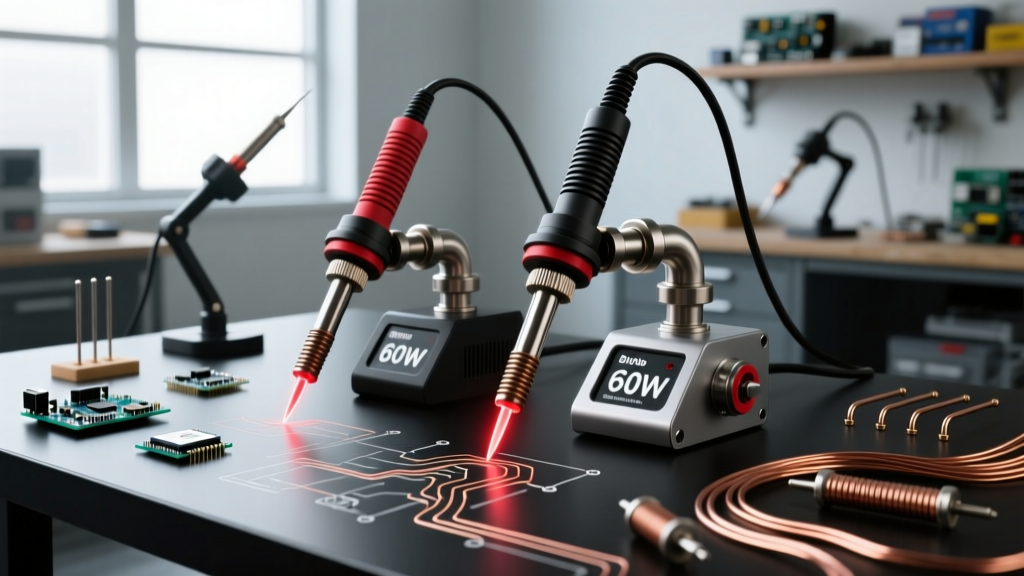
The Pittsburgh Pro 60W station relies on a basic analog thermostat with wide hysteresis. When you set the dial to 350°C (662°F), the heater element blasts at full power until a crude bimetallic strip or basic thermocouple trips the circuit off. The tip might overshoot to 380°C, then drop to 320°C before the heater kicks back on. This 60-degree swing is disastrous for sensitive components and lead-free solder.
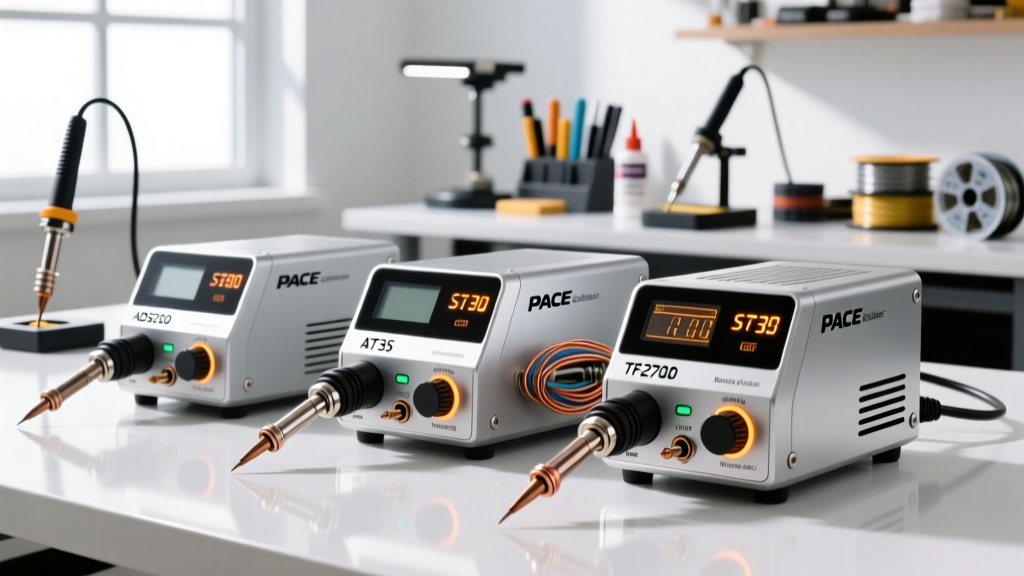
Premium stations like the Hakko FX-888D utilize a closed-loop PID (Proportional-Integral-Derivative) controller. The microprocessor samples the tip temperature multiple times per second, pulsing the heater to maintain a rock-solid 350°C ± 2°C. When you touch a cold solder pad, the premium station detects the micro-drop in temperature and instantly floods the element with current to compensate. The Pittsburgh Pro, by contrast, will stall, drop below the melting point of SAC305 lead-free solder (217°C), and leave you with a cold, grainy solder joint.
Expert Insight: According to the IPC J-STD-001 standard for soldered electrical assemblies, proper wetting and intermetallic compound (IMC) formation require precise thermal profiling. Prolonged dwell times caused by underpowered or poorly regulated irons lead to excessive IMC growth, resulting in brittle, unreliable solder joints that fail under mechanical stress.
Tip Metallurgy: The Hidden Ongoing Cost
Many hobbyists justify buying a cheap station by assuming they can just replace tips frequently. However, the metallurgy of budget tips introduces severe operational headaches.
- Premium Tips (Hakko/Weller): Manufactured with a high-conductivity copper core, electroplated with a thick layer of pure iron (the working surface), and finished with non-wetting chrome. The iron plating resists corrosion and can last for hundreds of hours of continuous use if properly tinned.
- Budget Tips (Pittsburgh Pro): Often skip the thick iron plating or use inferior alloy blends to cut costs. When exposed to the rosin fluxes in 63/37 SnPb solder at high temperatures, the copper core rapidly oxidizes and pits. A budget tip can become completely non-wetting and unusable in as little as 10 to 15 hours of active use.
Furthermore, the physical tolerances on budget tips are notoriously loose. A loose fit between the tip and the ceramic heating element creates an air gap. Because air is a thermal insulator, the sensor reads the internal heater temperature, not the actual tip temperature, exacerbating the thermal recovery issues mentioned above.
ESD Safety and Stray Voltage Risks
If you are only soldering thick wires, battery tabs, or simple through-hole LED kits, ESD (Electrostatic Discharge) is a minor concern. However, if you are repairing modern motherboards, working with raw CMOS logic chips, or assembling microcontrollers like the ESP32, stray voltage is a silent killer.
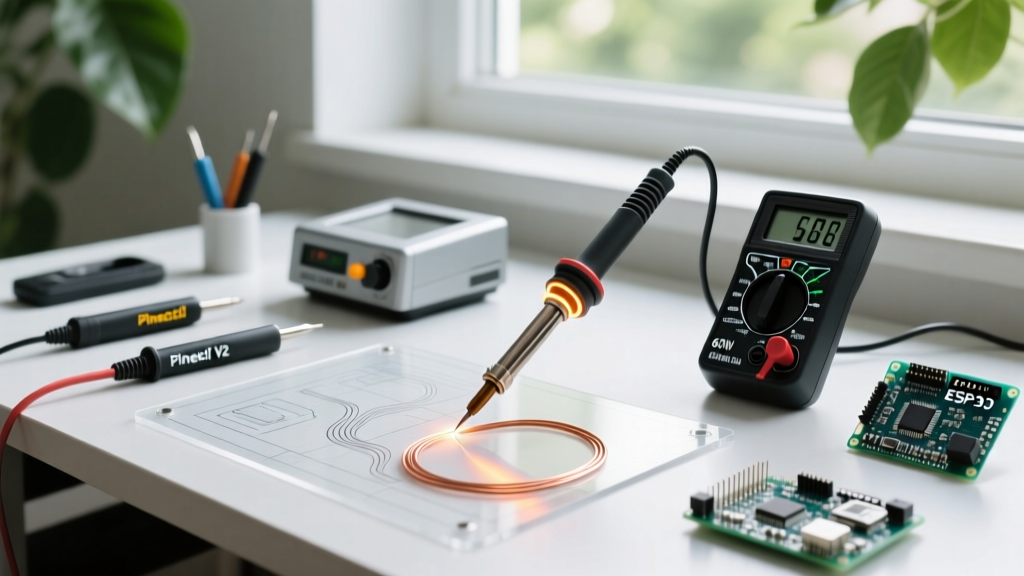
Testing the Pittsburgh Pro station with a true-RMS multimeter often reveals 10mV to 40mV of AC leakage voltage between the tip and earth ground, primarily due to the lack of proper isolation in the cheap step-down transformer and ungrounded chassis. While 40mV sounds negligible, the gate oxide layer on modern nanometer-scale MOSFETs can be punctured by voltage spikes well below human perception thresholds. The ESD Association strictly outlines the necessity of grounded workstations and tools when handling Class 0 and Class 1 ESD-sensitive devices. Premium stations feature a dedicated earth-ground wire connecting the tip directly to the third prong on your wall outlet, safely bleeding off any static or leakage current.
The 2026 Disruptor: Smart Irons vs. Traditional Stations
The traditional 'Budget vs. Premium' binary has been completely upended by USB-C PD (Power Delivery) smart irons. The Pinecil V2, powered by a RISC-V processor, costs less than the Harbor Freight station but delivers thermal recovery metrics that rival $200 professional setups.
By utilizing a 65W USB-C GaN laptop charger, the Pinecil V2 achieves a 15-second heat-up time and features a highly tunable PID algorithm via its open-source IronOS firmware. The catch? Out of the box, the Pinecil relies on the grounding of your specific USB-C power supply. If your GaN charger lacks an earth ground pin (common with 2-prong wall warts), you lose the ESD safety net of a traditional premium station. For ESD-critical work, a traditional grounded station like the Hakko or Weller remains mandatory.
Decision Framework: Which Iron Should You Buy?
Do not waste money on premium tools if your use case does not demand them, but do not ruin expensive PCBs with inadequate thermal control. Use this matrix to decide:
When the Harbor Freight Pittsburgh Pro is Acceptable:
- Tinning heavy-gauge silicone wires (12 AWG to 8 AWG).
- Soldering large through-hole components on single-layer protoboard.
- Basic plumbing or stained-glass foil work (with appropriate tip changes).
- Educational environments where equipment abuse and loss are highly likely.
When You Must Upgrade to Premium (Hakko/Weller) or Smart (Pinecil):
- SMD / Surface Mount Work: 0805, 0603, or QFN packages require instant thermal recovery and precise micro-tips that budget stations cannot adequately heat or support.
- Lead-Free Soldering: SAC305 and similar alloys require sustained 350°C+ temperatures; budget irons will oxidize their tips instantly trying to maintain this heat.
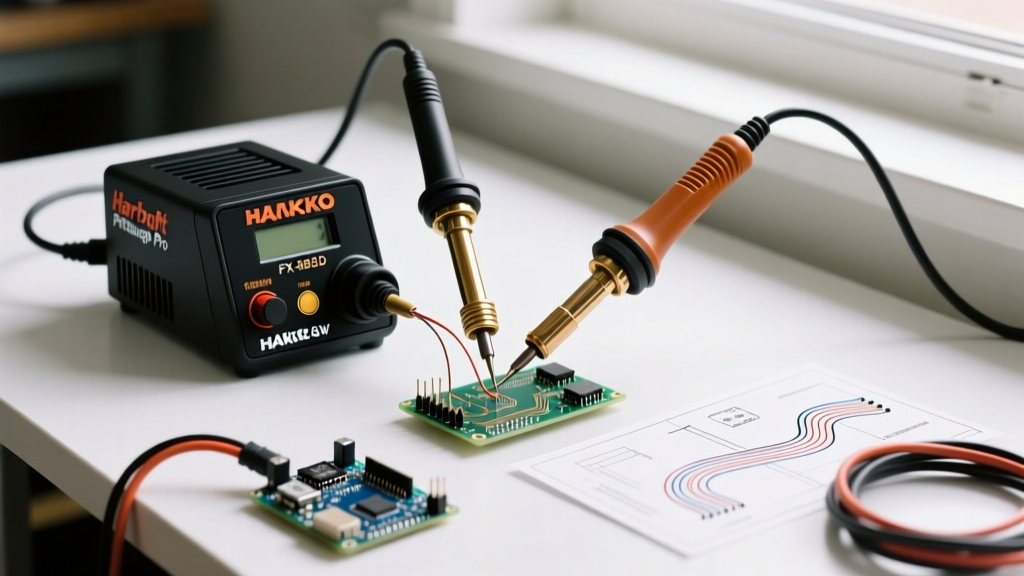
- Microcontroller Repair: Working on Arduino, Raspberry Pi, or custom PCBs with sensitive ICs requires strict ESD grounding and tight thermal tolerances to prevent pad lifting.
Final Verdict
The Harbor Freight soldering iron ecosystem serves a distinct purpose: it provides a functional, disposable heat source for heavy, non-precision tasks. However, labeling it a viable 'budget electronics station' is a disservice to the craft of PCB assembly. The time spent fighting oxidized tips, waiting for thermal recovery, and risking cold joints will quickly eclipse the $70 savings over a Hakko FX-888D. For the modern maker in 2026, the smartest budget move isn't buying a cheap analog station—it is investing $30 in a Pinecil V2 and a high-quality, grounded USB-C power supply.