
The Thermal Recovery Imperative in Modern Soldering Stations
The transition to lead-free SAC305 (Sn96.5/Ag3.0/Cu0.5) and SAC405 alloys has fundamentally changed the requirements for professional soldering stations. With a melting point of 217°C and optimal working temperatures hovering between 350°C and 380°C, modern PCB repair demands rapid thermal recovery. When a cold iron meets a high-thermal-mass ground plane, the tip temperature plummets. If the station cannot inject heat back into the joint within two to three seconds, operators risk cold solder joints, pad delamination, and prolonged heat exposure that damages sensitive SMD components.
In 2026, the best soldering stations are defined not just by peak wattage, but by sensor placement, cartridge integration, and adherence to strict ESD and workmanship standards like IPC J-STD-001. Below, we break down the top-performing stations across professional, mid-range, and budget tiers, analyzing their real-world performance on multi-layer PCBs.
2026 Soldering Stations Comparison Matrix
| Model | Power Output | Temperature Range | Tip / Cartridge System | Est. Price (2026) | Best Application |
|---|---|---|---|---|---|
| JBC CD-2BQE | 130W | 90°C - 450°C | C245 Integrated | $585 | High-volume SMT / BGA Rework |
| Hakko FX-951 | 70W | 200°C - 450°C | T12 Cartridge | $265 | General Prototyping / ESD Sensitive |
| Metcal MX-5200 | 80W (RF) | Fixed (Curie Point) | STTC / SMTC | $640 | Aerospace / Medical / ISO Audited |
| Weller WE1010NA | 70W | 50°C - 450°C | ETA Screw-in | $115 | Hobbyist / Light Through-Hole |
Top Tier Professional: JBC CD-2BQE
The JBC CD-2BQE remains the undisputed king of thermal recovery in 2026. Unlike traditional stations where the heater and thermocouple are housed in the wand and transfer heat to a slip-on tip, JBC utilizes the C245 cartridge system. The heating element and thermocouple are integrated directly into the tip itself, positioned millimeters from the solder joint.
Performance and Edge Cases
- Thermal Shock Recovery: When dragging a C245 chisel tip across a 4-layer PCB ground plane, the CD-2BQE recovers from a 50°C temperature drop in under 1.5 seconds.
- Sleep Mode: The station features an intelligent magnetic stand. When the handle is resting, the tip drops to 180°C, virtually eliminating dry-burn oxidation. Lifting the handle snaps it back to 350°C before it reaches the board.
- Edge Case - Heavy Copper: For extreme thermal masses (e.g., 4oz copper motor controllers), even the 130W CD-2BQE may struggle with a standard C245 tip. In these cases, operators must upgrade to the JBC DD (150W) or JT (200W) stations to maintain IPC-compliant wetting times.
Mid-Range Workhorse: Hakko FX-951
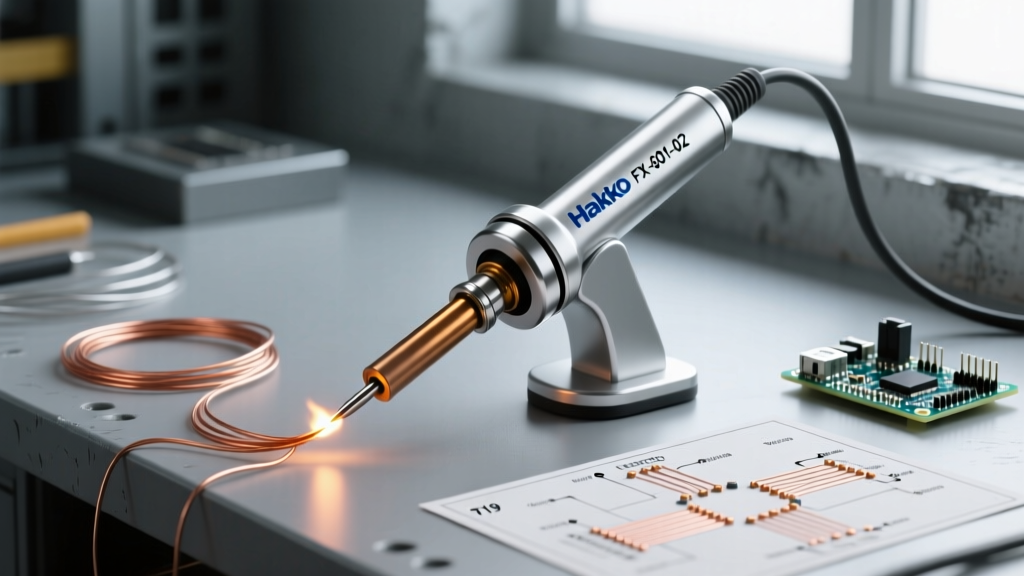
For labs and prototyping environments that require strict ESD compliance without the $600+ investment of a JBC or Metcal, the Hakko FX-951 is the industry standard. It utilizes the T12 cartridge series, which, while slightly longer than JBC's C245, still places the heater inside the tip for excellent thermal transfer.
ESD Safety and Grounding
Handling bare CMOS chips and RF modules requires verified grounding. The FX-951 is designed to meet stringent ESD Association standards. The wand features a conductive grip, and the base unit includes a dedicated grounding jack for connecting an operator's wrist strap. Pro Tip: Always verify the resistance between the tip and the earth ground pin on the power plug. It should read less than 5 ohms. If it reads higher, the internal grounding wire in the wand may be fatigued and requires replacement.
Aerospace and Medical: Metcal MX-5200
Metcal approaches temperature control through physics rather than digital feedback loops. The MX-5200 uses SmartHeat® induction technology. An RF generator sends an alternating current through a coil in the handpiece, inducing eddy currents in the ferromagnetic core of the soldering tip.
The Curie Point Advantage
The tip's outer layer is made of a specific nickel-iron alloy engineered to lose its magnetic properties at a precise Curie temperature (e.g., 350°C or 380°C). When the tip reaches this temperature, eddy currents cease, and heating stops instantly. As the tip cools during soldering, magnetic permeability returns, and heating resumes.
"Because Metcal stations rely on the physical properties of the cartridge alloy rather than software calibration, they are heavily favored in NASA NEPP compliant facilities and ISO 9001 audited environments where digital calibration drift is a liability."
The downside is the lack of a digital temperature display and the high cost of STTC/SMTC cartridges. However, for mission-critical medical devices, the elimination of calibration downtime justifies the $640 price tag.
Budget Precision: Weller WE1010NA
The Weller WE1010NA dominates the sub-$150 category. It uses the traditional ETA tip system, where a heating element slides into a copper sleeve. While this design inherently suffers from greater thermal lag compared to cartridge systems, Weller compensates with a robust 70W ceramic heater and a highly responsive PID controller.
Where the WE1010NA Excels and Fails
- Excels: Through-hole components, basic wire tinning, and 2-layer PCBs with minimal ground planes. The digital interface allows for easy temperature locking via a simple menu, preventing accidental bumps.
- Fails: Sustained drag-soldering on dense 0.5mm pitch QFPs. The thermal mass of the ETA tip and the physical gap between the heater and the working end cause a noticeable temperature droop, requiring the operator to slow their pace to avoid cold joints.
Buying Guide: Wattage vs. Thermal Mass
A common misconception in 2026 is that higher wattage equals higher maximum temperature. In reality, wattage dictates thermal recovery rate. A 40W iron and a 130W iron can both reach 400°C in open air. However, when applied to a solder joint, the 40W iron lacks the energy transfer rate to maintain that temperature against the heat-sinking effect of the PCB.
The Decision Framework:
- 40W - 70W (Conduction): Sufficient for 0402 to 0805 SMDs, standard ICs, and light through-hole work.
- 80W - 130W (Cartridge/Induction): Required for multi-layer PCBs, heavy ground planes, DPAK/D2PAK components, and continuous drag soldering.
- 150W+ (Heavy Duty): Reserved for thick copper busbars, large gauge wire lugs, and structural plumbing soldering.
Maintenance: Preventing Tip Oxidation and Failure
Even the most expensive JBC or Metcal station will perform poorly if the tip is oxidized. Lead-free fluxes are highly aggressive and leave carbonized residues that insulate the tip, blocking heat transfer.
The Brass Wool Mandate
Stop using wet cellulose sponges. Plunging a 380°C tip into a wet sponge causes rapid thermal shock. Over time, this micro-cracks the iron plating on the tip, allowing the solder to eat into the underlying copper core, destroying the tip in weeks. Instead, use a dry brass wool tip cleaner. It scrapes away oxidation without dropping the tip temperature, preserving the iron plating and maintaining thermal mass.
Frequently Asked Questions
Can I use leaded solder with these stations?
Yes. While these stations are optimized for the higher thermal demands of lead-free SAC305, they handle 63/37 Sn/Pb (leaded) solder effortlessly. Simply lower the operating temperature to 315°C - 330°C to extend tip life and prevent flux burn-off.
Are cheap clone T12 stations safe for sensitive electronics?
Clone T12 stations often lack proper ESD grounding and use unregulated power supplies that can leak AC voltage directly into the tip. This can instantly destroy sensitive MOSFETs and microcontrollers. For professional repair, always use genuine Hakko, JBC, or Weller equipment with verified earth grounding.
How often should I replace my soldering tips?
In a high-volume production environment running lead-free solder at 380°C, a standard T12 or ETA tip may last 2 to 4 weeks. Using sleep modes (like the JBC magnetic stand) and keeping idle temperatures below 300°C can extend tip life to several months. Replace the tip immediately if you notice pitting, holes, or if solder refuses to wet the working surface even after cleaning and re-tinning.