
The Hidden Variable in Electronics Assembly: Choosing Your Alloy
When building or repairing electronics, hobbyists and professionals alike often obsess over their hardware—debating the merits of a Hakko FX-951 versus a Weller WE1010. Yet, the actual consumable that forms the electrical and mechanical bond is frequently an afterthought. Selecting the right solder for soldering iron applications is the hidden variable between a reliable, long-lasting PCB and a field-failure nightmare plagued by cold joints and micro-fractures.
In 2026, the market offers a dizzying array of alloys, flux chemistries, and wire diameters. Whether you are hand-soldering fine-pitch SMD components or terminating heavy-gauge wires to a ground plane, the metallurgical properties of your solder dictate your iron's temperature profile, tip lifespan, and ultimate joint reliability. This comprehensive comparison breaks down the exact specifications you need to make an informed purchase.
The Core Debate: 63/37 vs. 60/40 Leaded Solder
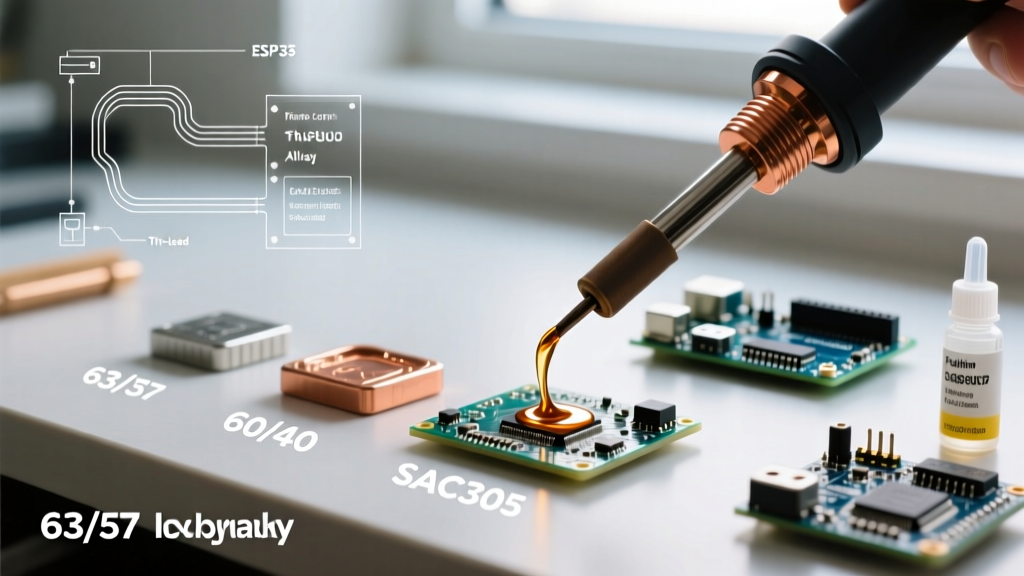
For non-RoHS (commercial and hobbyist) applications, tin-lead alloys remain the gold standard due to their superior wetting characteristics and lower melting points. However, not all leaded solders behave the same way under the iron.
Sn63/Pb37: The Eutectic Standard
Composed of 63% tin and 37% lead, this is a true eutectic alloy. It melts and solidifies at a single, precise temperature: 183°C (361°F). Because it transitions instantly from liquid to solid, it completely bypasses the "plastic" (semi-solid) phase. This is critical for hand soldering; if you accidentally bump a component while the joint is cooling, a eutectic joint will not suffer from a disturbed crystalline structure. Kester 44 and Multicore 63/37 remain the industry benchmarks, typically costing between $45 and $55 per 1lb spool in 2026.
Sn60/Pb40: The Plastic Phase Risk
At 60% tin and 40% lead, this non-eutectic alloy has a melting range between 183°C and 190°C (374°F). In this 7-degree window, the solder is in a plastic state. While slightly cheaper, moving a component during this phase results in a "disturbed joint," characterized by a dull, grainy appearance and significantly reduced mechanical strength. For precision PCB work, 60/40 is generally not recommended unless you are using a reflow oven with strict profile control.
Expert Insight: According to workmanship standards outlined by NASA's Electronic Parts and Packaging (NEPP) Program, disturbed joints in non-eutectic solders are a primary cause of micro-cracking in high-vibration environments. Always default to 63/37 for hand-assembled aerospace or automotive prototypes.
Lead-Free Alloys: Navigating SAC305 and High-Temp Profiles
If you are manufacturing for commercial markets in the EU or California, RoHS compliance is mandatory, forcing a shift to lead-free alloys. The most ubiquitous lead-free solder for soldering iron use is SAC305 (96.5% Tin, 3.0% Silver, 0.5% Copper).
- Melting Point: 217°C to 220°C (422°F - 428°F).
- Required Iron Temperature: 340°C to 360°C (644°F - 680°F).
- Cost: $65 to $85 per 1lb spool, heavily influenced by silver spot prices.
- Failure Mode: SAC305 has a higher surface tension and wets slower than leaded solder. If your iron lacks the thermal mass to recover heat quickly, you will experience "graping" (where the solder balls up and fails to flow onto the pad) or severe tip oxidation.
Because of the higher operating temperatures, SAC305 accelerates soldering tip degradation. If you are running a lead-free production line, budget for replacing your tips 30% to 40% more frequently than you would with tin-lead, and ensure you are using lead-free dedicated sponges and brass wool to prevent cross-contamination.
Flux Chemistries: Rosin, No-Clean, and Water-Soluble
The alloy is only half the equation. The flux core inside the solder wire dictates how well the alloy wets to the copper pads and what post-assembly cleaning is required. The IPC (Institute of Printed Circuits) categorizes fluxes under the J-STD-004 standard, but practically, you will choose between three main types:
1. Rosin Mildly Activated (RMA)
The traditional choice (like Kester 44). It uses a pine-tree rosin base with mild chemical activators. It leaves a hard, amber residue that is non-corrosive and non-conductive. It is excellent for high-reliability joints but requires cleaning with isopropyl alcohol (IPA) or specialized solvents if aesthetic cleanliness is required.
2. No-Clean (NC)
Formulated to leave a minimal, clear residue that is safe to leave on the board. However, "no-clean" does not mean "no-impact." The residue can sometimes interfere with high-impedance analog circuits or conformal coating adhesion. If you are soldering RF modules or high-gain op-amp circuits, wash the no-clean residue anyway.
3. Water-Soluble (Organic Acid / OA)
Highly active fluxes designed for difficult-to-solder surfaces (like oxidized nickel). They wash off easily with warm deionized water. Warning: If left on the board, OA flux is highly corrosive and will eat through copper traces and component leads within weeks. Never use water-soluble solder for soldering iron projects unless you have a dedicated ultrasonic or heated DI-water washing station.
Wire Diameter Selection: Matching Solder to the Joint
Using a 1.5mm thick solder wire on a 0402 SMD resistor guarantees bridged pads and thermal shock to the component. Conversely, using 0.3mm wire on a 12-gauge power connector results in flux exhaustion before the joint reaches thermal equilibrium. Refer to this sizing matrix:
| Wire Diameter | Imperial Equivalent | Target Application | Recommended Flux % |
|---|---|---|---|
| 0.3mm - 0.5mm | 0.012" - 0.020" | 0402/0603 SMD, fine-pitch QFP/QFN | 1% - 2% (Low flux to prevent bridging) |
| 0.8mm - 1.0mm | 0.031" - 0.040" | Standard DIP ICs, THT resistors, 0805 SMD | 2% - 3% (Standard core) |
| 1.2mm - 1.5mm | 0.050" - 0.062" | Large terminal blocks, heavy gauge wires, ground planes | 3% - 4% (High flux for oxide removal) |
Comprehensive Alloy Comparison Matrix
To summarize the operational differences, here is a direct comparison of the most common alloys you will encounter when shopping for the best solder for soldering iron use in 2026.
| Alloy Designation | Melting Point | Optimal Iron Temp | Wetting Speed | Tip Wear Impact |
|---|---|---|---|---|
| Sn63/Pb37 (Eutectic) | 183°C | 300°C - 320°C | Very Fast | Low |
| Sn60/Pb40 | 183°C - 190°C | 310°C - 330°C | Fast | Low |
| SAC305 (Lead-Free) | 217°C - 220°C | 340°C - 360°C | Moderate | High |
| Sn96.5/Ag3.5 (Silver) | 221°C | 350°C+ | Slow | Very High |
Real-World Failure Modes and Troubleshooting
Even with premium solder, incorrect technique or mismatched thermal profiles lead to distinct failure modes. Understanding these will help you diagnose whether the fault lies with the solder for soldering iron or the operator.
- Tombstoning (Drawbridging): Common in SAC305 SMD work. Occurs when one pad heats faster than the other, causing the surface tension of the melting solder to pull the component upright. Fix: Use a lower flux-activation solder and ensure both pads are pre-heated simultaneously.
- Cold Joints: Characterized by a dull, lumpy appearance. In 63/37, this is almost always caused by removing the iron before the flux has fully activated and wetted the pad, or using an iron set below 280°C. Fix: Increase iron temp by 20°C and hold the iron on the pad for an additional 1-2 seconds to allow the rosin to break down surface oxides.
- Flux Spitting / Solder Balling: If your solder wire literally pops and shoots tiny spheres across the PCB, your iron temperature is too high, boiling the flux core instantly before it can do its chemical work. Fix: Drop your station temperature by 30°C.
Expert Verdict: Which Solder Should You Buy?
For hobbyists, prototypers, and repair technicians working on non-commercial gear, Sn63/Pb37 with a 2% RMA Rosin core at 0.8mm diameter is the undisputed champion. It offers the widest thermal margin, the best wetting, and the lowest learning curve. Invest in a 1lb spool of Kester 44 or Multicore; it will last years and yield professional-grade joints on a standard $100 soldering station.
If you are bound by RoHS compliance for commercial manufacturing, SAC305 with a No-Clean core at 0.5mm is the industry standard. However, you must pair it with a high-wattage, fast-recovery soldering station (like a JBC or Hakko FX-951) capable of sustaining 350°C without dropping temperature when it hits a large ground plane. For further foundational techniques on mastering these alloys, consult Adafruit's Excellent Soldering Guide, which provides exceptional visual references for joint wetting and flux activation.
Ultimately, the best solder for soldering iron projects is one that matches your thermal equipment, your component density, and your regulatory requirements. Treat your solder spool with the same respect as your precision drivers and multimeters, and your builds will stand the test of time.