
The Thermal Reality of High-Mass Soldering
Standard 40W to 60W electronics stations are perfect for delicate surface-mount devices and 22 AWG signal wires. However, when you attempt to solder a 6 AWG battery cable, an XT90 connector, or a multi-layer PCB with massive internal ground planes, a standard iron will fail catastrophically. The solder will cool faster than the iron can transfer heat, resulting in a cold, grainy joint that will inevitably fail under mechanical or electrical load.
This is where a high wattage soldering iron becomes mandatory. In the professional electrical and electronics fabrication space, high wattage typically refers to tools operating between 80W and 300W. These tools do not necessarily run "hotter" in terms of peak temperature; rather, they possess the thermal mass and continuous power draw required to maintain their tip temperature when coupled to a massive heat sink (like a thick copper busbar). According to the soldering guidelines outlined in NASA-STD-8739.3 for terminal connections, the heating tool must be capable of bringing the terminal and wire to the solder's melting point within a strict dwell time—usually 2 to 5 seconds—to prevent insulation damage and ensure proper wetting.
The Golden Rule of Thermal Mass: A 250W iron set to 350°C will actually cause less heat damage to surrounding plastic connectors than a 40W iron set to 400°C. The 250W iron transfers heat instantly and is removed in 3 seconds, while the 40W iron lingers for 45 seconds, slowly baking the plastic housing and lifting copper pads.
2026 Heavy-Duty Soldering Iron Comparison Matrix
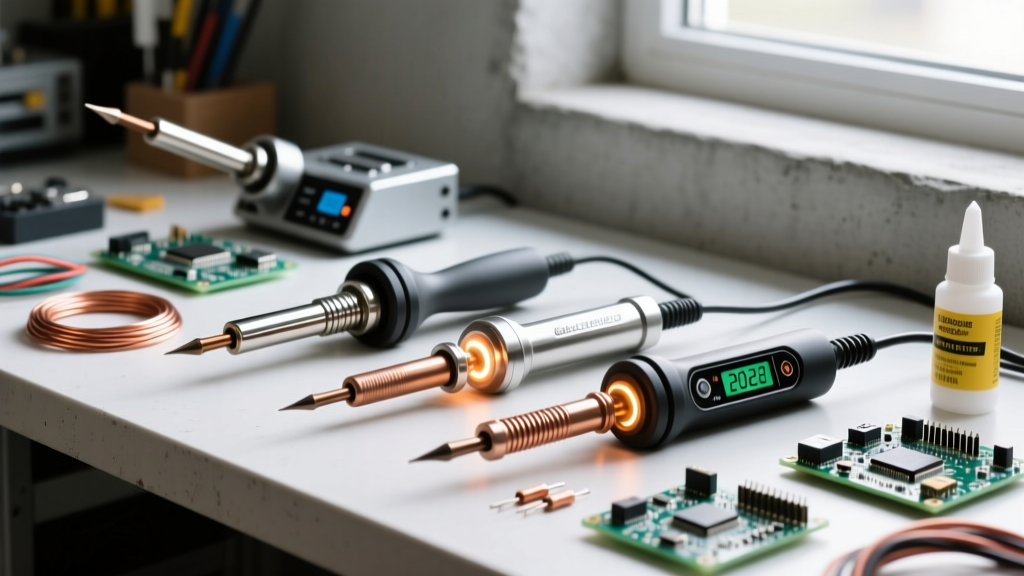
Below is a snapshot of the top-performing heavy-duty irons on the market as of early 2026, categorized by their ideal use cases and thermal recovery capabilities.
| Model | Peak Wattage | Temp Range | Ideal Use Case | Est. Price (2026) |
|---|---|---|---|---|
| Weller W100PG | 100W | Up to 700°F (371°C) | 10-4 AWG wire, RC batteries, heavy terminals | $125 |
| Hakko FX-601 | 67W - 135W | 400°F - 700°F | Multi-layer PCB ground planes, thick coax | $85 |
| American Beauty 1177 | 250W | Fixed (High Thermal Mass) | Plumbing, stained glass, heavy copper busbars | $215 |
Top Heavy-Duty Soldering Iron Reviews
1. Weller W100PG (100W) – The Heavy-Duty Workhorse
The Weller W100PG is a legendary heavy-duty pencil iron that has been a staple in automotive and aviation wiring harness fabrication for decades. Unlike modern digital stations, it uses a magnetic temperature control system via its CT6F7 tips. When the tip reaches the Curie temperature of the internal magnetic core, the heating element cuts off. This provides incredibly reliable, self-regulating heat without the need for fragile thermocouples in the tip.
- Thermal Recovery: Excellent. The massive copper-and-iron plated ETA series tips hold enough thermal energy to solder an 8 AWG wire to a heavy-duty ring terminal in under four seconds.
- Edge Case Warning: The W100PG is strictly for heavy electrical work. Do not use this on sensitive ICs or small PCBs; the physical size of the smallest available chisel tip is too large for 0805 SMD components.
- Verdict: At roughly $125, it is the most cost-effective dedicated heavy-wiring iron for EV battery pack builders and drone fabricators.
2. Hakko FX-601 – The Precision High-Heat Option
Hakko designed the FX-601 to bridge the gap between standard electronics soldering and heavy industrial work. It features an adjustable wattage output that dynamically scales. When the thermistor detects a massive heat sink, the internal ceramic heater pushes up to 135W to force thermal recovery, then drops back to 67W to maintain idle temperature and protect the tip from oxidation.
- Tip Compatibility: It uses the T19 series tips. For maximum thermal transfer on large ground planes, pair it with the T19-D24 (2.4mm chisel) or the T19-BL (bevel tip) to maximize surface area contact.
- Best Application: Soldering thick coaxial cables (like RG-213 for amateur radio antennas) and repairing heavy copper pours on automotive ECU boards.
- Verdict: Priced around $85, it is the best "hybrid" iron for technicians who need high heat but still require the precision of a standard pencil grip.
3. American Beauty 1177 (250W) – The Industrial Beast
When you move beyond electronics into plumbing, stained glass, or heavy electrical busbars, you need raw, unadulterated thermal mass. The American Beauty 1177 is a 250W iron that features a solid copper tip measuring over an inch across. This tool does not feature electronic temperature control; it relies entirely on the sheer mass of the copper tip to hold and transfer heat.
- Performance: It will melt 60/40 lead-tin solder and high-temp silver-bearing solders on contact, even when applied to 1/4-inch copper pipes or massive automotive starter motor terminals.
- Safety Requirement: A 250W iron generates significant flux vaporization. The IPC J-STD-001 standards heavily emphasize the need for localized fume extraction when operating at these thermal extremes to prevent rosin-induced occupational asthma.
- Verdict: At $215, this is a specialized tool. Buy it only if you are soldering structural metals, heavy plumbing, or industrial power distribution busbars.
Buying Framework: Matching Wattage to Thermal Mass
How do you know exactly how much wattage your project requires? Use this practical decision framework based on the American Wire Gauge (AWG) and substrate type:
- 22 AWG to 16 AWG (Standard PCB & Signal Wiring): 40W - 60W. (Standard stations like the Hakko FX-888D are perfect).
- 14 AWG to 10 AWG (RC Batteries, Automotive Accessories, Thick Coax): 80W - 100W. (Requires Weller W100PG or equivalent).
- 8 AWG to 4 AWG (EV Battery Packs, Inverter Cables, Starter Motors): 120W - 150W. (Requires high-wattage stations like the JBC DDSE or heavy pencil irons).
- 2 AWG and larger / Copper Pipes / Busbars: 200W - 300W+. (Requires American Beauty solid-copper irons or propane torches).
Failure Modes: Why Under-Powered Irons Destroy Electronics
A common misconception among hobbyists is that turning up the temperature dial on a cheap 60W iron will help it solder a thick wire. This leads to severe failure modes:
- Pad Lifting: By holding a low-wattage iron on a PCB pad for 30+ seconds waiting for the solder to flow, the heat conducts through the via and delaminates the copper pad from the fiberglass substrate.
- Insulation Melt-Back: Prolonged heating causes the PVC or silicone insulation on wires to melt back, exposing bare copper and creating a short-circuit hazard inside connectors.
- Cold Joints: If the wire acts as a heat sink and pulls the temperature of the tip below the solder's liquidus point (e.g., 183°C for Sn63/Pb37) before the flux can clean the oxidation, the resulting joint will be dull, grainy, and highly resistive.
Frequently Asked Questions
Can I use a high wattage soldering iron for delicate microcontrollers?
Yes, but only if the iron features rapid-response digital temperature control and uses low-thermal-mass tips (like JBC C245 or Hakko T18). A high-wattage station with a micro-tip will actually protect delicate components by finishing the joint in 1 second, whereas a low-wattage iron might linger for 5 seconds, spreading heat into the IC pins.
Do high wattage irons consume more electricity?
Not necessarily. Wattage is a measure of capacity, not continuous draw. A 135W Hakko FX-601 only draws peak power during the initial heat-up and during the exact seconds it is applied to a heavy joint. When idling, it draws minimal power to maintain temperature, often consuming less daily energy than an inefficient 60W iron that constantly cycles its heater to fight ambient heat loss.
What solder alloy is best for heavy-duty high-wattage work?
For heavy electrical connections, 60/40 (Sn60/Pb40) leaded solder remains the gold standard due to its low melting point and excellent wetting characteristics. If lead-free is required by RoHS compliance, use SAC305 (Sn96.5/Ag3.0/Cu0.5) and ensure your high wattage iron is rated for lead-free temperatures (350°C+), as SAC305 requires significantly more thermal energy to flow properly into thick wire strands.