
The Harbor Freight Soldering Gun Landscape in 2026
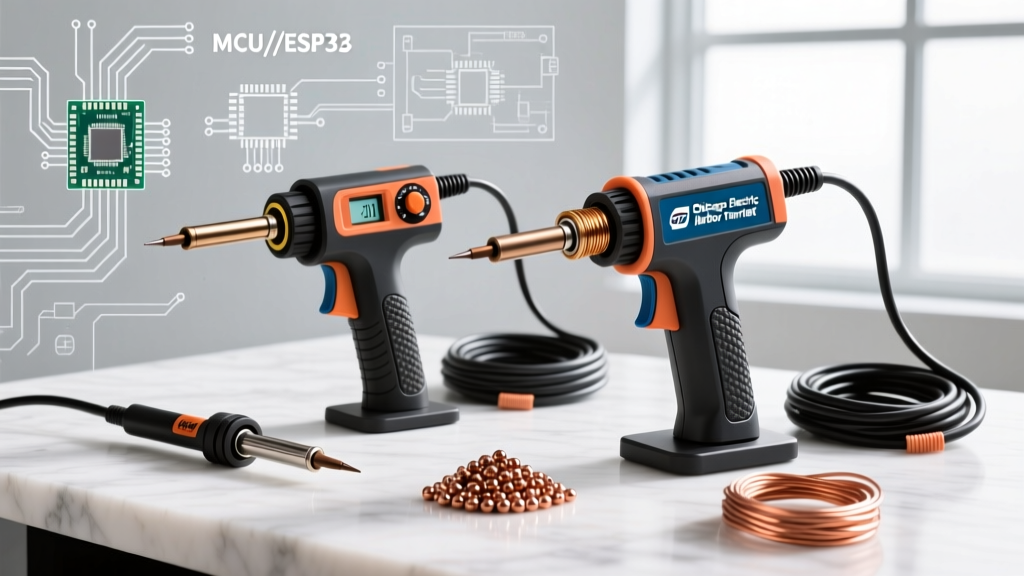
When tackling heavy-gauge automotive wiring, RC battery connectors, or thick stranded copper for marine applications, a standard 40W ceramic soldering iron simply lacks the thermal mass to overcome the heat-sink effect of the metal. This is where the classic transformer-based soldering gun becomes indispensable. For budget-conscious DIYers and weekend mechanics, the harbor freight soldering gun kit remains a staple on the workbench. However, Harbor Freight currently offers two distinct 200W/100W dual-heat kits under their house brands: the premium Bauer line and the legacy Chicago Electric line.
In this 2026 comparison, we strip away the marketing fluff and evaluate the exact thermal recovery times, tip degradation rates, and transformer acoustics of both kits. Whether you are soldering 4 AWG battery cables or repairing stained glass, understanding the metallurgical and electrical differences between these two kits will save you time, solder, and frustration.
Bauer vs. Chicago Electric: Head-to-Head Specifications
Before diving into the teardown and performance metrics, let us look at the raw specifications and current 2026 retail pricing for both models. Both kits utilize a step-down transformer to deliver high amperage at a low voltage (typically under 1V) directly to a copper loop tip.
| Feature | Bauer 200W/100W Kit (Item 57384) | Chicago Electric 200W/100W Kit (Item 60444) |
|---|---|---|
| Peak Wattage | 200W (High) / 100W (Low) | 200W (High) / 100W (Low) |
| Heat-Up Time (to 360°C) | ~4.5 seconds | ~6.0 seconds |
| Integrated Work Light | Yes (Dual LED) | Yes (Single Incandescent Bulb) |
| Trigger Mechanism | Two-stage tactile switch | Single-stage mechanical switch |
| Included Case | Hard-shell blow-molded plastic | Thin plastic blister tray |
| Average 2026 Price | $34.99 | $17.99 |
Deep Dive: Bauer 200W/100W Dual Heat Soldering Gun Kit
The Bauer brand represents Harbor Freight's push into the "pro-sumer" tier, and the Item 57384 soldering gun kit reflects this with noticeable ergonomic and electrical upgrades. The most critical improvement is the two-stage trigger. By pulling the trigger halfway, the primary coil engages a lower wattage tap (100W), allowing you to maintain a baseline temperature without overheating the copper tip or burning your rosin-core flux. Squeezing fully engages the 200W secondary tap for rapid thermal recovery when touching massive copper lugs.
Pros and Cons of the Bauer Kit
- Pro: The dual-LED work light is positioned to eliminate the shadow cast by the tip, a massive improvement over the Chicago Electric's single bulb.
- Pro: The power cord features a heavier 18 AWG jacket with a reinforced strain relief, reducing the risk of internal wire fatigue.
- Con: The two-stage internal switch is more complex; if dropped on a hard concrete floor, the internal plastic detents can fracture.
- Con: The included 60/40 rosin-core solder is of mediocre quality, often containing excessive flux splatter. We recommend discarding it and using Kester 44 or MG Chemicals.
Deep Dive: Chicago Electric 200W/100W Soldering Gun Kit
The Chicago Electric model (Item 60444) is a legacy design that has remained largely unchanged for over a decade. It relies on a simple mechanical trigger switch that physically bridges the high and low taps on the transformer. Because it lacks the refined secondary winding of the Bauer, the 60Hz AC transformer hum is significantly louder, and the unit vibrates more noticeably in the hand during extended 200W operation.
Pros and Cons of the Chicago Electric Kit
- Pro: At under $20, it is an unbeatable value for infrequent users who only need to solder a few thick wires a year.
- Pro: The simple mechanical switch is easy to disassemble, clean, and repair if the contacts become pitted from inrush current arcing.
- Con: The incandescent work light bulb generates its own heat and is prone to shattering if the gun is bumped against a metal chassis.
- Con: The thermal mass of the included copper tips is slightly lower, meaning the tip temperature drops more drastically when applied to a large ground plane.
The Physics of the Trigger: Inductive Kickback and PCB Safety
Before using either of these kits, you must understand a critical limitation of transformer-based soldering guns. When you release the trigger, the magnetic field in the transformer collapses. This sudden collapse induces a high-voltage spike (inductive kickback) across the secondary winding and the tip. In a heavy-duty copper wire, this spike is harmless. However, if you touch a soldering gun tip to a Printed Circuit Board (PCB) containing CMOS logic, MOSFETs, or sensitive microcontrollers, this voltage spike will instantly punch through the gate oxide layer and destroy the component.
CRITICAL WARNING: Never use a Harbor Freight soldering gun for electronics repair, SMD components, or PCB through-hole soldering. The inductive kickback and lack of precise temperature control violate the thermal and electrical safety parameters outlined in IPC J-STD-001 standards for electronic assemblies. Reserve these guns strictly for heavy-gauge wire, mechanical lugs, and non-semiconductor metalwork.
Tip Metallurgy: Why Your Copper Tips Are Dissolving
A common complaint in DIY forums regarding the harbor freight soldering gun kit is that the tips "eat away" or dissolve after a few hours of use. This is not a manufacturing defect; it is basic metallurgy. The tips are made of bare copper. When bare copper is exposed to molten tin-lead solder (or lead-free SAC305), the tin aggressively dissolves the copper to form a Copper-Tin Intermetallic Compound (IMC).
According to guidelines documented in NASA Workmanship Standards and general soldering metallurgy, leaving a copper tip submerged in molten solder or operating it at excessive wattage without a load accelerates this leaching process. To maximize the lifespan of your Bauer or Chicago Electric tips:
- Never leave the gun powered on while resting in its holder. The 200W setting will oxidize and dissolve the tip in minutes.
- Always keep the tip heavily tinned with a layer of solder when powering down to create a sacrificial barrier against oxidation.
- Use the 100W setting for 80% of your work, reserving the 200W setting only for the 3-5 seconds required to bring a heavy lug up to temperature.
Step-by-Step: Soldering 4 AWG Battery Cables with the Bauer Kit
To demonstrate the practical application of the Bauer kit, here is the optimal workflow for terminating a 4 AWG automotive battery cable with a copper ring terminal. This process ensures a solder joint that meets the mechanical pull-strength requirements for high-vibration environments.
- Preparation: Strip exactly 5/8" of insulation from the 4 AWG wire. Do not twist the strands tightly; keep them flared slightly to allow solder wicking.
- Flux Application: Apply a generous amount of high-tack rosin paste flux (not the liquid flux included in the kit) to the bare copper strands and the inside of the ring terminal barrel.
- Pre-Tinning: Squeeze the Bauer trigger to the 100W position. Feed 60/40 solder into the wire strands until they are fully silver-coated. Let it cool for 5 seconds.
- Terminal Heating: Slide the ring terminal onto the pre-tinned wire. Squeeze the trigger to the full 200W position. Apply the copper loop tip directly to the side of the terminal barrel (not the wire). Hold for 3 to 4 seconds.
- Solder Feeding: Touch your solder wire to the opposite side of the terminal barrel. When the terminal reaches ~183°C (for 60/40 solder), the solder will instantly flash and wick deep into the strands via capillary action.
- Cooling: Release the trigger immediately. Hold the wire perfectly still for 8 seconds. Moving the wire while the IMC layer is solidifying will result in a "cold" or fractured solder joint.
Final Verdict: Which Kit Earns Your Bench Space?
If your budget is strictly capped and you only need to solder a few thick wires a year, the Chicago Electric 200W/100W Kit at $17.99 provides the raw thermal wattage required to get the job done. It is loud, heavy, and rudimentary, but it works.
However, for anyone doing regular automotive, marine, or RC work, the Bauer 200W/100W Kit is the undisputed winner for 2026. The $34.99 price tag is justified by the two-stage trigger (which drastically reduces tip degradation), the superior LED shadow-free lighting, and the durable hard case. The Bauer kit bridges the gap between disposable budget tools and expensive professional stations like the Weller 9400WPKS, making it the ultimate harbor freight soldering gun kit for the serious DIY electrical enthusiast.