
The Thermodynamics of Tip Degradation
Choosing the right sponge for cleaning soldering iron tips is not merely a matter of workshop preference; it is a critical thermodynamic decision that dictates the lifespan of your equipment. Modern soldering tips, such as the Hakko T18 series or Weller RT cartridges, are engineered with a highly conductive copper core encased in a protective iron plating. This iron layer is remarkably thin—typically ranging from 0.08mm to 0.15mm. When this plating is compromised by thermal shock or abrasive scratching, the underlying copper rapidly leaches into the molten solder, resulting in catastrophic tip failure and concave pitting.
As of 2026, the transition to high-temperature lead-free alloys like SAC305 (Tin-Silver-Copper) requires sustained tip temperatures between 320°C and 360°C (608°F–680°F). At these elevated operating temperatures, the method you use to remove oxidized flux and burnt rosin directly impacts the structural integrity of the iron plating. Below, we break down the three primary cleaning mediums, analyzing their failure modes, costs, and optimal use cases.
Material Breakdown: The Three Contenders
1. Cellulose Sponges (The Traditional Standard)
Cellulose sponges have been included in almost every Hakko FX-888D and Weller WE1010 kit for the last two decades. Made from natural wood pulp, these sponges expand when wet and provide a broad, flat surface for wiping the tip.
- Cost: $3 to $6 per sponge.
- Failure Mode: Severe thermal shock. When a 350°C tip strikes a wet cellulose sponge, the surface temperature drops by up to 120°C in under half a second. This rapid contraction causes micro-fissures in the iron plating.
- Expert Caveat: You must strictly use distilled water. Tap water contains calcium and magnesium minerals that bake onto the tip, creating an insulating oxide layer that ruins thermal transfer.
2. Brass Wire Sponges (The Modern Workhorse)
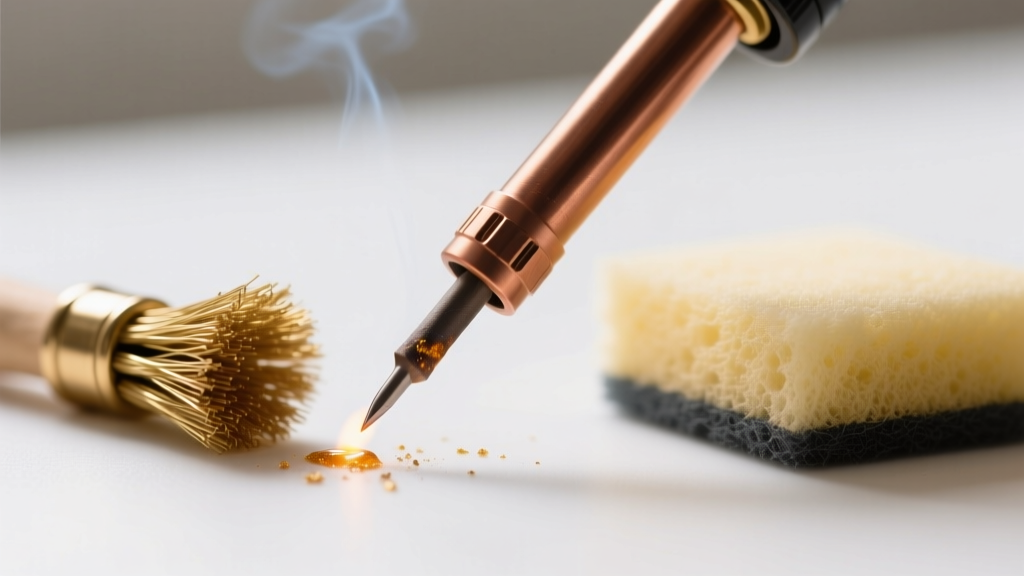
Brass wire sponges (often housed in a metal or high-temp silicone bowl) consist of soft, coiled brass shavings. Because brass is softer than the iron plating on your soldering tip, it scrapes away oxidation without gouging the protective layer.
- Cost: $8 to $18 for a quality unit (e.g., Hakko 598 or Weller WSP150).
- Failure Mode: Embedding. If the brass is not 'fluffed' regularly, it mats down and can trap hard flux residue, which may scratch the tip. Additionally, cheap, unbranded brass sponges often use harder alloys that will aggressively wear down the iron plating.
- Advantage: Zero thermal shock. The tip temperature drops by less than 5°C during cleaning, keeping the heating element well within its PID control loop.
3. Silicone Tip Scrubbers (The Niche Polishing Bar)
Products like the Edsyn Tip Scrubber utilize a high-temperature silicone polymer embedded with mild polishing compounds. They are designed to clean and simultaneously re-tin the tip.
- Cost: $10 to $25.
- Failure Mode: Melting and chemical degradation. If a user leaves a 400°C iron resting in the silicone scrubber, the polymer will melt and fuse to the tip, destroying it instantly.
Head-to-Head Comparison Matrix
| Feature | Cellulose Sponge | Brass Wire Sponge | Silicone Scrubber |
|---|---|---|---|
| Thermal Shock Risk | High (Up to 120°C drop) | Negligible (< 5°C drop) | Low (If used briefly) |
| Abrasiveness | Low (if properly damp) | Very Low (Soft brass) | Moderate (Polishing grit) |
| Tip Life Impact | Reduces life via micro-cracking | Maximizes tip lifespan | Good for restoring dead tips |
| Maintenance | Requires distilled water | Requires periodic fluffing | Replace when saturated |
| Best Environment | Budget hobbyist setups | High-volume SMT rework | Field repair / Mobile kits |
The Water Quality Factor: Why Cellulose Sponges Fail Prematurely
A frequently overlooked variable in Hakko's official soldering guidelines is water chemistry. If you opt for a cellulose sponge, the moisture level is paramount. The sponge should be dampened until it expands to roughly 10mm thick, then squeezed out until it feels like a wrung-out dishcloth. A dripping wet sponge guarantees massive thermal shock, while a dry sponge will scorch, leaving carbon deposits on your tip.
Furthermore, using municipal tap water introduces chlorine and dissolved solids. When the water flashes to steam against a 350°C tip, these solids are left behind as a microscopic crust. Over a 40-hour work week, this crust acts as a thermal insulator, forcing the user to turn up the station temperature, which accelerates oxidation—a vicious cycle that destroys tips in weeks rather than months.
Step-by-Step: The Optimal 2026 Cleaning Routine
To align with modern IPC J-STD-001 soldering standards regarding workmanship and tool maintenance, follow this exact sequence for high-reliability soldering:
- Pre-Tin Before Wiping: Always apply a small amount of fresh, flux-cored solder to the tip before you clean it. The fresh solder acts as a thermal buffer and helps lift burnt rosin off the iron plating.
- The Plunge (Brass): Insert the tip into the brass wire sponge at a 45-degree angle. Twist gently (do not jab aggressively) for 1.5 seconds.
- The Wipe (Edge Case): If you must use a cellulose sponge for heavy flux removal, use the 'figure-eight' motion on the damp sponge for no longer than 2 seconds to minimize the thermal delta.
- Post-Clean Tinning: Immediately after wiping, apply a generous coat of fresh SAC305 or 63/37 SnPb solder to the tip. This sacrificial layer will oxidize in the air, protecting the actual iron plating underneath until your next joint.
Pro-Tip for Lead-Free Rework: When working with SAC305, never let your iron sit idle at 380°C. If you are stepping away for more than 3 minutes, drop the station temperature to 250°C or use the auto-sleep feature on stations like the Hakko FX-951 to prevent rapid dry-burn oxidation.
Real-World Scenarios: Which Tool Wins?
Scenario A: High-Volume PCB Assembly
Winner: Brass Wire Sponge. In an environment where an operator is making 300 joints an hour, the thermal stability of the brass sponge ensures the PID controller doesn't have to work overtime. The tip temperature remains stable, ensuring consistent wetting and preventing cold joints.
Scenario B: Vintage Electronics & Delicate Through-Hole
Winner: Cellulose Sponge (with strict water discipline). When working on 1980s arcade boards or fragile single-sided phenolic PCBs, operators often use lower temperatures (280°C) and larger chisel tips. The broad wiping surface of a damp cellulose sponge effectively clears large volumes of rosin flux without snagging on delicate component leads.
Scenario C: Field Repair and Drone Maintenance
Winner: Silicone Scrubber. When repairing drones or automotive ECUs in the field, carrying a bowl of brass wire or a bottle of distilled water is impractical. A silicone polishing bar fits in a pocket, requires no liquid, and can resurrect a heavily oxidized tip in seconds.
Frequently Asked Questions
Can I use a kitchen sponge instead of a soldering sponge?
No. Kitchen sponges are typically made of synthetic polyurethane or polyester foams. When touched by a 350°C soldering iron, these synthetic materials will instantly melt, releasing toxic fumes and fusing a sticky, insulating plastic residue directly onto your tip, ruining it permanently.
How often should I replace my brass wire sponge?
A high-quality brass sponge will last 2 to 3 years under normal hobbyist use. However, if the brass turns black and brittle, or if it becomes heavily clogged with hardened flux that cannot be shaken out, it is time to replace the insert. You can clean a heavily soiled brass sponge by soaking it in isopropyl alcohol (IPA) and agitating it, but replacement is usually more cost-effective.
Why does my tip turn blue and black even when I use a brass sponge?
Discoloration (blue/black) is a sign of severe oxidation, usually caused by 'dry burning.' As noted in Wikipedia's technical overview of soldering thermodynamics, oxidation rates double for every 10°C increase in temperature. If your tip is turning black, you are likely leaving the iron idle at too high a temperature without a protective layer of sacrificial solder. Always tin your tip heavily before placing it in the holder.